

Preserving the Past,
Inspiring the Future
Explore the rich cultural heritage of the Igbo people through our comprehensive digital archives, community lore, and educational resources.
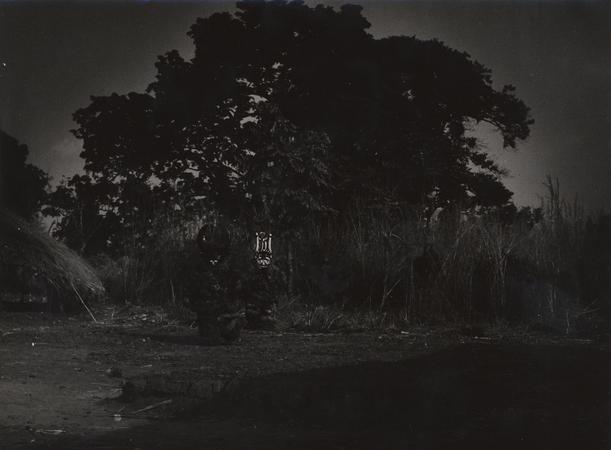
Rural Scene with Igbo Masquerades
A black-and-white gelatin silver print depicting a rural scene with two adult Igbo males dressed in masquerade costumes. The figures wear shaggy costumes and painted wooden masks featuring large horns, with one mask also exhibiting large teeth. The image was identified as originating from the Niger Delta region, with ethnic group and location suggestions provided by N F Barley in 1998.
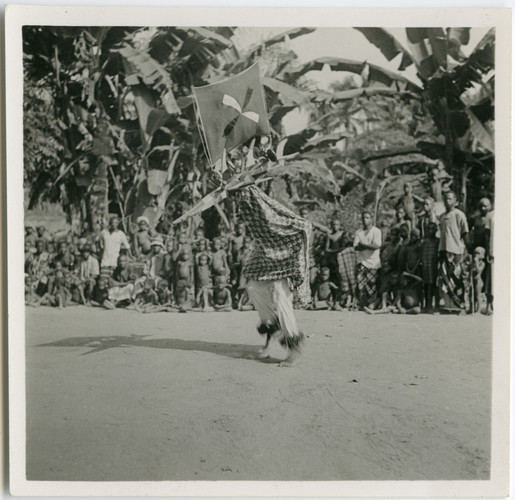
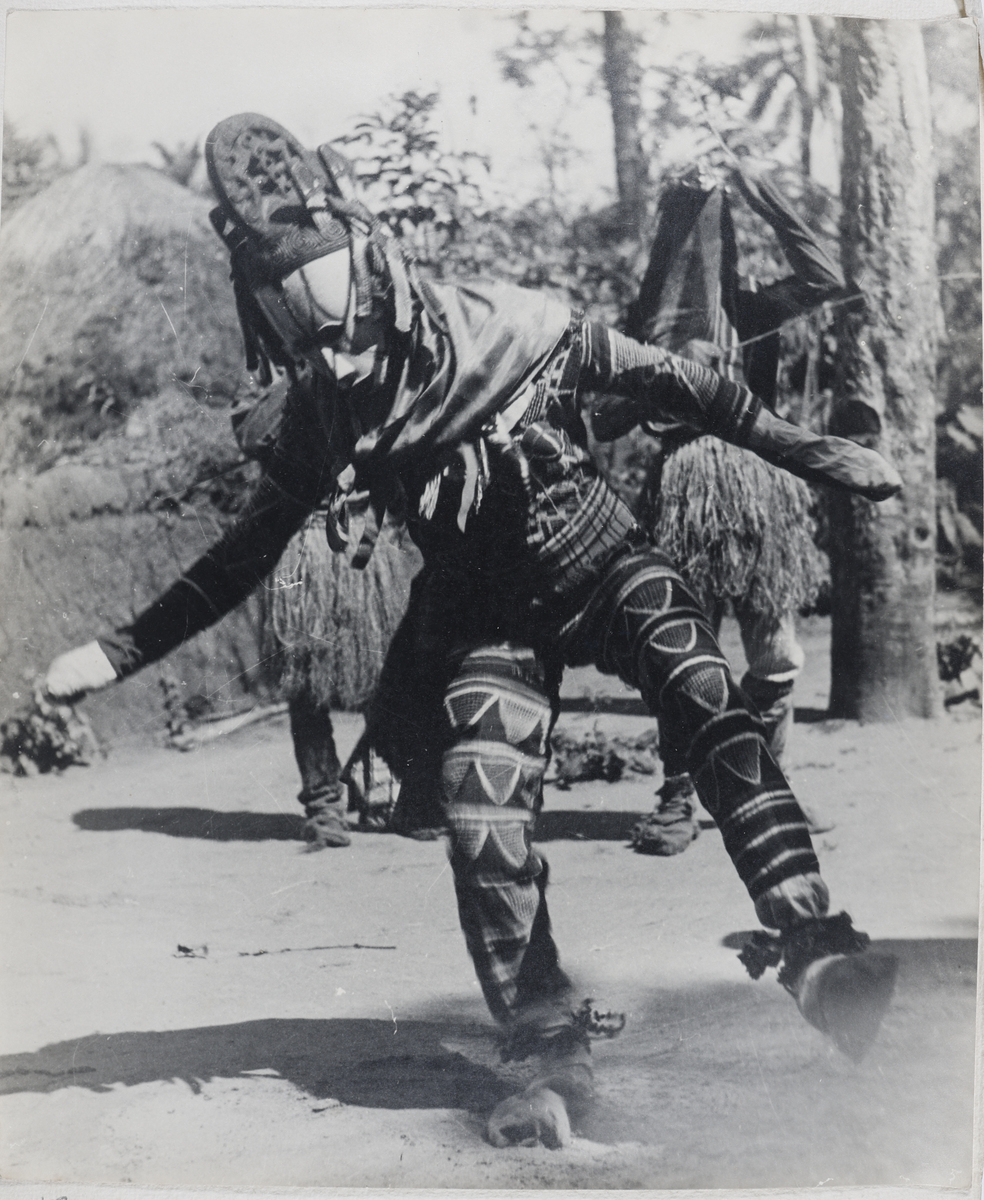
Dancer Wearing Fish Mask
A photograph depicting a dancer in a mid-motion stance during a ritual or ceremonial performance. The figure wears a vertically oriented head structure with a rectangular textile element featuring a four-armed geometric motif, and elongated pointed components extending upward. The torso is draped in a heavy patterned textile with a geometric or checkered motif, while the lower extremities are covered in voluminous light-colored fibrous material. A multi-generational group of spectators, including adults and children, is positioned in a semi-circular perimeter …
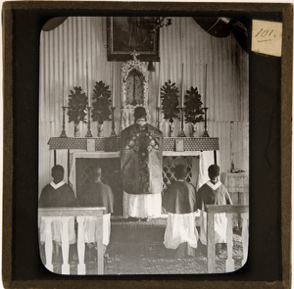
African Priest and Altar Boys at a Christian Church
A photograph depicting an African priest and four altar boys worshipping at a Christian church. The priest wears a white alb and a dark embroidered chasuble with floral motifs. The four boys are dressed in dark short capes over white ankle-length garments with lace-like edging. The church interior is constructed from corrugated iron. The altar is decorated with candles, floral garlands, and a patterned cloth, with a rug featuring geometric motifs on the floor.
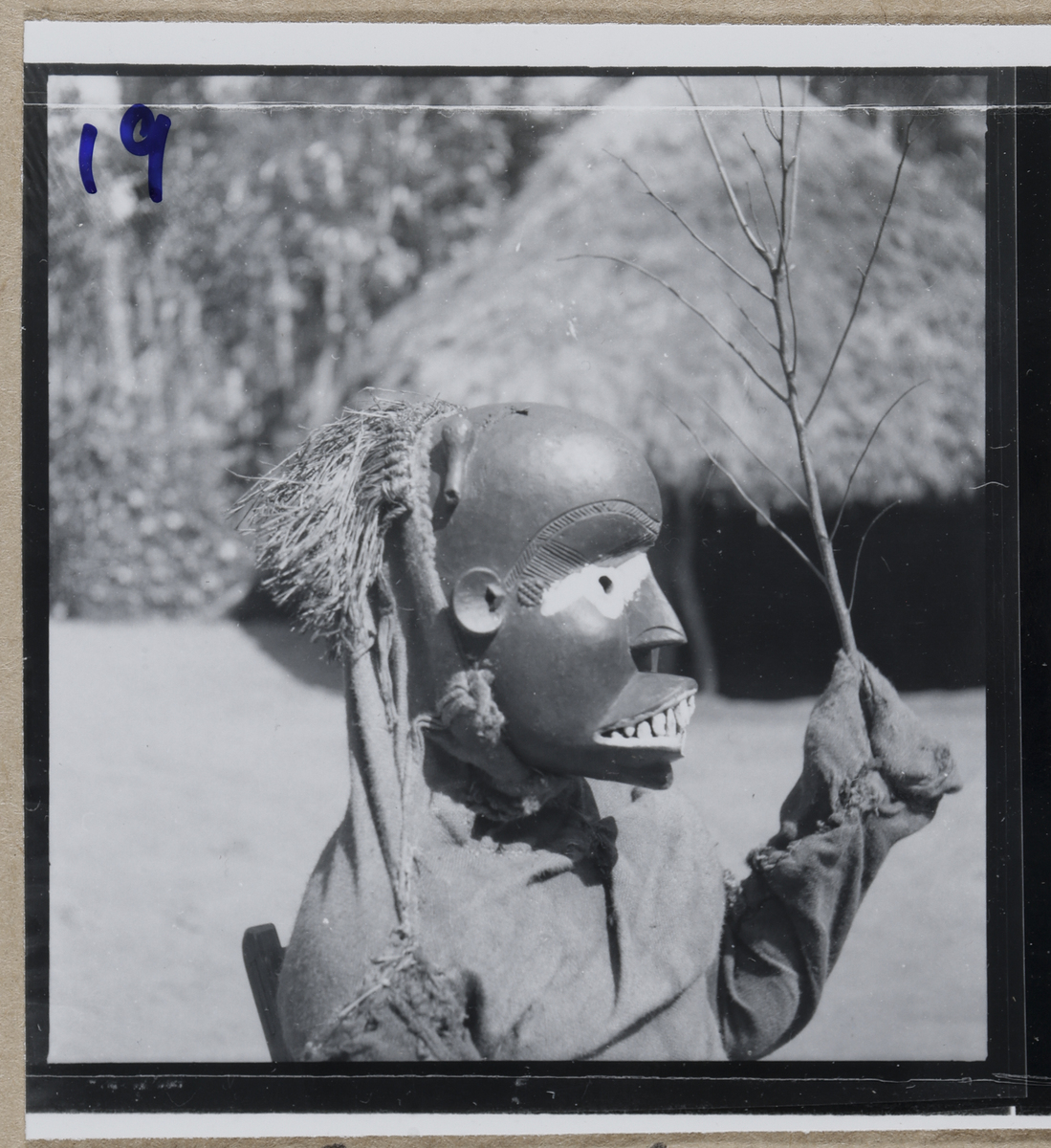
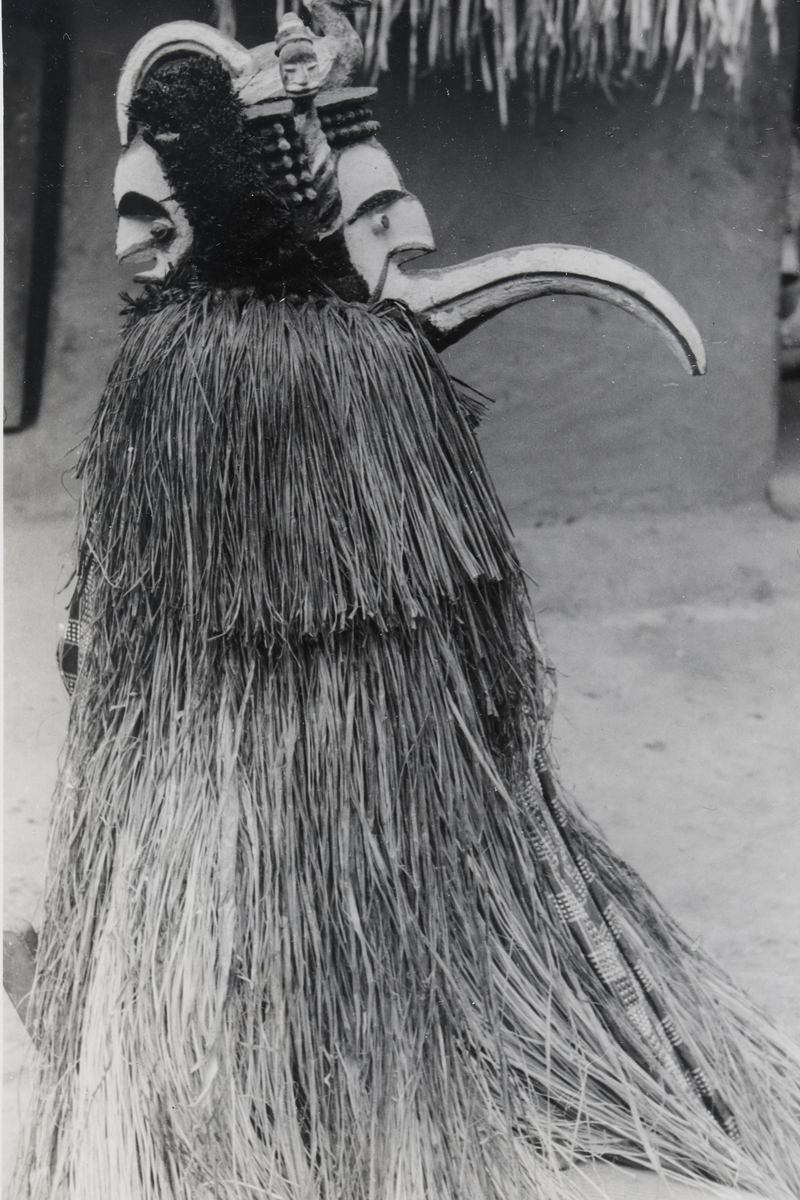
Ogbugulu Mau (Ghost) Masquerade: Iro Ekpetu (Merciless)
A close up view of Iro Ekpetu (Merciless) wearing a black wooden face mask during an Ogbugulu Mau (Ghost) masquerade. The forehead is incised with decoration, the eyes consist of two small holes accentuated with white paint, and the mouth and teeth are also accentuated with white paint. Raffia hair is attached to the back of the mask, and a protrusion is visible on the head. The masquerader wears a cloth top and holds a stick switch. In the background, …
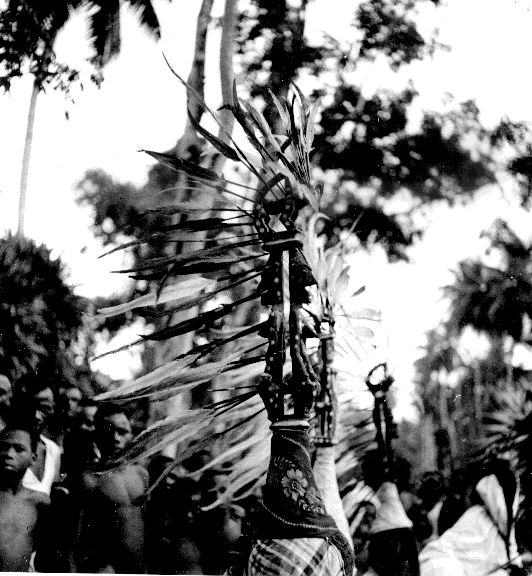
Feathered Headdress Ogonya Play
A photograph depicting a feathered headdress used in the Ogonya Play in Ogume village, South Ika. The image shows a vertical ornamental structure with a dark central axis and radiating light-toned, blade-like feathers. An arm clad in patterned fabric holds the object aloft. In the background, a group of young males with bare torsos are positioned among dense tropical vegetation, including palm trees. The high-contrast monochrome composition emphasizes the verticality of the headdress and the surrounding flora.
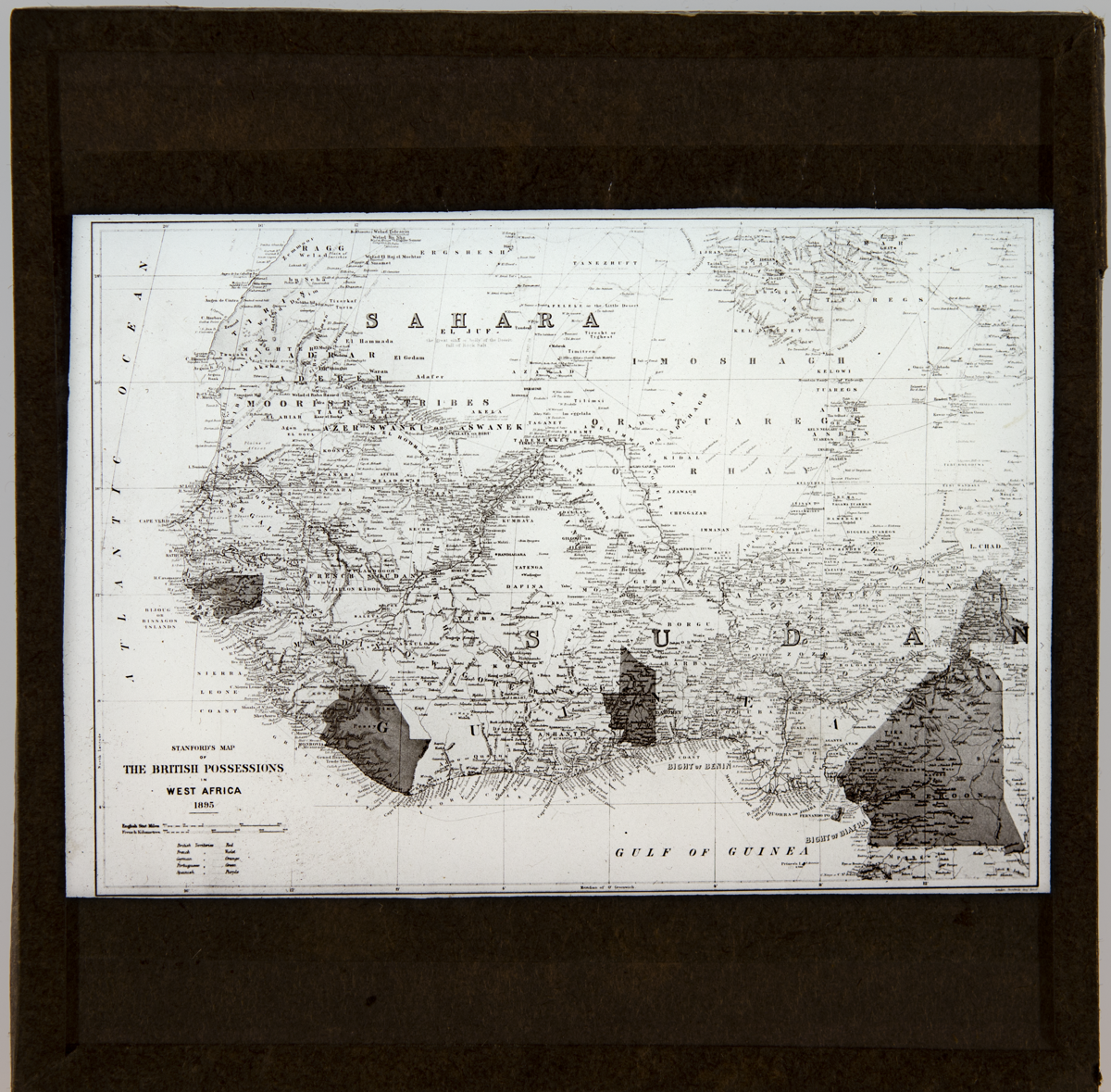
Stanford's Map of the British Possessions in West Africa 1895
A grayscale cartographic map titled Stanford's Map of the British Possessions in West Africa 1895. The document depicts the Gulf of Guinea, Bight of Benin, Bight of Biafra, and various river systems. It includes labels for regions such as Borno, Kumbawa, and the Sahara. The map uses specific shading and hatching patterns to delineate territories associated with British, French, German, Portuguese, and Belgian colonial interests. This map was part of the Crosse Collection, documented in relation to the Royal Niger …
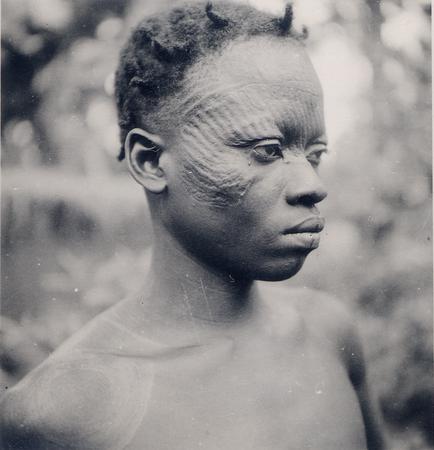
Portrait of an Igbo Man with Ichi Markings
A monochromatic photographic portrait of an Igbo man presented in a three-quarter profile view. The subject exhibits raised, hypertrophic ridges of Ichi scarification on the cheek, temple, and lateral forehead. His hair is plaited with small, vertical, cylindrical tufts on the crown of the head. The image is a gelatin silver print, set against a blurred natural background of vegetation. The portrait captures the dermal modifications and cranial styling typical of Igbo nobility during the late 19th to early 20th …
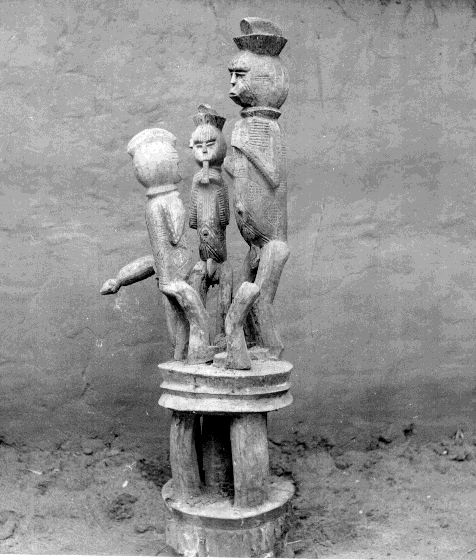
Nwamno Figure from Ogume Village
A photograph depicting a multi-tiered vertical wooden sculpture from Ogume village in South Ika. The object consists of a circular base supporting three vertical pillars, which in turn support a platform for a sculptural grouping of three anthropomorphic figures. The figures vary in scale and postural orientation, featuring stylized facial features with deeply set eye cavities and tiered headdresses. The surface of the carvings exhibits rhythmic horizontal and vertical incisions on the torsos and necks, indicating a precise carving technique. …
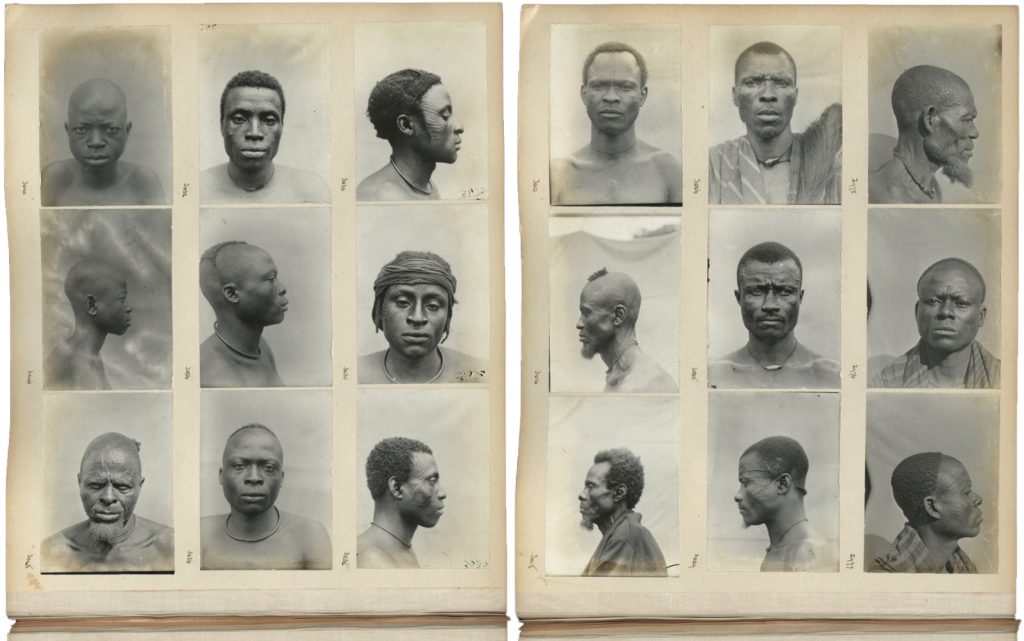
Physical Type Portraits of Igbo-speaking Communities
A photograph of two album pages featuring eighteen monochrome and sepia-toned portrait prints of human males of various ages. These portraits, known as physical type photographs, are organized in two symmetrical 3x3 grids on a light-colored substrate. The subjects are captured in frontal, profile, and three-quarter views, focusing on the head and shoulders. Visual details include various hair patterns, shaved heads, facial hair, and visible scarification. Some subjects are bare-chested while others wear textured or patterned fabrics and neck adornments. …
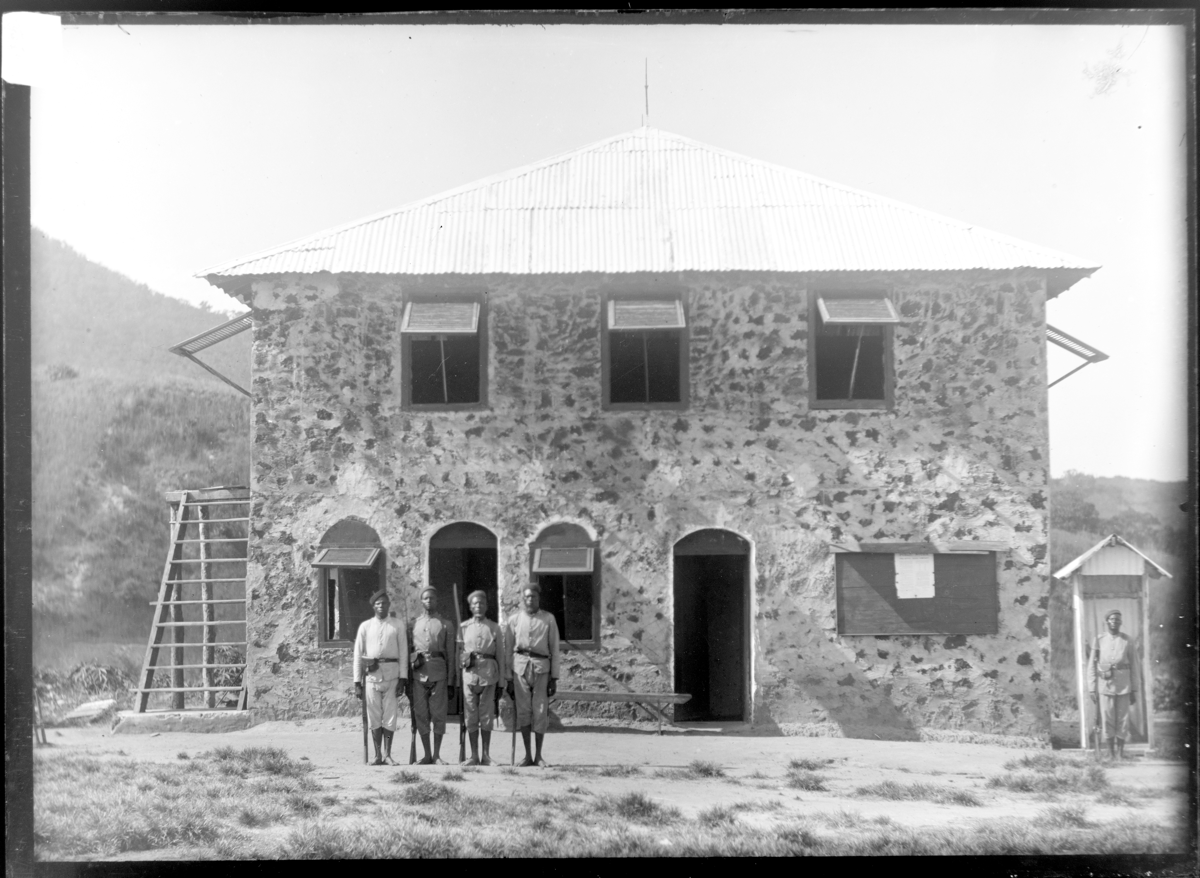
Royal Niger Company Station with Soldiery
A monochromatic photograph depicting a two-story masonry structure built from irregular stone and mortar in a hilly landscape. Five uniformed male subjects, identified in manuscript notes as "Soldiery", are present: four stand in a line in the foreground holding rifles, and one is positioned within a pitched-roof sentry box to the right of the building. The structure features a corrugated metal hip-roof with a central spire, upper-level windows with awnings, and arched openings on the ground floor. The image was …
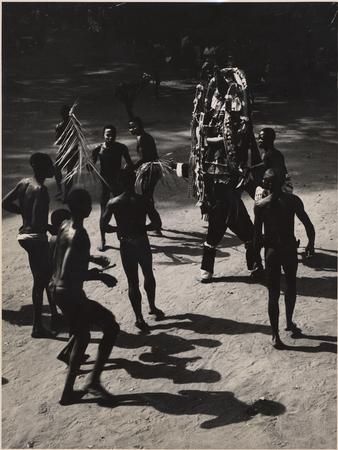
Igbo Adult Males Performing Masquerade
A black-and-white gelatin silver print depicting a group of Igbo adult males engaged in a ceremonial performance in an outdoor setting. One figure on the left wears an elaborate mask featuring cloth streamers and trousers with rattles tied around the knees. Other participants are dressed in loincloths, with some holding palm leaves. The background shows a crowd of onlookers. The scene is characterized by high-contrast natural lighting with dappled shadows on the ground, suggesting the event took place under a …
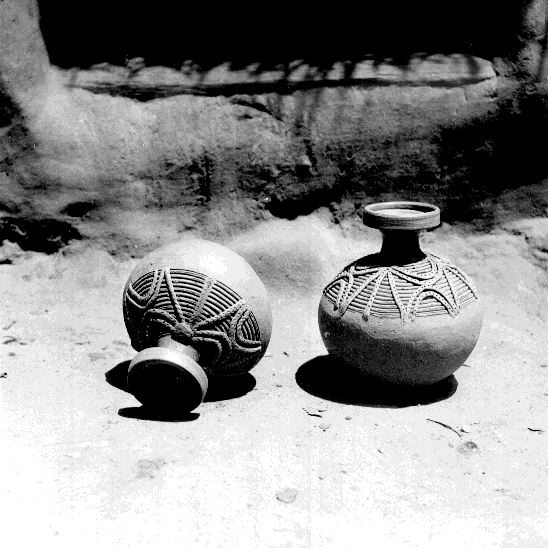
Decorated Pots of North Ika
A monochromatic photograph depicting two earthenware vessels from North Ika. The vessels feature globular bodies with short cylindrical necks and wide, flattened rims. One vessel stands upright while the other lies recumbent on a granular substrate. Both pots are adorned with high-relief, segmented geometric ornamentation on the upper shoulders, consisting of radiating curvilinear segments defined by punctate borders and fine parallel striations. The high-contrast lighting suggests an archaeological or field-documentation setting.
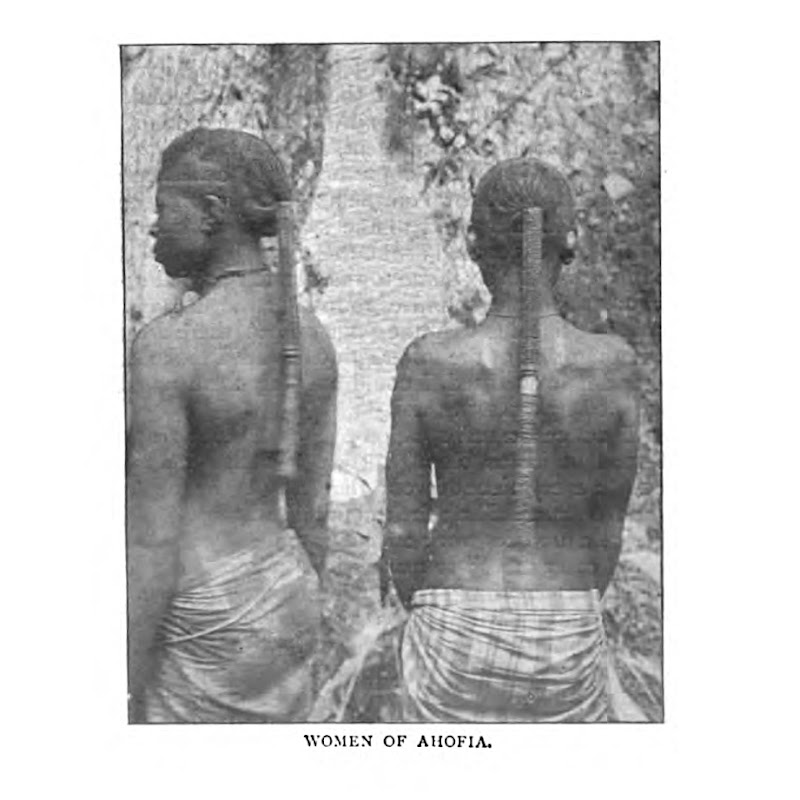
Ohafia Women with Traditional Long Braids
A photograph depicting two Ohafia women from a posterior perspective, showing traditional long braids that extend from the head down the spinal column. The subjects have bare upper torsos and wear light-colored fabric wraps around the hips. The image originates from The Women's Missionary Magazine of the United Free Church of Scotland, 1904. This cultural practice is associated with Ohafia, where historical records and folktales mention women warriors known as dike nwaàmị̀.
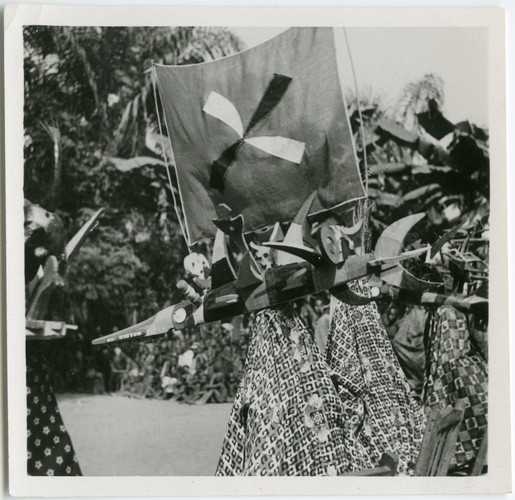
Dancer Wearing Fish Mask
A photograph depicting a dancer wearing a ceremonial mask representing a fish. The apparatus is an elongated, tapered horizontal structure with a crest-like form, featuring small, stylized facial motifs and light-colored decorative accents. A rectangular textile banner with a central four-pointed motif is mounted atop the structure. The dancer and other participants wear wrap-around garments with dense, repetitive geometric patterns of interlocking squares and diamonds. The scene is set outdoors in a tropical environment with dense vegetation and a crowd …
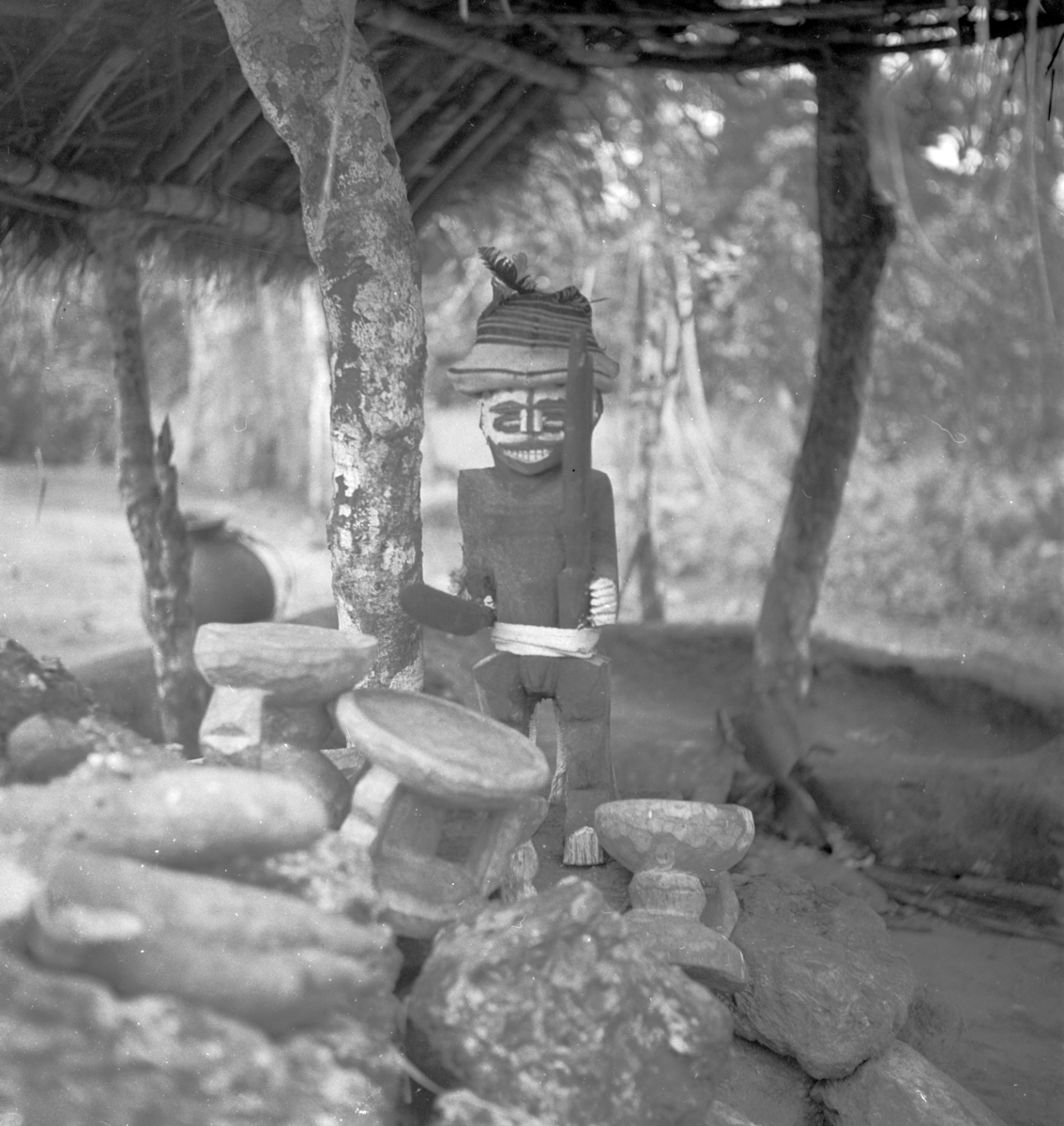
Alose Shrine Figure
This black-and-white photograph by G.I. Jones documents an Alose shrine in south-eastern Nigeria. The wooden figure stands inside a thatched structure, wearing a striped hat with feather and white facial paint. The deity holds objects in both hands among carved pots and stools. The sculpture represents spiritual forces significant in Igbo religious practice.
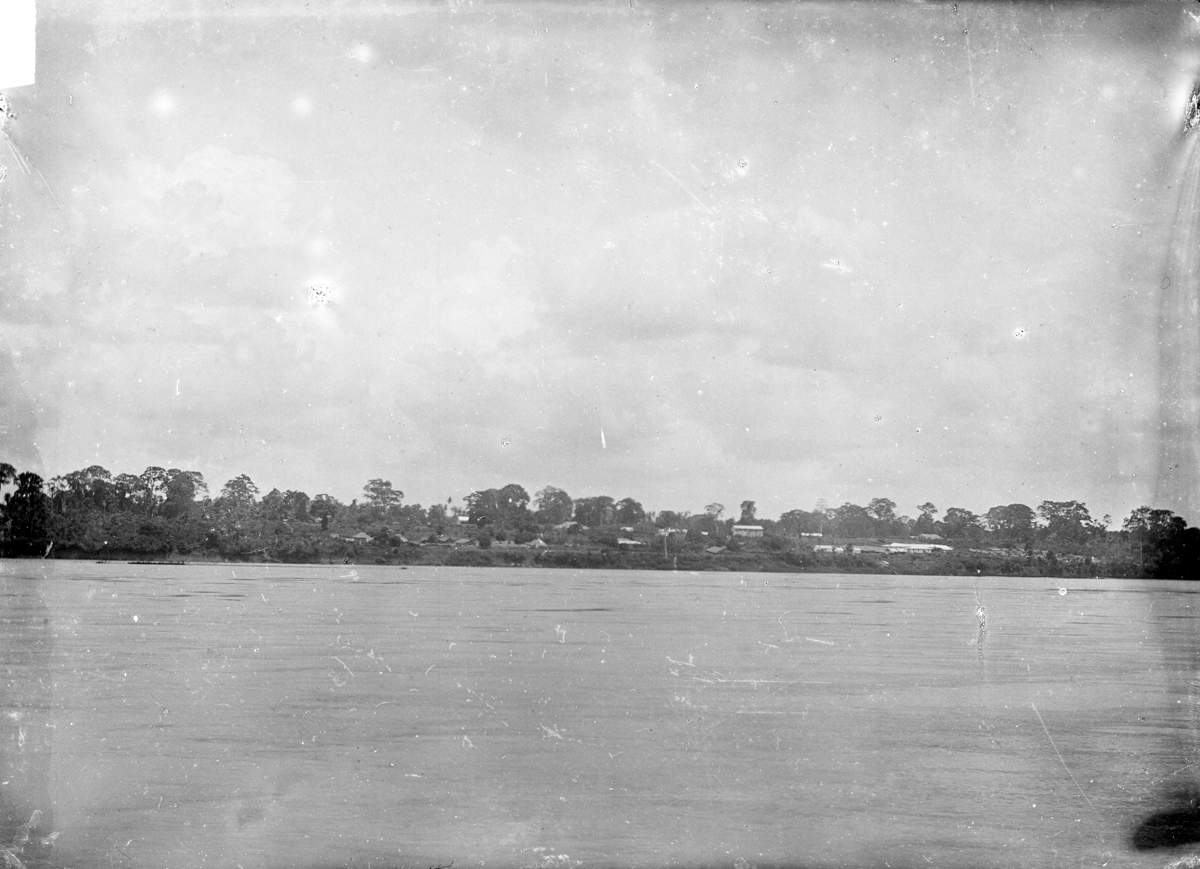
Settlement along the Niger River
A monochrome landscape photograph depicting a riparian settlement along the Niger River. The composition features a wide body of water in the foreground with a dense line of forest vegetation and dispersed, low-profile, single-story buildings along the shoreline. Some structures feature light-toned, reflective roofing. The sky is overcast with heavy cloud cover. The photographic medium shows significant physical degradation, including surface scratches and light leaks.
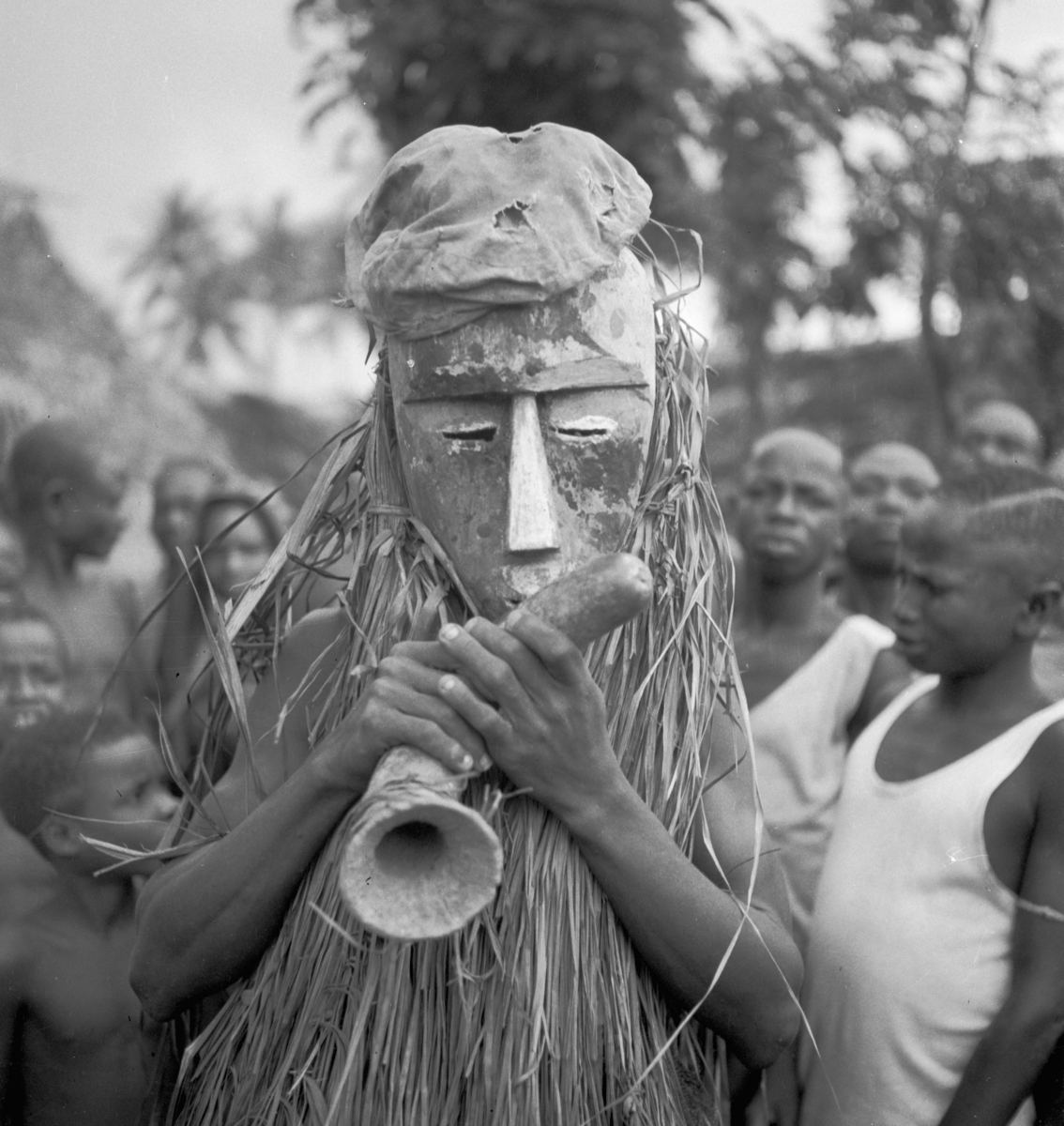
Ohaffia Masquerader Performing in Okwanku Masquerade, Akanu Village
Black-and-white photograph by G.I. Jones showing a masked Ohaffia performer in the Okwanku masquerade at Akanu village. The figure wears a wooden face mask with white pigment, high forehead, slit eyes, long nose and mouth, surmounted by a hat, with long raffia hair hanging down. The performer plays a horned instrument while spectators watch in the background. Jones recorded that Okwanku masquerade characters performed comic dramas, including one in which the Dibia (Doctor) character poisoned and revived the Rain Driver. …
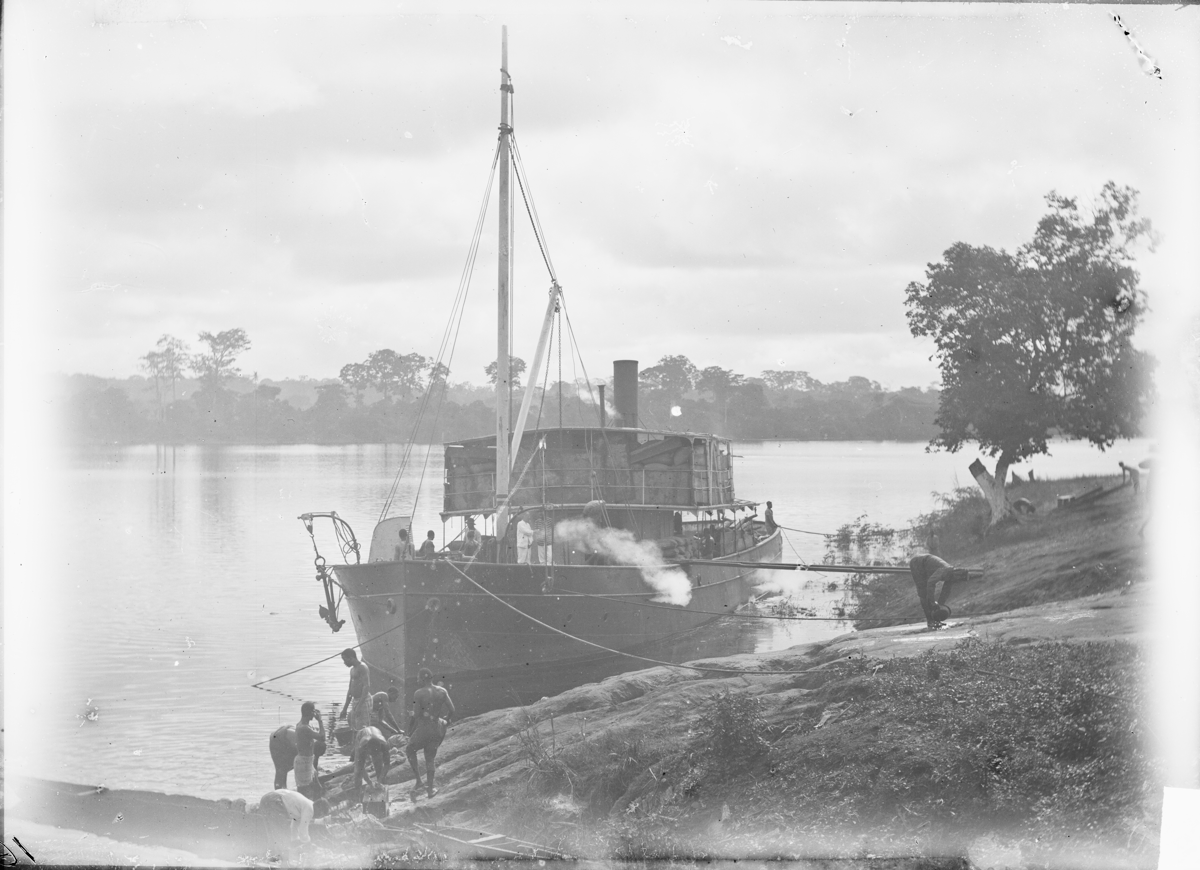
Steam Vessel Anchored on the Niger River
A photograph depicting a single-masted, steam-powered vessel moored parallel to an earthen riverbank along the Niger River. The vessel features a vertical smokestack emitting a plume of white smoke, a central multi-level superstructure with railings, and a tall mast with rigging lines. On the sloping bank, a group of approximately five to six men wearing minimal clothing, primarily light-colored wraps or loincloths, are engaged in manual labor near the water's edge. The image is part of the Crosse Collection, taken …
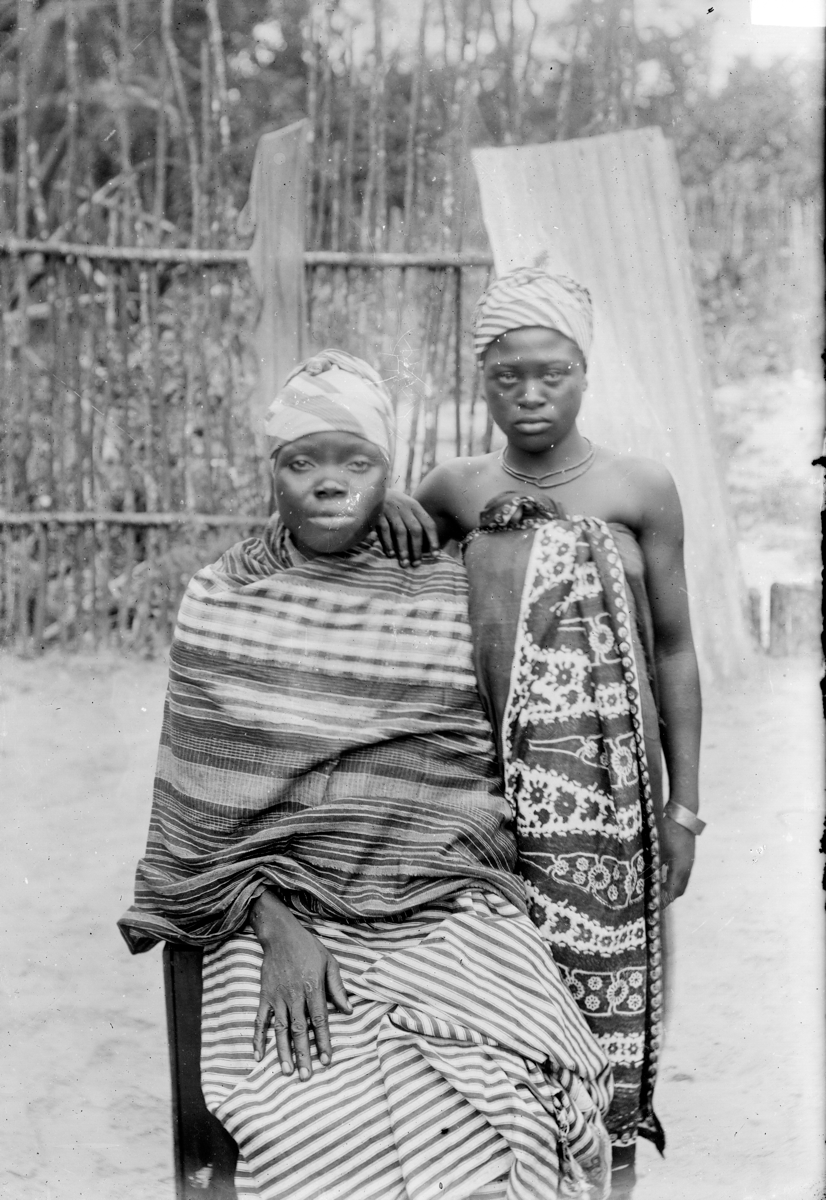
Portrait of Two Women
A photograph depicting two women in an outdoor setting. One woman is seated on a wooden chair, wearing a striped head scarf, a shawl, and a striped cloth. A second woman stands beside her with an arm placed on the seated woman's shoulder, wearing a head scarf and a printed wrapper. The background consists of a fence made of wooden poles or reeds and blurred vegetation. The image was captured by William Henry Crosse between 1886 and 1895 as part …
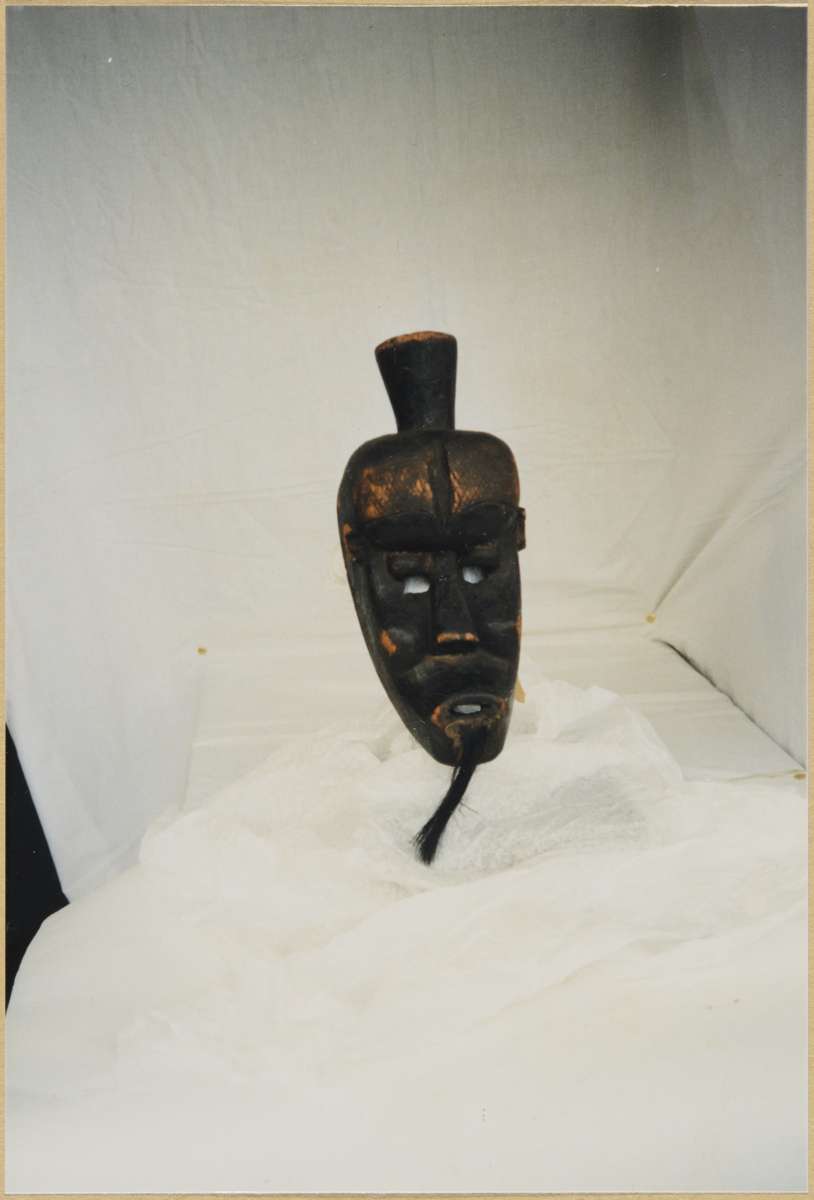
Face Mask Documentation Photograph
A documentation photograph of a face mask. The face is elongated. The mask has a thick stud-shaped crest on top, a prominent forehead above recessed eyes and wide nose, with a small straight open mouth. The mask is decorated with metallic paint, and has a beard of hair.
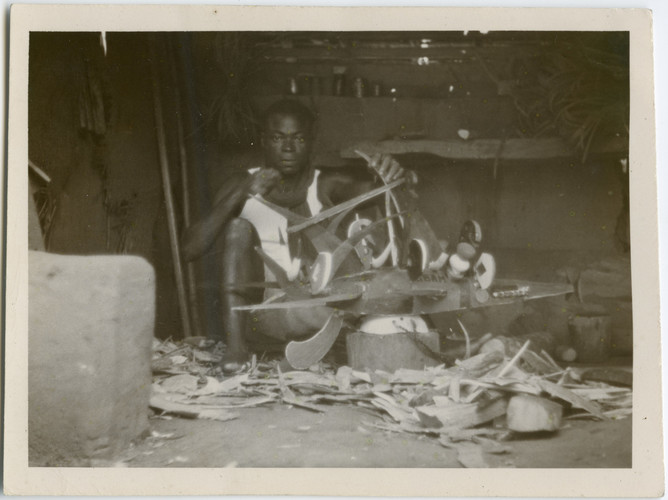
Mask Maker in Workshop with Fish Mask
A photograph depicting a male mask maker in his workshop, holding a completed wooden mask representing a fish. The subject is seated on the ground, wearing a light-colored sleeveless garment, and is surrounded by wood shavings. The image, taken circa 1935, was provided by G. I. Jones to the Pitt Rivers Museum.
An Igbo couple from Asaba
This studio portrait from around 1900 depicts an Asaba man in riding gear or English recreational dress posing with his wife, illustrating the blend of traditional and colonial influences in Asaba. Asaba was a site of resistance to European invasion by the Igbo in the early 19th century, where British explorers Richard and John Lander were taken captive in 1830 during their expedition to trace the course of the Niger River. Later, Asaba became a trading post and administrative headquarters …

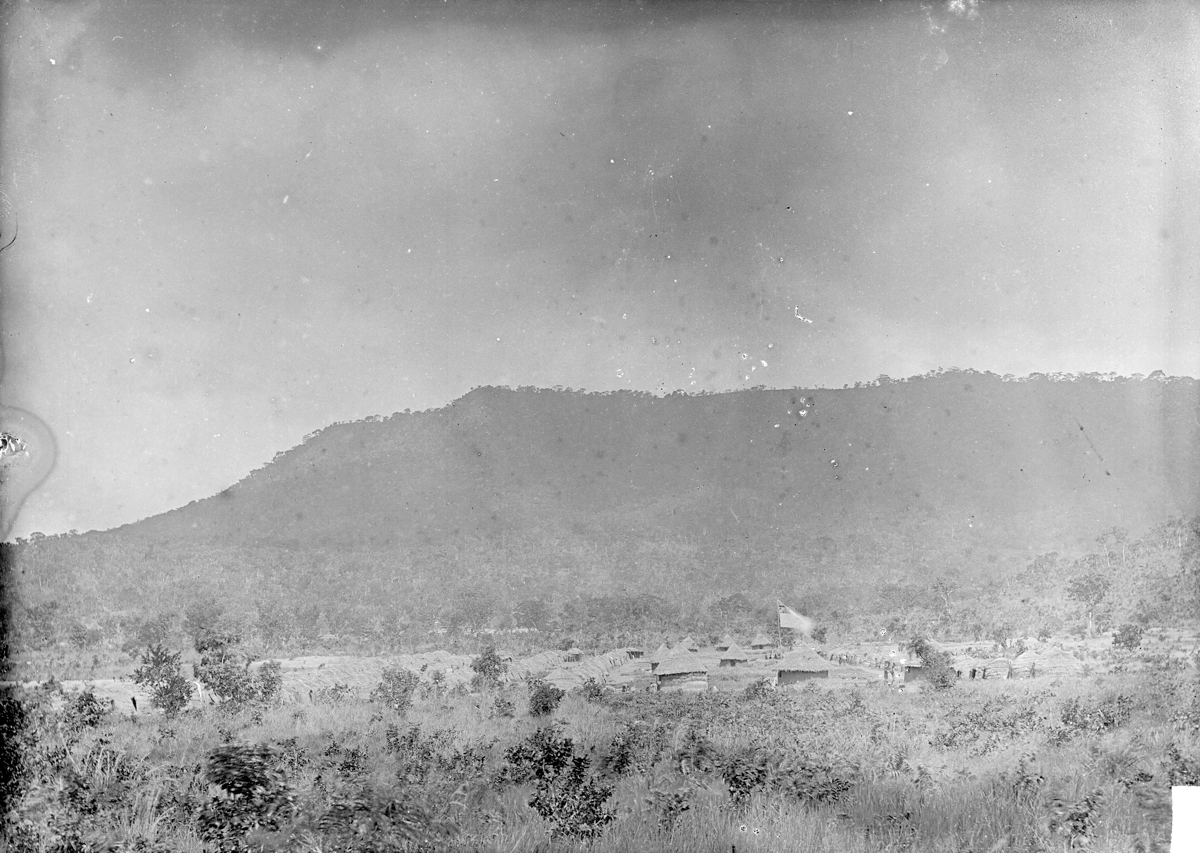
Landscape of an Escarpment Area along the Niger River
A monochromatic photograph from the late 19th century depicting a landscape view of an escarpment area along the Niger River. The foreground consists of dense, low-lying shrubbery and grasses on sloping terrain. In the midground, a cluster of vernacular structures with steeply pitched conical thatched roofs is situated, featuring a single light-toned flag positioned near the primary buildings. The background is dominated by a prominent, elongated forested ridge spanning the horizon under a hazy sky. The image was captured by …
Oji Onu Masquerade with Janus-Faced Helmet Mask
This black-and-white photograph shows a close-up view of a seated masquerade character in the oji onu masquerade, photographed by Gwilliam Iwan Jones between 1932 and 1938 in Akama, Anambra State, Nigeria. The masquerader wears a janus-faced helmet mask featuring two distinct faces: one with deep-set eyes, a hooked nose and wide open mouth, the other with a hooked nose and long downward curving beak. Both faces are painted white with features highlighted in dark pigment. The mask is topped with …
Igbo Woman with Elaborate Geometric Hairstyle
This photograph, taken by Northcote Thomas around 1910 as part of his anthropological documentation, features an Igbo woman with an elaborate geometric hairstyle. In Igbo culture, hairstyles often signified age, social status, and marital status, offering insight into personal adornment practices in early 20th-century Igbo society.

Ogbugulu Mau Masquerader Performing in Amuda Village
This black-and-white photograph captures the Ogbugulu Mau masquerade performance in Amuda village near Awka, southeastern Nigeria, between 1932 and 1938. The masquerader Nwaogho Ehi (Heifer) wears a white helmet mask with distinctive v-shaped markings above and below the eyes, a brightly colored harlequin-like appliqué costume, cloth cloak tied around the neck, and ankle-rattles made from seeds. The photograph documents Igbo masquerade traditions among the Isuochi people, showing the elaborate costume design and performance context within a rural setting with mud …
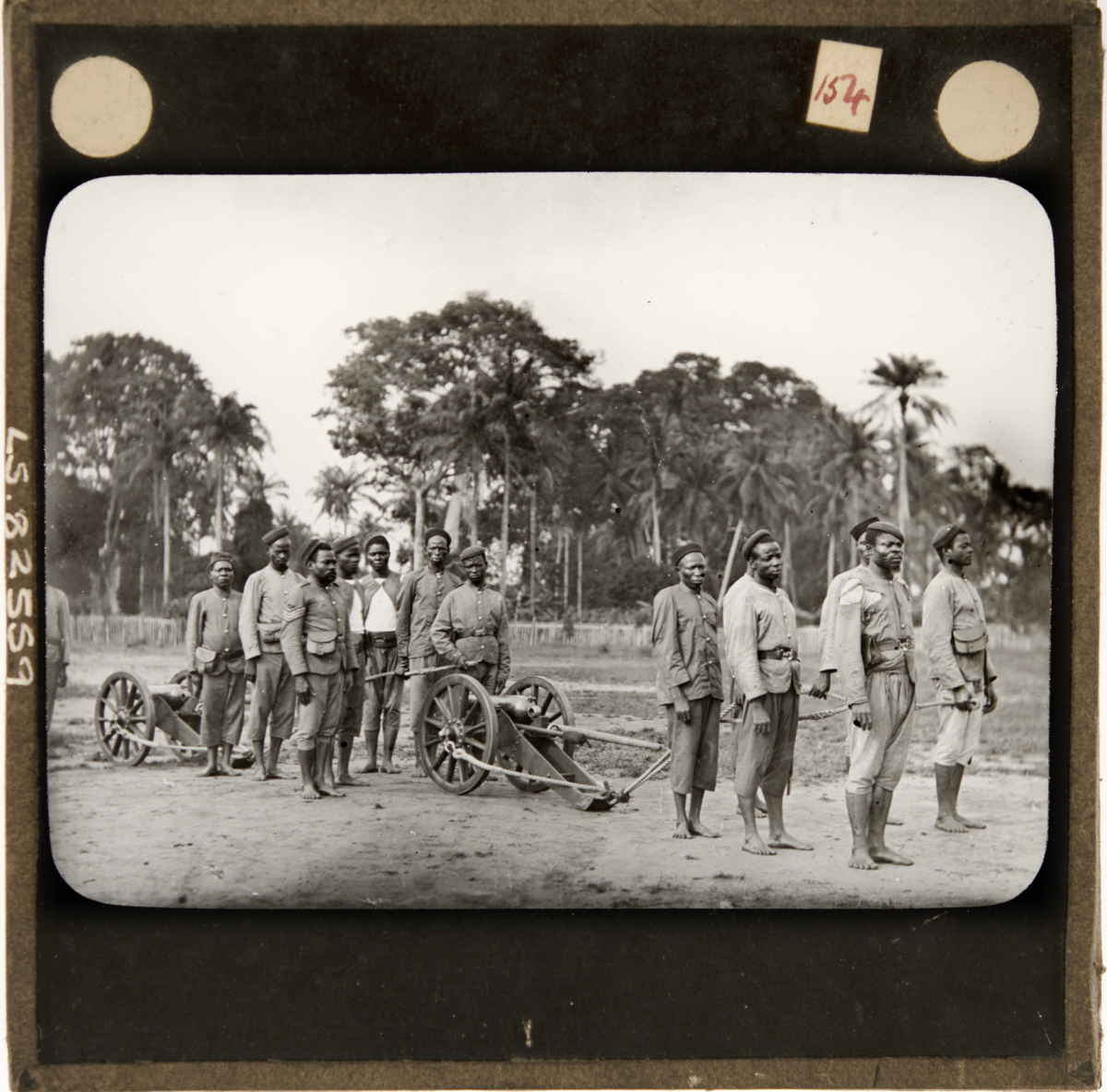
Soldiers of the Royal Niger Company
A photograph depicting approximately twelve men of African descent in light-colored military uniforms and dark pillbox caps. The subjects are positioned in a loose horizontal formation on a flat dirt expanse. Two light field artillery pieces, featuring dark metal barrels and wooden spoked wheels, are situated within the group. The background consists of a linear fence and tropical flora, including palm trees.
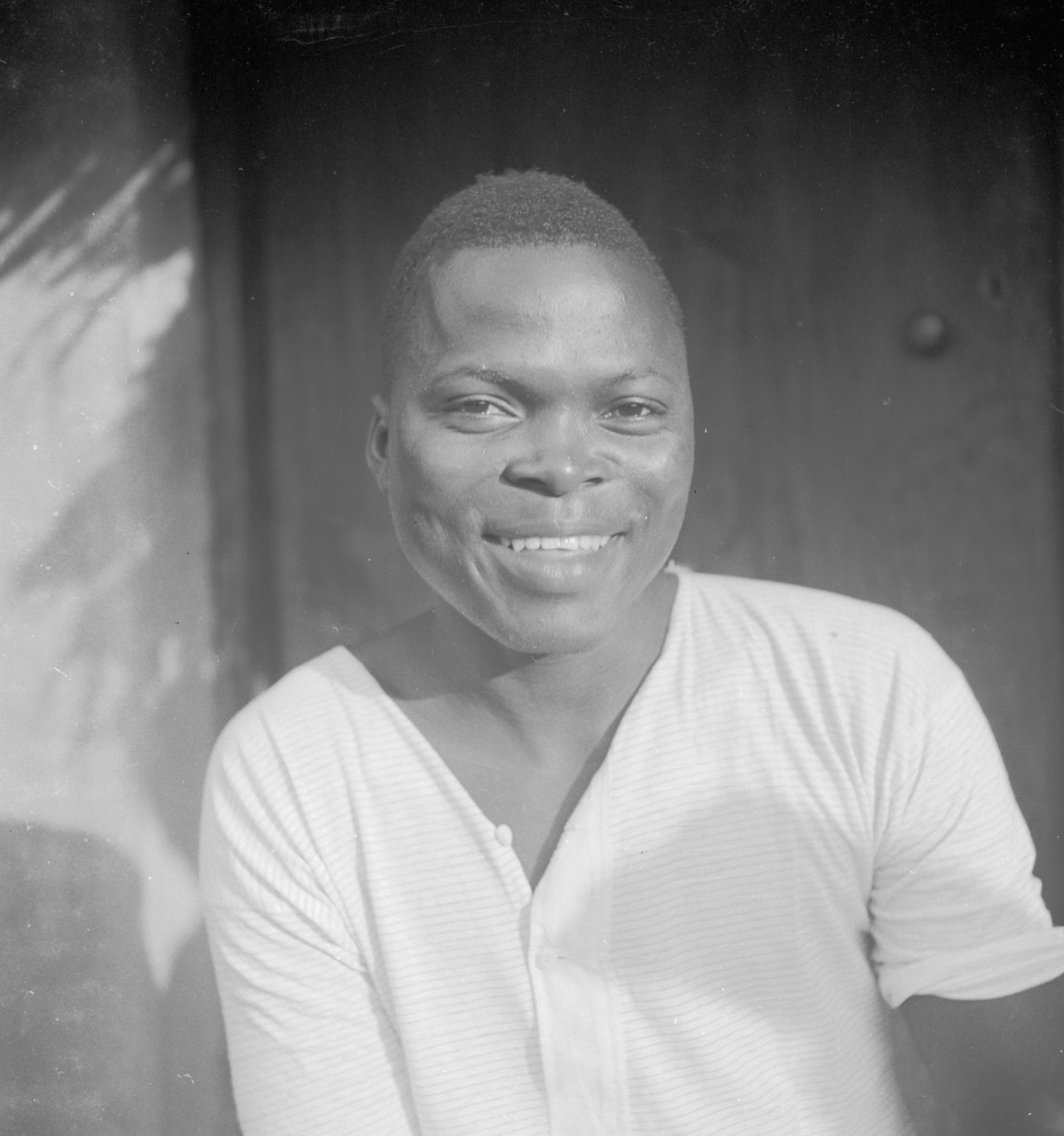
Portrait of an Igbo Man
Black-and-white portrait of an Igbo man with a smile, short hair, and a white collarless shirt. The background appears to be a wall or door with a contrasting lighter area, of natural light.
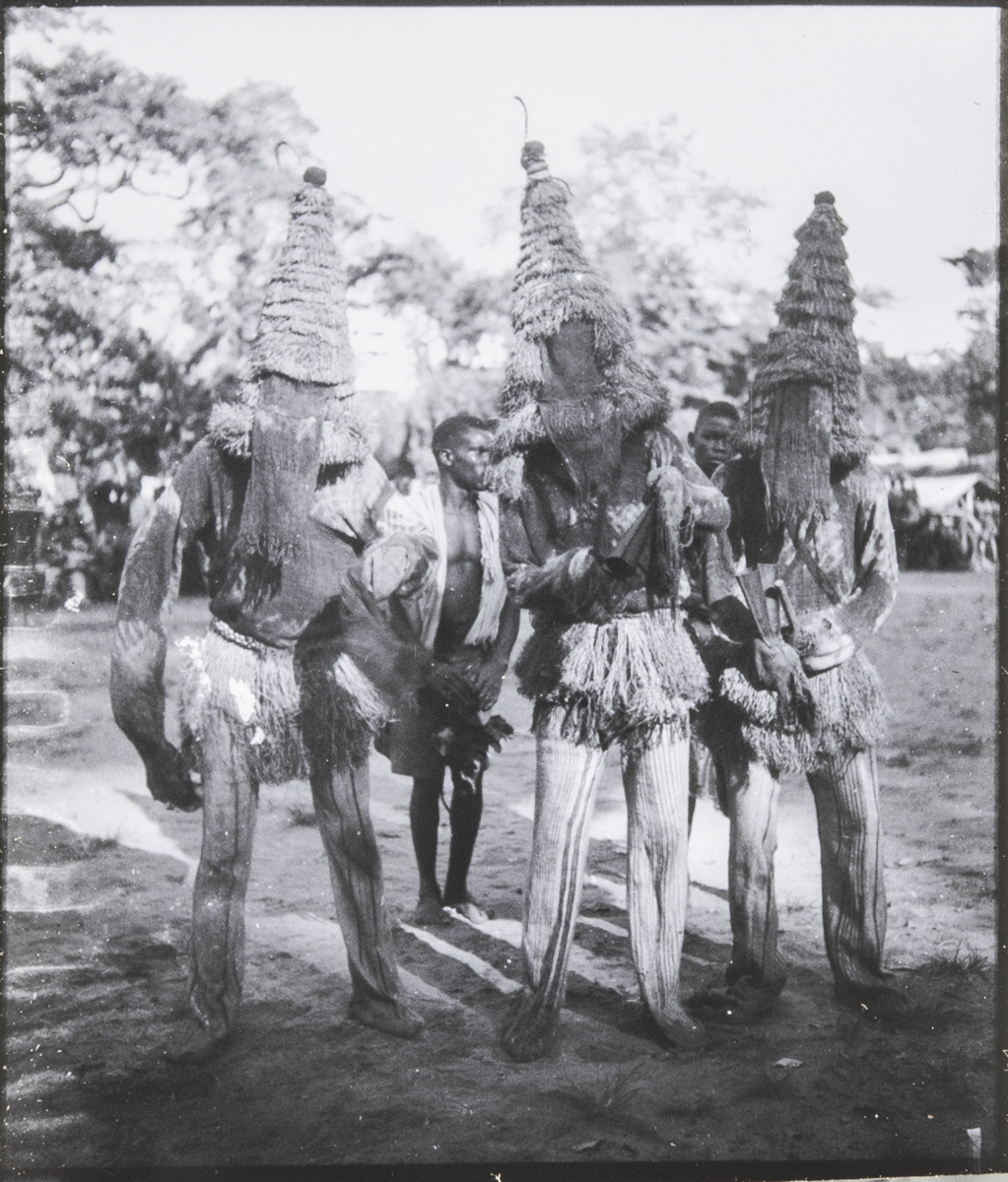
Onu Kamma Masqueraders at Nimo
Black-and-white photograph showing three Onu Kamma (Mouth stronger than sword) masqueraders at Nimo, Nri Awka, Onitsha province. Each figure wears a large conical faceless mask constructed from layered fibre with a cloth panel at the front. Their attire includes tie-dyed or batik upper garments, striped woven cloth trousers, and fibre skirts secured at the waist; cowrie shells are visible on the rightmost performer. Two masqueraders hold metal gongs, one striking his with a stick. A sizable crowd of bystanders observes …
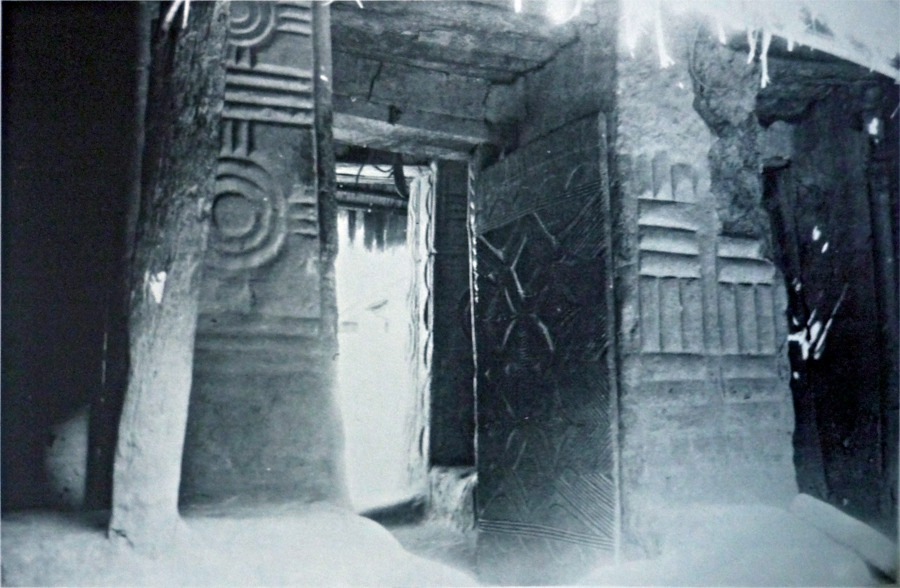
Entrance Portico of Chief Ogbua's Iba
This black-and-white photograph, taken in 1961 by Z.R. Dmochowski as part of his documentation of Nigerian traditional architecture, features the entrance portico of Chief Ogbua's Iba (palace or house) in Onitsha. The entrance is adorned with intricate Igbo wood carvings on pillars and walls, depicting symbolic motifs and ancestral figures that reflect the owner's spiritual and social status.
Group Portrait at a Royal Niger Company Station
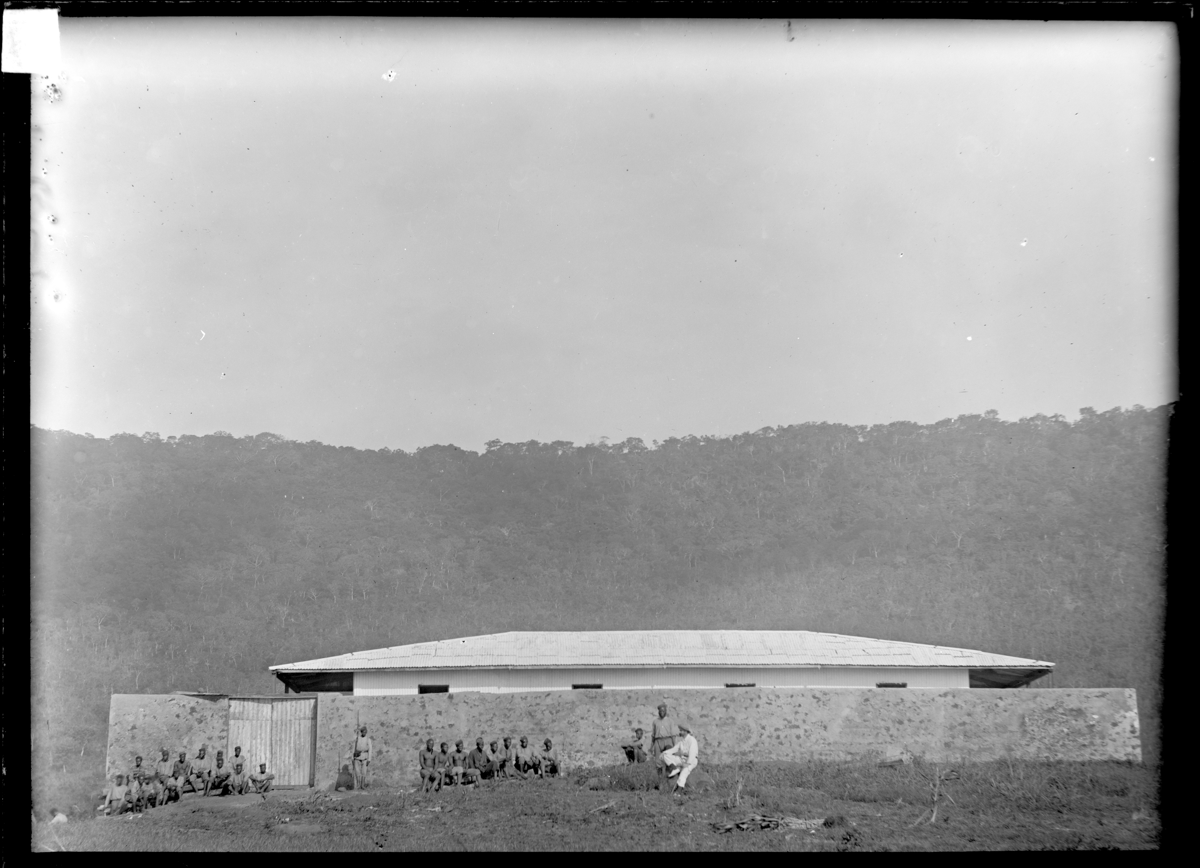
A photograph depicting a group of individuals positioned in front of a long, single-story rectangular building and a high masonry perimeter wall. Several subjects wearing light-colored, simple garments are seated or crouching on the unpaved foreground, while others stand near a vertical-slatted wooden gate. One individual on the right is dressed in more structured clothing, suggestive of a jacket. The background is dominated by a dense canopy of trees on a sloping hill under a light-toned sky. The image was …
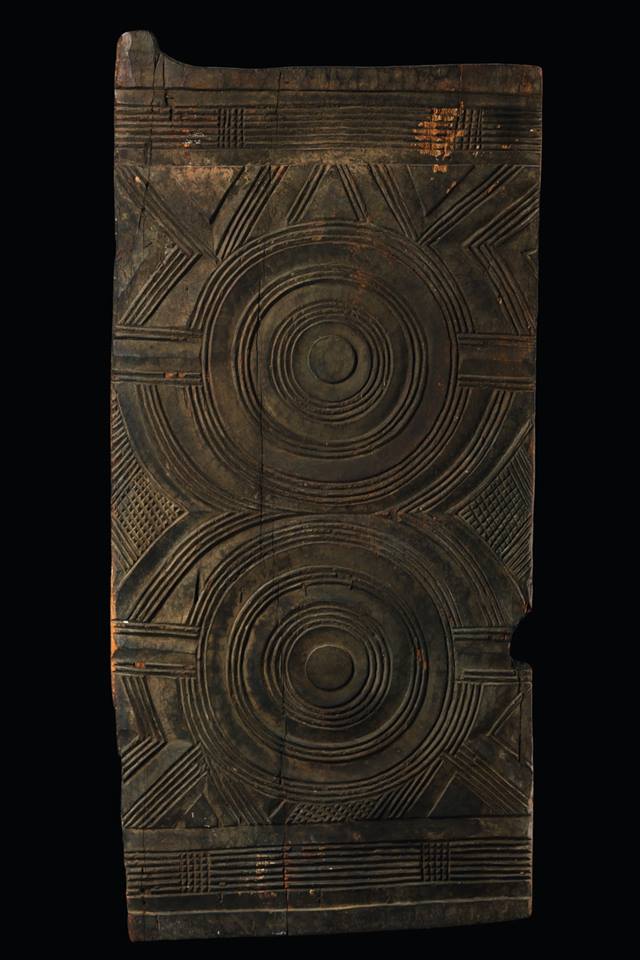
Heavy Wood Door from Nri Awka
This heavy wooden door from the Nri-Awka region, known as ḿgbó èzí, is an example of traditional Igbo wood carving from the 19th-20th century. Carved from sacred hardwood like iroko with symbolic motifs and patterns, such doors served as entrances to compounds of influential families, conveying stories, status, and spiritual beliefs.
G.I. Jones at Nsude Village Shrine Pyramid
A black-and-white photograph from the 1930s showing anthropologist G.I. Jones seated in front of a stepped earthen pyramid at the Nsude Village Shrine in Abaja, Northern Igbo region. The pyramid structure consists of rounded graduated steps decreasing in size and culminating in a pointed apex. The structure, made of mud, stands in an open area surrounded by grasses and vegetation. Jones is wearing shorts, a white shirt, and a pith helmet. The Nsude pyramids were temples dedicated to the deities …

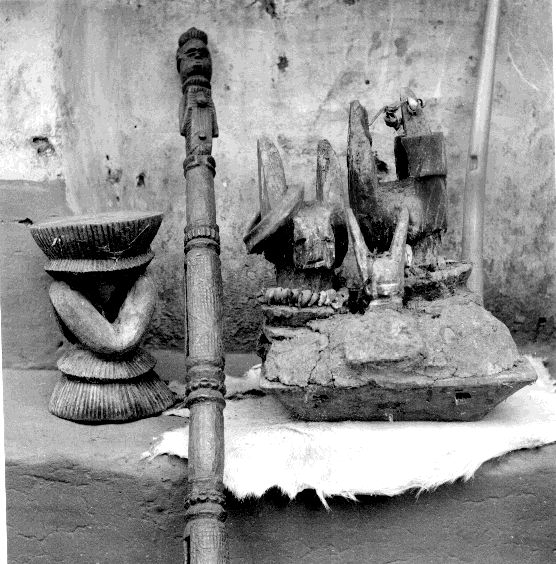
Ofo, Uxurhe, and Ikenga from North Ika
A monochromatic archival photograph depicting a collection of three carved wooden objects from North Ika. On the left is a carved pedestal or vessel with a ribbed rim and a conical base. In the center is an elongated vertical staff, identified as an uxurhe, featuring a carved human figure at the apex and a textured shaft with horizontal bands. On the right is a complex sculptural assemblage, including an Ikenga, characterized by pointed appendages and a carved face, resting on …
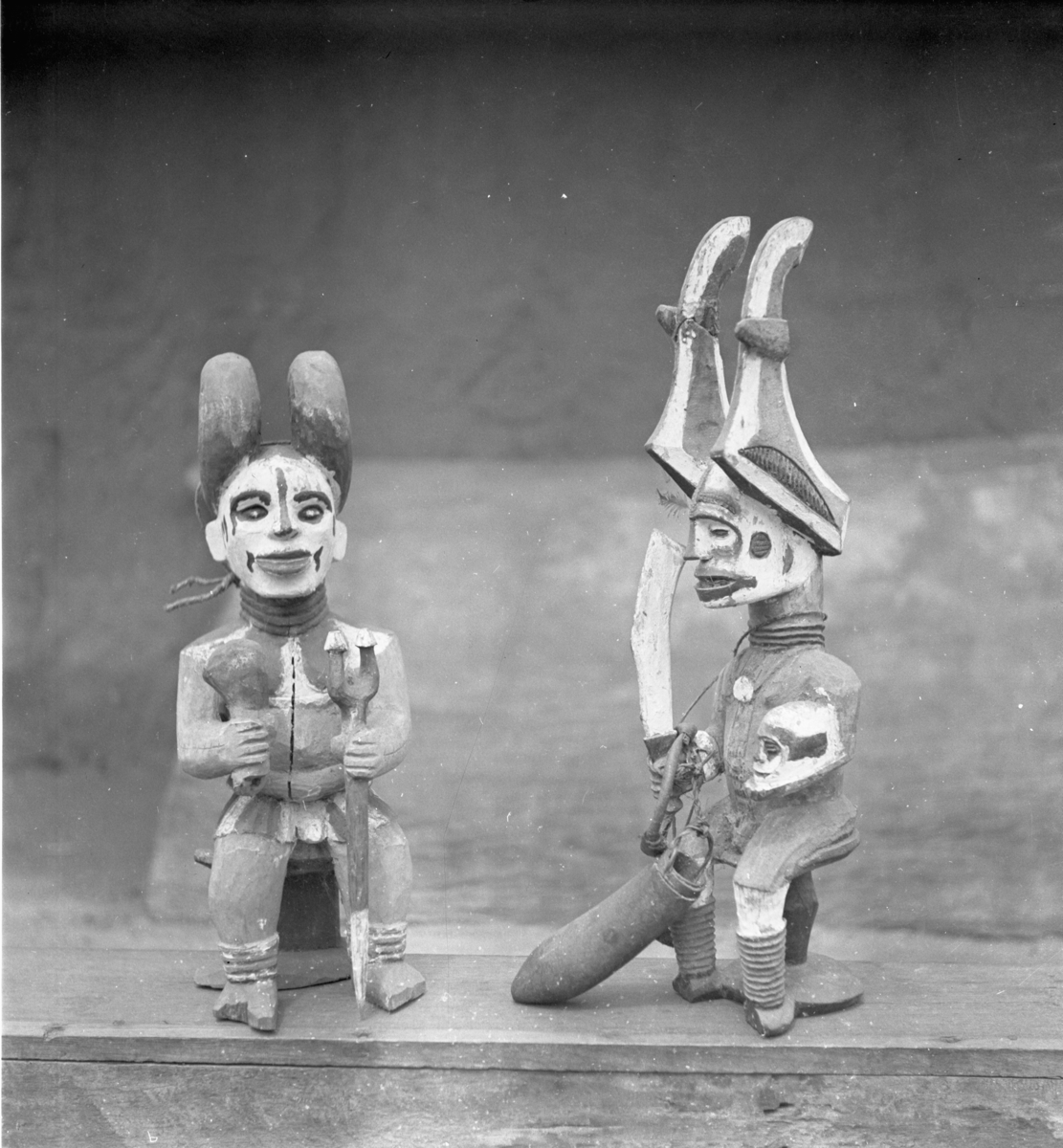
Two Ikenga Figures from Nri Awka Igbo
Two wooden Ikenga figures. The figure on the left is seated on a stool and is holding a staff in one hand and another object in the other. The figure has a stylised human face painted white with black markings accentuating the eyebrows, eyes, nose and mouth, the two horns are curled. The figure is sitting and around the neck are coiled rings, the torso is painted white and black and he is wearing a painted ruffled tunic, there are …
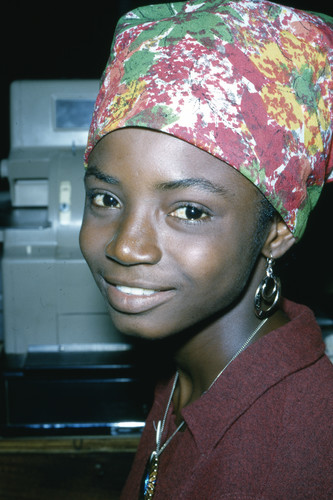
Portrait of an Igbo Woman Clerk in Maiduguri
A photograph depicting a young Igbo woman employed as a clerk in Maiduguri. The subject is shown in a three-quarter profile, facing left, with a smile. She wears a multicolored, mottled textile head wrap with red, green, yellow, and white pigments, large metallic-toned hoop earrings, and a metallic-toned chain necklace with a rounded dark pendant. Her garment is burgundy with a visible collar. The background is an indoor setting with low ambient light, featuring a blurred mechanical or electronic device …
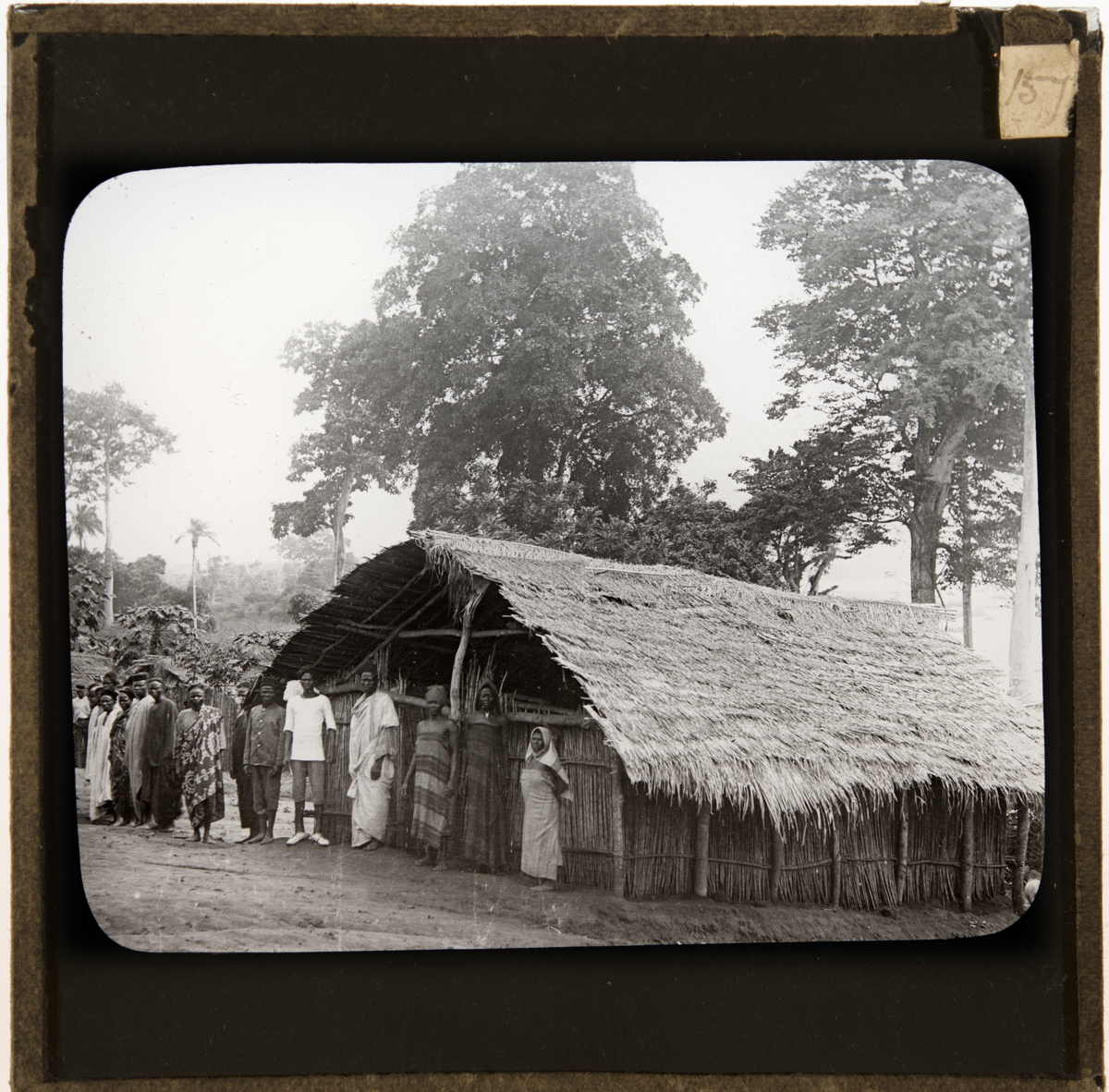
Group Portrait from Royal Niger Company
A photograph depicting approximately 13 individuals standing in a horizontal line before a long, low-profile building. The structure features a steeply pitched gabled roof made of thatch or plant fibers and walls constructed from vertical organic elements such as reeds or wooden poles. The subjects exhibit a variety of clothing, including traditional wrapped textiles with geometric or organic motifs, and Western-influenced attire such as button-down shirts, shorts, and trousers. The setting is characterized by a flat, unpaved earth surface and …
Trader from Timbuctou and Rich Trading Woman
This photograph, taken by G.F. Packer in 1889 and housed in the Pitt Rivers Museum, features a trader from Timbuktu on the right and a rich trading woman on the left, possibly a member of the Onitsha women's Otu Odu (ivory group) society or an Omu, the female counterpart to the king. The woman wears large ivory anklets, indicative of high socio-economic status in this traders' group. The image illustrates long-standing trade connections across West Africa and Igbo commerce along …
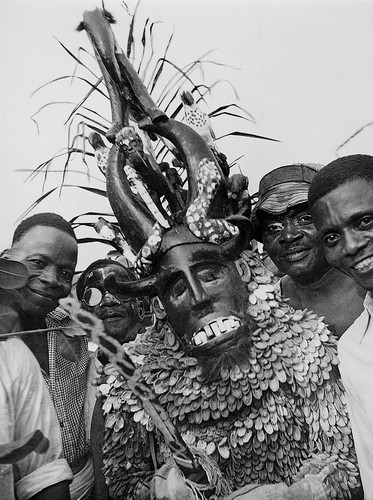
Igbo Dancer Performing Agaba Masquerade
A photograph depicting an Igbo dancer in Okitipupa, Ondo Province, performing the Agaba masquerade. The central figure wears a dark, matte-textured mask with wide, recessed eyes and an open mouth revealing white, rectangular teeth. The headdress features two large, curved horns and carved humanoid figures, with organic stalks extending vertically. The performer's torso is covered in a garment of overlapping light-toned, disc-shaped objects. Four men in mid-century attire are positioned around the dancer, observing the performance. This image was published …
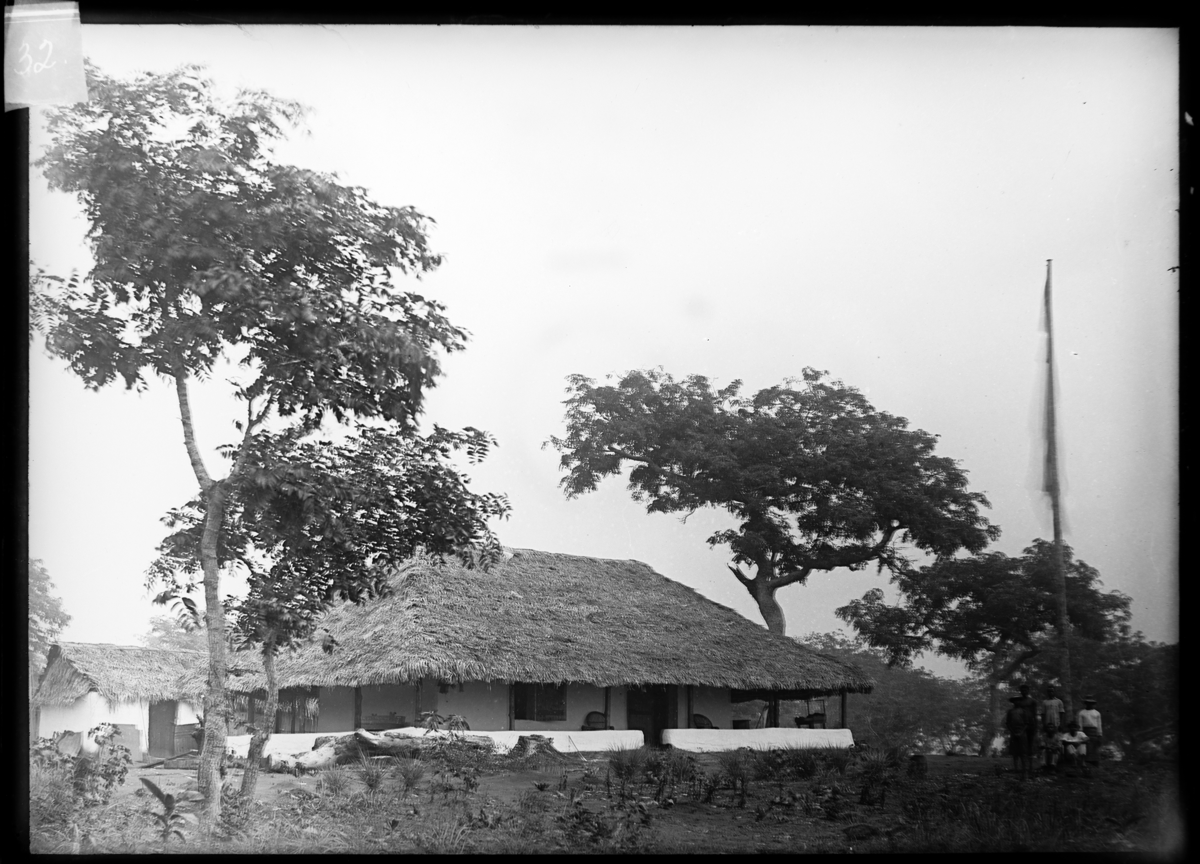
Thatched Dwelling and Group of Individuals
A photograph depicting a single-story dwelling with a steeply pitched thatched roof and light-colored walls. The structure features a veranda area with a low perimeter wall and several dark rectangular openings. To the right, a group of approximately five individuals wearing light-colored tunics and hats stands near a tall, slender vertical pole. The environmental context includes a tall, slender tree in the left foreground and a broad canopy tree behind the building. This monochrome image is a glass negative halfplate …
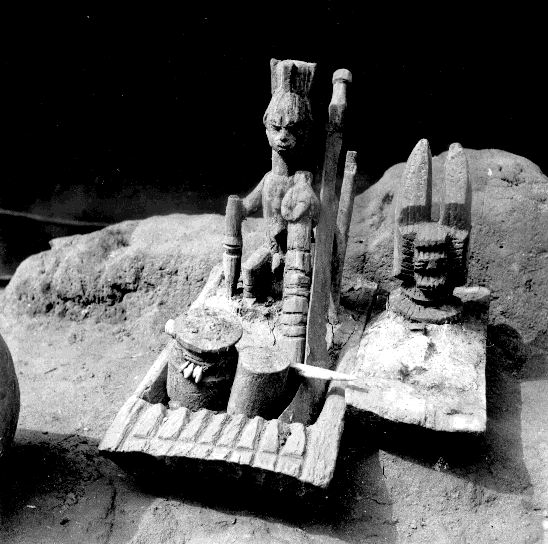
Okike, Ikenga and Other Shrines of North Ika
A monochromatic photograph depicting a collection of carved wooden objects on a granular substrate. The central assemblage features a seated humanoid figure with a tall, vertically striated cylindrical headdress, positioned on a rectangular base with diagonal rhythmic ridges. Adjacent to the figure is a slender vertical staff with a rounded terminal and a short cylindrical vessel adorned with small, pointed protrusions. A secondary object to the right consists of a mask-like form with two elongated vertical protrusions extending from the …
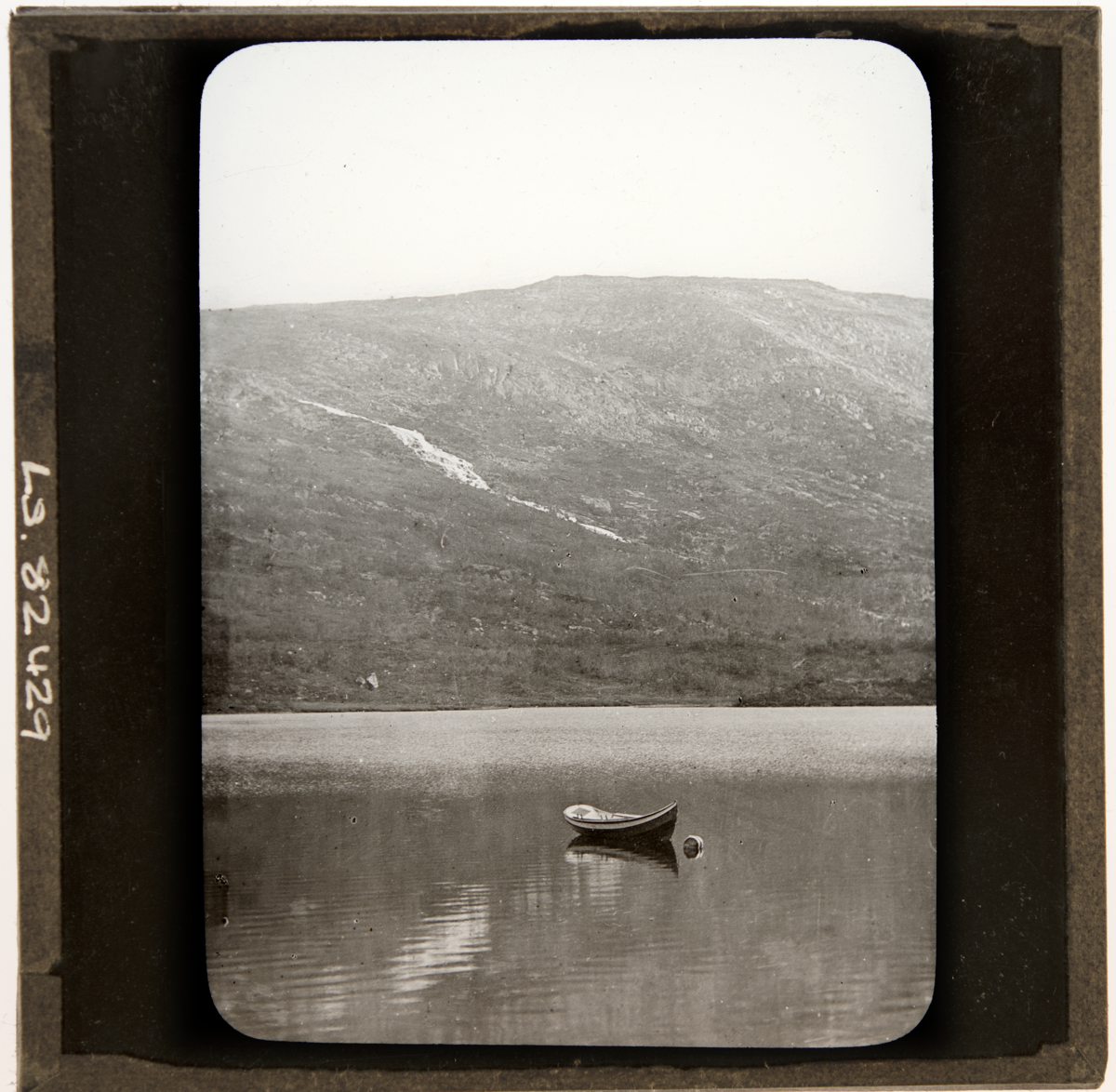
Landscape of the Niger River
A monochrome photograph from the Crosse Collection depicting a landscape along the Niger River. In the foreground, a single open-hull rowboat floats on a calm body of water with visible ripples. The midground features a shoreline that transitions into a large, rocky topographical elevation dominating the background. A prominent light-toned linear feature is visible on the slope of the mountain. The image was captured as a lantern slide between 1886 and 1895 by William Henry Crosse, the Principal Medical Officer …
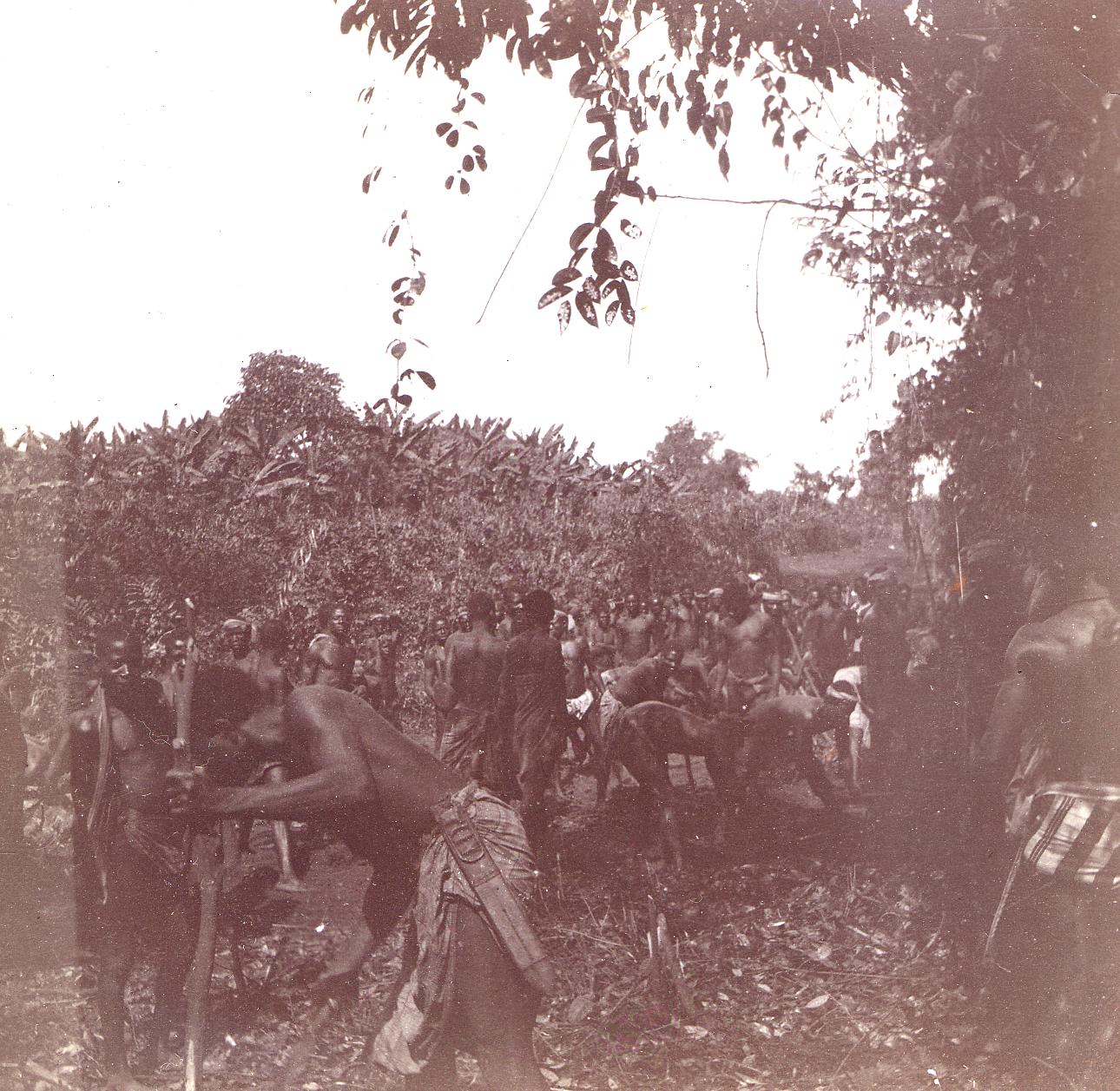
Aro men in loincloths clearing thick forest overgrowth under direction of colonial forces
This photograph, taken by Donald A. MacAlister as part of a series from the Aro Punitive Expedition, shows a group of Aro men clearing forest vegetation with machetes to facilitate British colonial troop movement during the Anglo-Aro War of 1901. The war sought to dismantle the Aro Confederacy and the Ibini Ukpabi (Long Juju) oracle, marking a significant event in British colonial efforts against indigenous powers in eastern Nigeria.
Building on the Banks of the Niger River
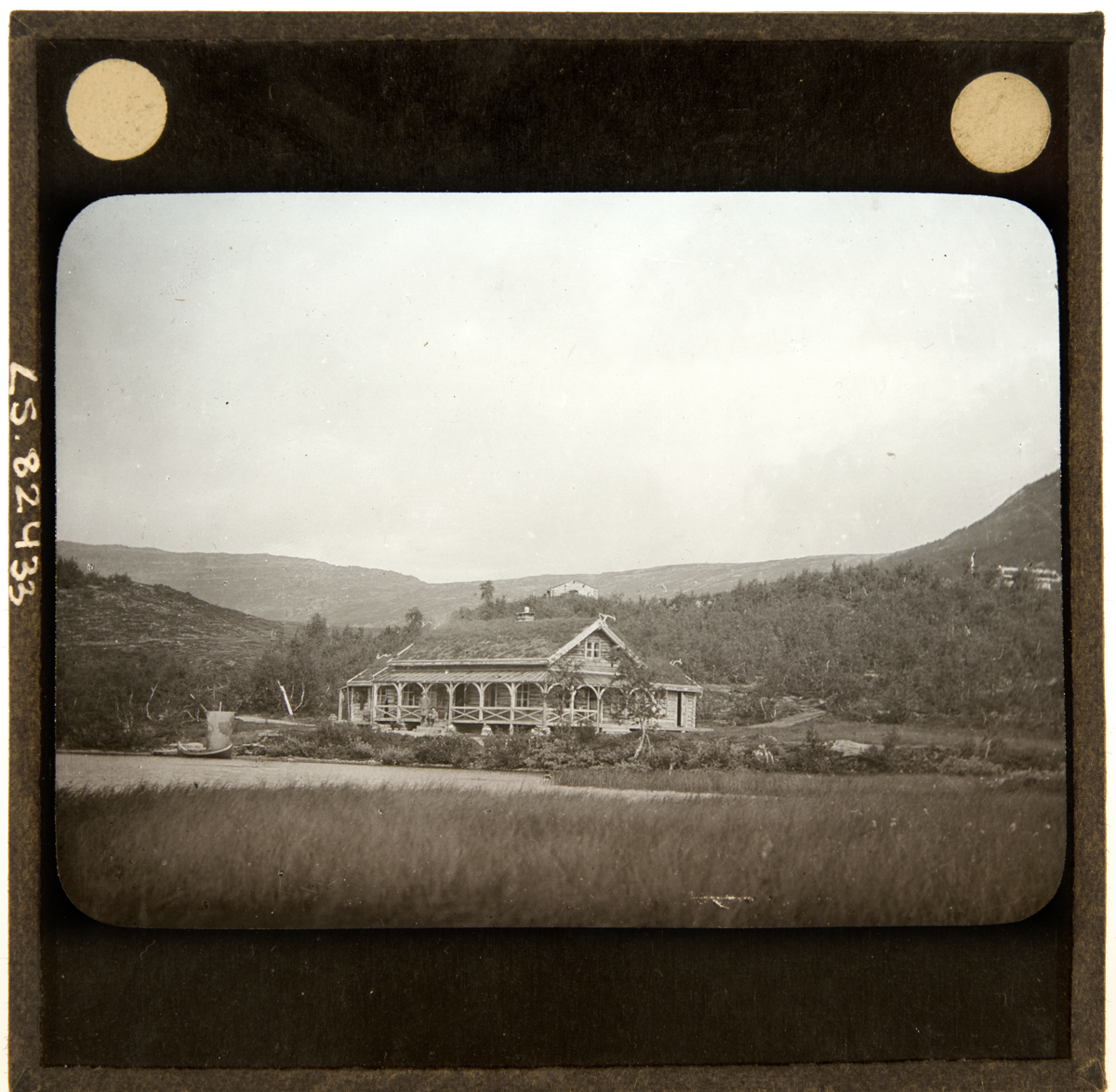
This monochrome lantern slide, taken between 1886 and 1895 by Dr. William Henry Crosse, depicts a single-story building on the banks of the Niger River in Nigeria. The structure features a pitched gable roof with an organic covering and an elongated front porch supported by decorative wooden latticed elements. Tall vegetation and a calm body of water occupy the foreground, while rolling hills and distant structures are visible in the background. The photograph was part of a series documenting the …
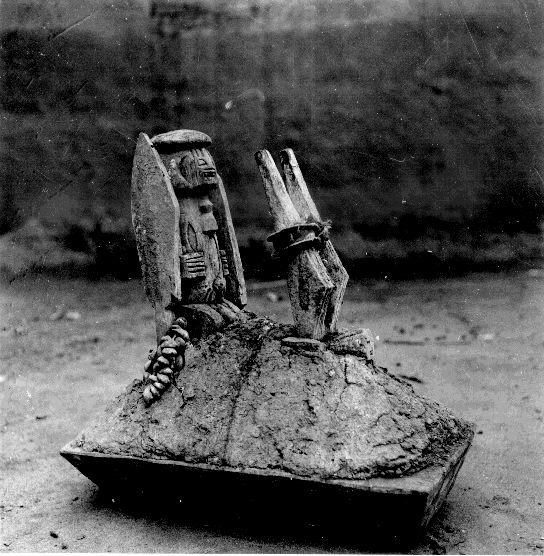
Portable Household Shrine, North Ika
A monochromatic photograph depicting a portable household shrine from North Ika. The assemblage features a central anthropomorphic wooden carving with stylized facial elements, a torso, and horizontal lines suggesting arms, flanked by two weathered wooden slabs. To the right is a composite structure of two vertical wooden pieces secured by a dark circular band. These elements are positioned atop a conical mound of compacted earth, clay, or mud, which rests on a flat, rectangular wooden platform.
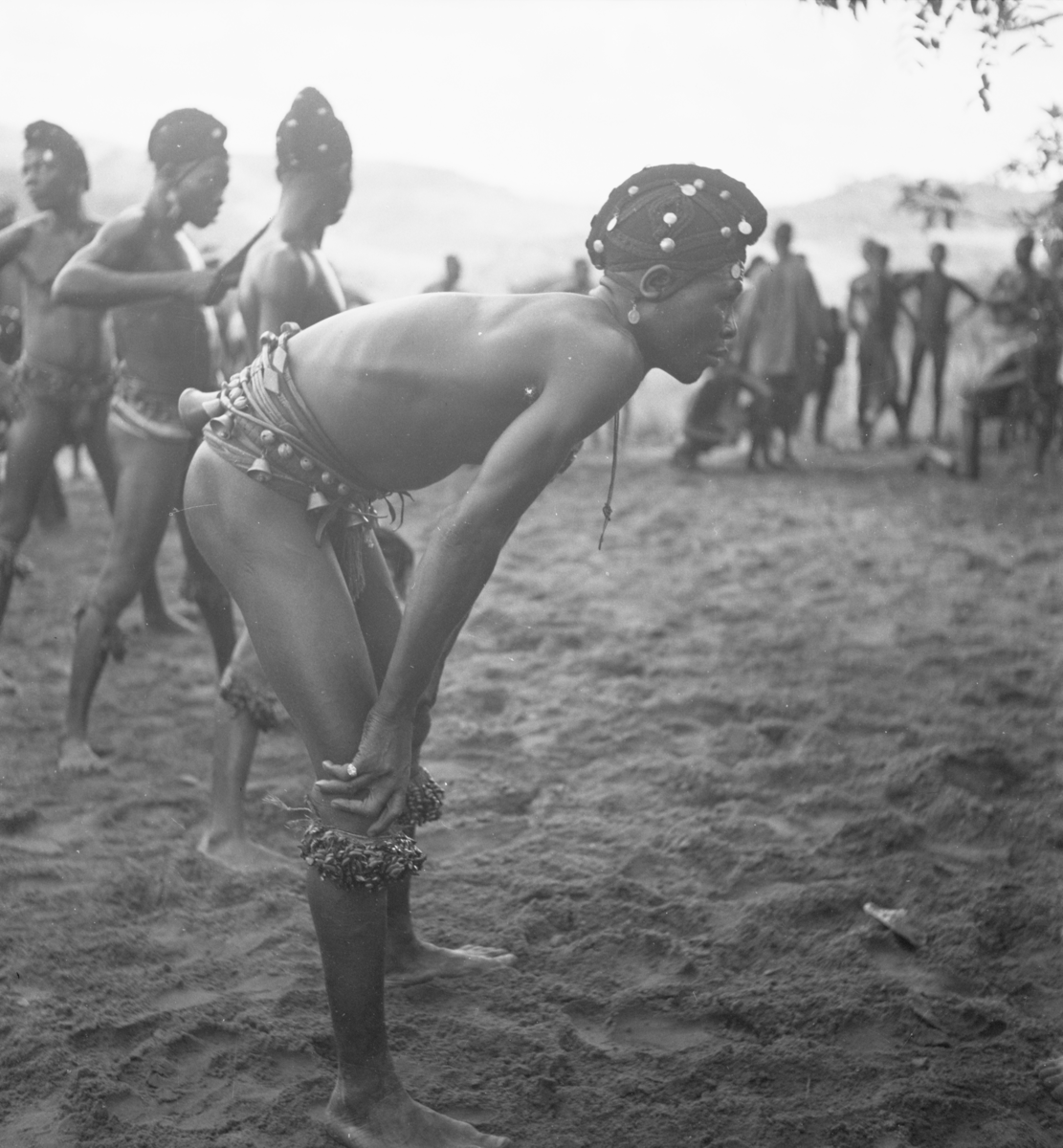
Boys' Initiation Dance in the Nri Akwa Area
A photograph depicting a boys' initiation dance in the Nri Akwa area. The male initiates are adorned with tight loin cloths decorated with bells around the waist, knee bands made of seeds or metal, and black caps styled as coiffure and studded with round metal decorations. Some individuals wear necklaces. In the background, spectators observe the ceremony. The image captures the physical posture of the initiates, including one subject in the foreground leaning forward at the waist with hands near …
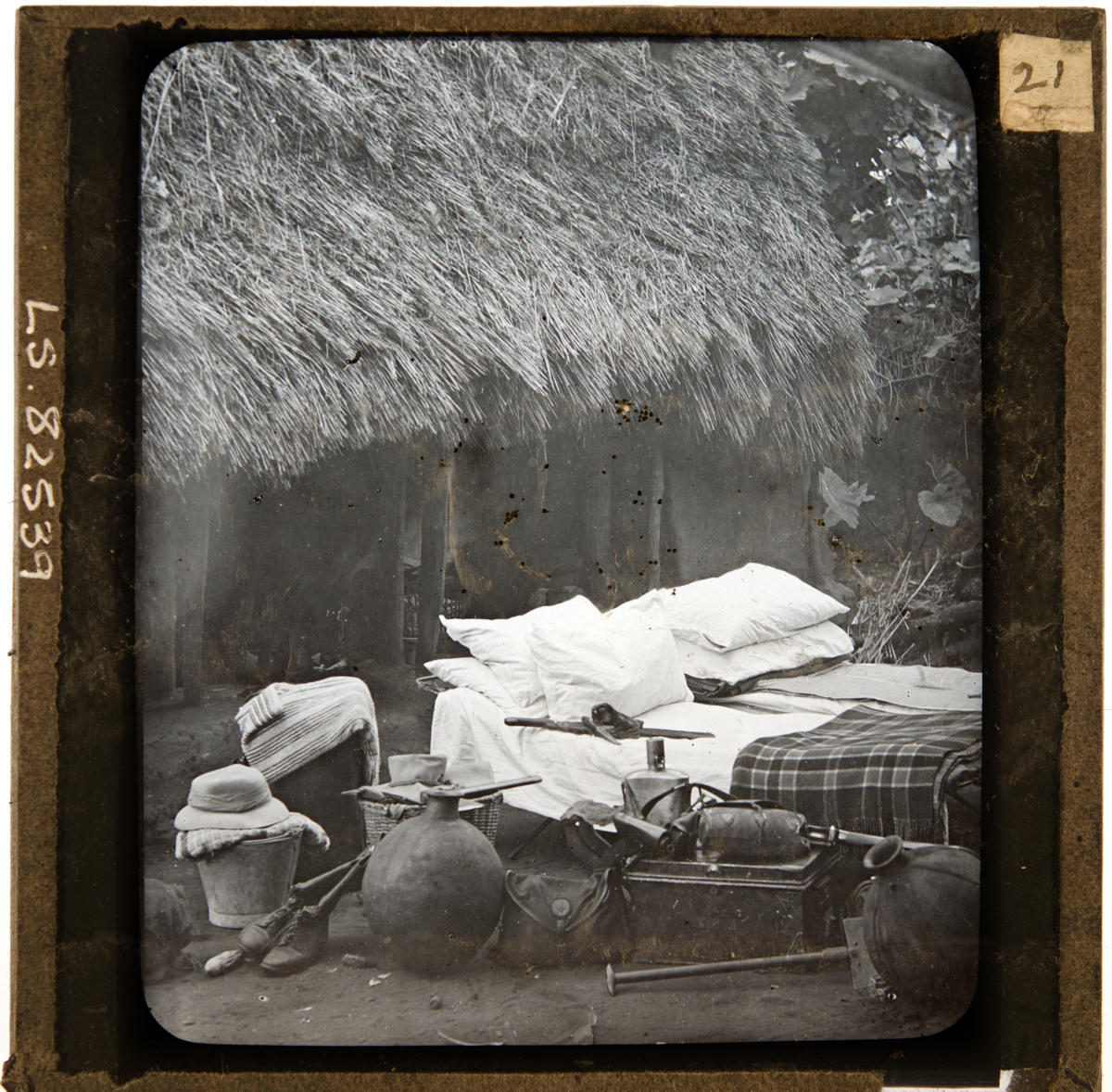
Domestic assemblage and sleeping area
A photograph depicting a collection of functional items and a sleeping area in an outdoor or semi-sheltered environment. The foreground contains various vessels, including a large spherical container and a rounded pot, along with a brimmed hat, dark footwear, and a rectangular chest. The midground features an elevated sleeping surface with light-colored sheets and pillows. A large thatched roof made of fibrous materials dominates the background.
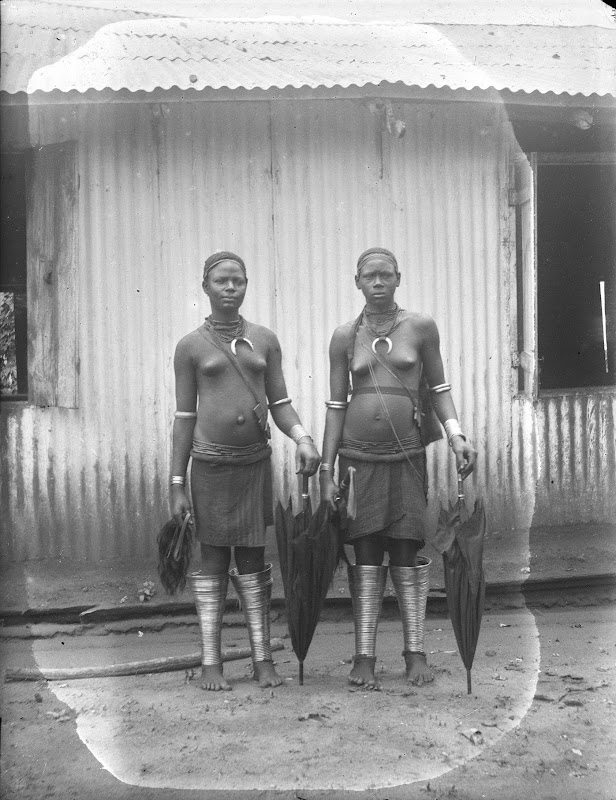
Two Igbo Women in Traditional Attire, Onitsha
A photograph depicting two ladies from the Onitsha area. Both subjects are bare-chested and wear tight-fitting dark bands around their heads, multiple beaded necklaces with a central crescent-shaped pendant, and a diagonal sash across the torso. Their attire includes metallic bands on the upper arms and wrists, a wide multi-layered waist belt, and short wrap-around skirts. Both wear cylindrical metallic leg guards extending from the ankle to below the knee. One subject holds a fly-whisk and a closed umbrella, while …
Portraits of an Igbo Woman in Oweri Province
These black-and-white portraits, taken by Northcote Thomas between 1909 and 1913 as physical type photographs in his anthropological survey, depict an Igbo woman from Oweri Province (now Owerri). The frontal view highlights her direct gaze and the gap between her front teeth, a cultural marker of beauty, with a simple headscarf against a plain background. The side profile shows her headscarf revealing neat hair lines, characteristic of Igbo styles, and a small earring, contrasting with her simple attire.

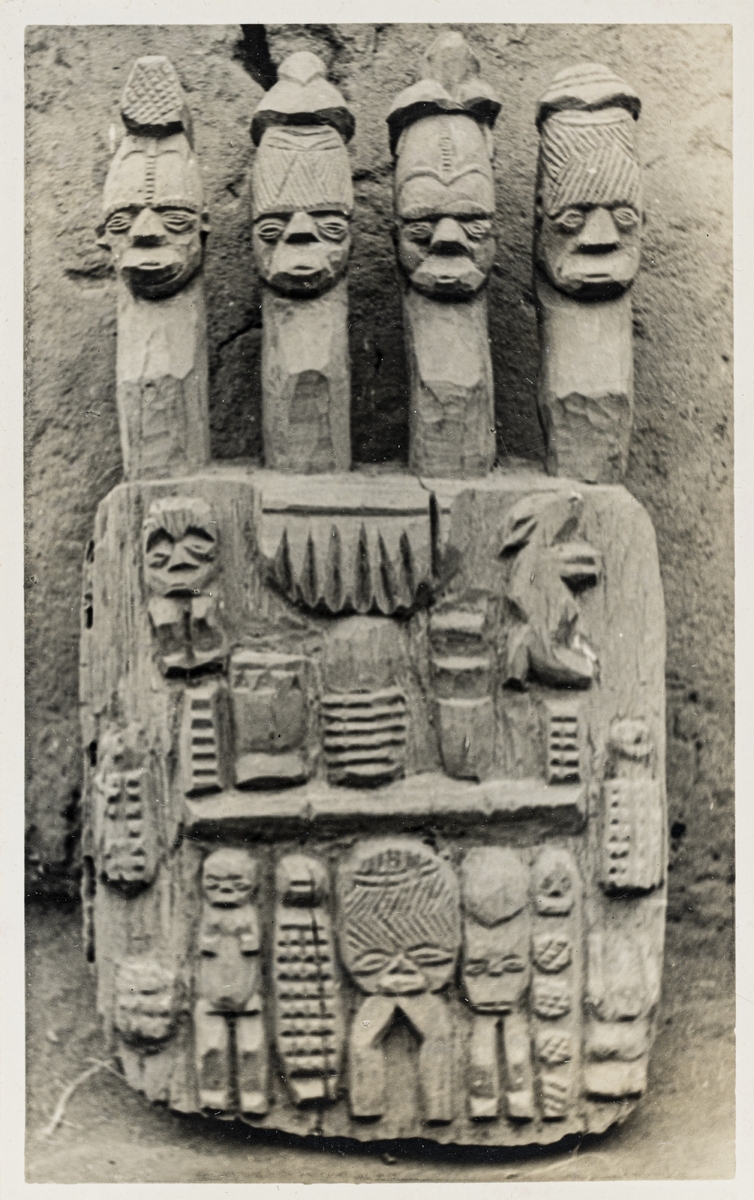
Carved Wooden Ceremonial Board Staff
A photograph depicting a carved wooden figure, possibly a ceremonial board staff, featuring a multi-register relief carving. The structure consists of a base board decorated with various faces, bodies, and geometric shapes. From the top of the board project four short poles, each terminating in a stylized human head with distinct decorative coiffures. The lower register features a prominent central face with a patterned forehead, flanked by smaller humanoid forms and patterned columns. The work is characterized by manual subtractive …
Discover Our Platform
A comprehensive digital platform dedicated to preserving and celebrating Igbo culture, history, and heritage for future generations.
Cultural Archives
Explore our extensive collection of photographs, documents, artifacts, and historical records that tell the story of Igbo people.
Browse ArchivesCommunity Lore
Read and share perspectives on Igbo culture, traditions, and contemporary issues. Connect with writers preserving our heritage.
Read LoreBook Reviews
Discover and review books about Igbo culture, history, language, and literature. Build your knowledge through curated recommendations.
Browse BooksIgbo Archives AI
Chat with our AI assistant to learn about Igbo culture, get translations, analyze images, and receive personalized cultural lore.
Try AI AssistantCommunity
Join a vibrant community of culture enthusiasts, historians, and learners. Share knowledge and preserve our heritage together.
Join NowSupport Us
Help us preserve Igbo heritage for future generations. Your contribution keeps this platform running and growing.
DonateWhy Igbo Archives?
Preserve Heritage
Digitally preserve Igbo cultural artifacts for future generations
Global Access
Connect Igbo people worldwide with their roots and heritage
Educational
Comprehensive resources for learning and research
Community-Driven
Built by the community, for the community