

Portrait of a Woman Seated on a Bentwood Chair
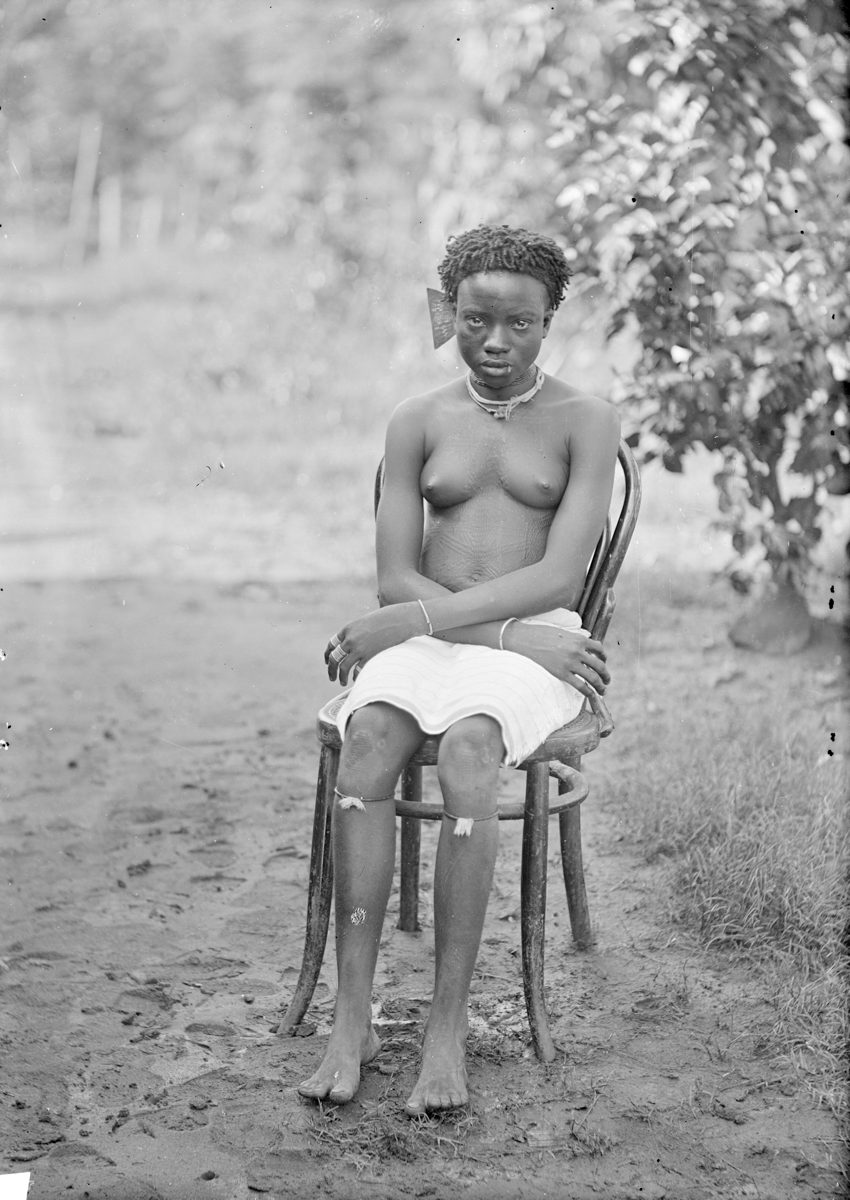
A monochrome photograph of a seated woman posing in an outdoor setting. The subject is bare-chested and wears a white cotton wrap-style waist cloth. Her adornments include a narrow necklace, bracelets on both wrists, a ring on her right hand, and bands with white fibrous attachments around her ankles. Repetitive patterned markings, consistent with scarification, are visible on her abdomen. She is seated on a bentwood-style chair on a dirt surface with dense vegetation in the background.
Community Notes

Onyeka Nwokike
Apr 23, 2026
The photograph is part of the Crosse Collection, with the negative originally located in a box later associated with the handwriting of G.I. Jones. According to the Museum of Archaeology and Anthropology at Cambridge, the images may have been donated by Rev. Charles Henry Robinson, who utilized several of Crosse's photographs in his 1900 publication, Nigeria: Our Latest Protectorate.
Onyeka Nwokike
Apr 23, 2026
The patterned abdominal scarification seen on the subject is a practice known as Ude, which is common among the Esan people of south-south Nigeria. As detailed in a prospective analysis on the practice, these markings are deep-rooted in the culture and are sometimes historically associated with the treatment of abdominal swelling, such as splenomegaly.
Onyeka Nwokike
Apr 23, 2026
This image was captured during the operational era of the Royal Niger Company (RNC), which worked to establish control over the Nigerian interior between 1879 and 1900. Research from the University of Benin indicates that the British occupation of Esanland was part of a broader conquest that culminated in the revocation of the RNC's royal charter in 1899 and the subsequent transfer of company territories to the British Government on January 1, 1900.
Log in to add context.
Explore Further
Discover related books and stories to deepen your understanding.

Trade Winds on the Niger: Saga of the Royal Niger …
By Geoffrey L. Baker
Igbo in the Atlantic World
By Toyin Falola and Raphael Chijioke Njoku

The Thing Around Your Neck
By Chimamanda Ngozi Adichie

Efuru
By Flora Nwapa

DIRT ON WHITE SPECTRUM: Myths, Travails and Legacies of Eze …
By Chukwuemeka Ifeanacho Onyesoh

Igbo Arts: Community and Cosmos
By Herbert M. Cole and Chike G. Aniakor

The Asaba Massacre: Trauma, Memory, and the Nigerian Civil War
By S. Elizabeth Bird and Fraser M. Ottanelli

One Is Enough
By Flora Nwapa

The Rise of British Colonialism in Southern Nigeria, 1700-1900: A …
By Kalu E. Ume
POLYGAMY: THE WAY OF A CHIEF
By Dandy Ahuruonye
Drums, Dust, and Departure: Cultural Meanings of Death among the …
By Dandy Ahaoma Ahuruonye
You May Also Like
Exhibition Stall of Local Produce in Southern Nigeria
Figure of Chief North Ika
By G.I. Jones
Buildings and Warehouses along the River Niger
By William Henry Crosse
Igbo bu Igbo (Great Igbo)
By Northcote Thomas
Portrait of a Man in a Roofed Building
By G.I. Jones
Notes and Queries on Anthropology: Descriptive Characters
Igbo Elder in Knit Hat Portrait
By G.I. Jones
Igbo Man at Masquerade Event
By G.I. Jones

An Igbo couple from Asaba
No comments yet. Be the first to share your thoughts!