Drums, Dust, and Departure: Cultural Meanings of Death among the Igbo
Death Among The Igbo
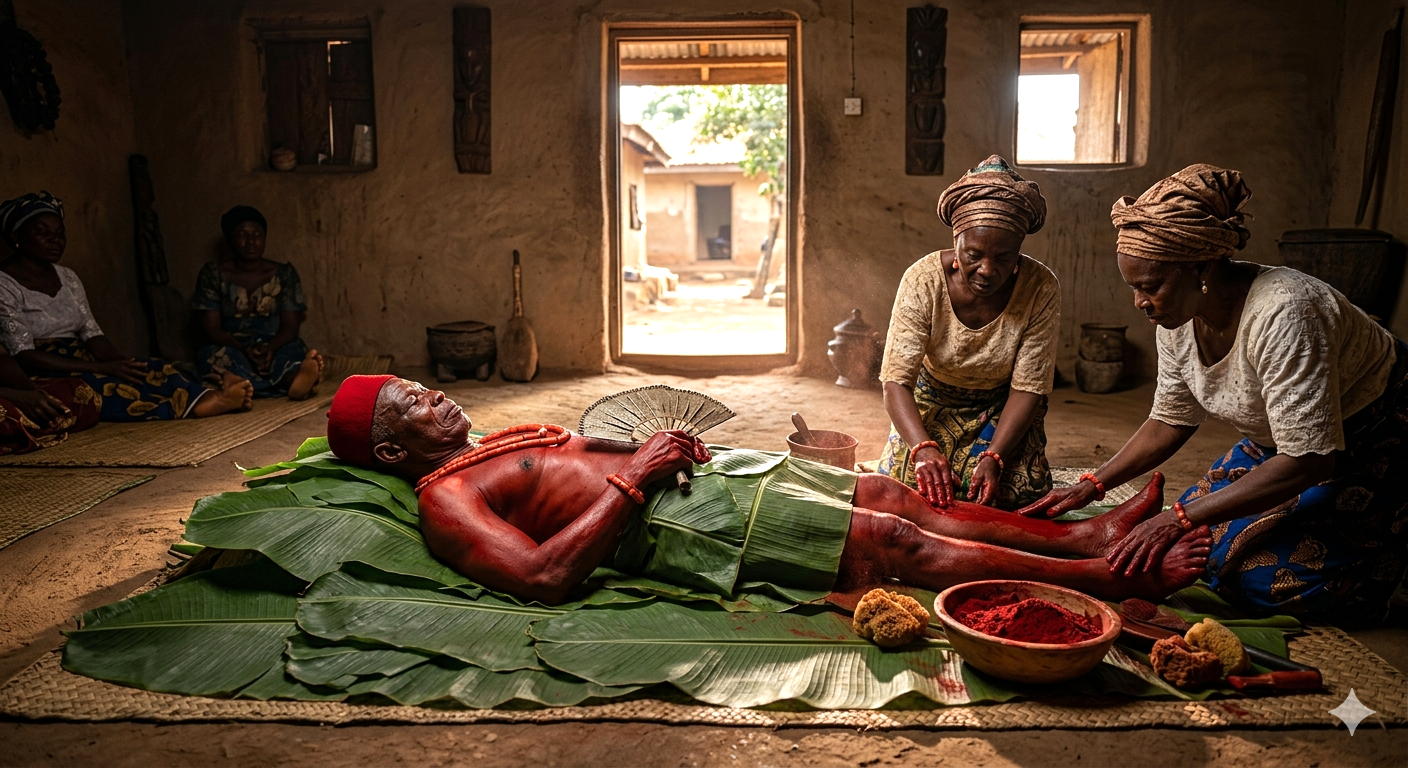
As with life (birth), death is also a highly significant event that they celebrate, viewing it as having the same influence as life itself. Immediately after someone dies, they must call the nearest kin in the family to confirm the death. That simple confirmation triggers a series of events that would keep the family very busy for the next while. Right away, they must prepare the body by following the regular funeral rites. Most times, they would immediately stretch the corpse of an elderly man or woman out on plantain leaves and sponge it down thoroughly. They then rub the body with dye made of camwood powder to mark it as sacred. The closest family members or a trusted indigenous specialist(s) hired from nearby villages are the ones to carry out these sensitive roles.
Camwood powder is red and made from the Camwood tree (osisi uhie). Depending on the method of preparation, the powder may contain various essential oils, chemicals, and minerals. In some cases, the powder may contain emollient, anti-ageing, antiseptic, antibacterial, and anti-inflammatory ingredients. The powders locally prepared by native experts for preserving a dead body would also contain various other minerals, cicatrising agents, astringent properties, as well as antispasmodic chemicals. As soon as they have completed the initial ritualistic cleaning, the body is laid out in the largest room in the home, usually the living room, with the feet facing the direction of the entryway or gate. This is critically important for them as they believe that this is a way of directing the dead as to the right exit route to take on their way to the afterlife. Sometimes ~ for the deceased woman ~ the villagers often had her seated and kept upright with the help of a wedge, in readiness to be carried, perhaps on a chair placed on a stretcher, back to her ancestral village for her burial there. It is at this point that they would take another very important step ~ this involves breaking news of the death to others outside the family. Tradition has it that when a death has occurred (especially in the case of a notable person), a certain procedure for breaking the news of this death in the community MUST be followed. The next of kin (who confirmed the death) would contact the first group of stakeholders that must be informed. That first group comprises the immediate members of the cadaver’s direct family. The second step to follow is to break the news to extended family members like the elders of the kindred and other local chiefs. The eldest son or another highly regarded male member of the bereaved family welcomes these community elders into their compound by presenting ọjị Igbo (the locally acceptable type of kola nuts) and palm wine. The leaders or juju priests among these elders and chiefs may offer prayers, and pour libations meant to beckon ancestral spirits into the home to escort the spirit of the deceased. Afterwards, there is an íkpọ Oku (summoning) where the entire village and nearby communities are invited to a kind of meeting so that the family can formally break the news to them.
This is more than a simple gathering; it is an event with its own full merits as this news, which everyone would already have heard by now, is yet to be officially broken to the general public. From here on, there would be no respite for the family because this meeting, for starters, involves presenting the invitees with lots of alcoholic drinks including fresh palm wine, gin (usually Schnapps), and the best available Kai-Kai (local moonshine, also called ogogoro or etí-etí). This meeting will also require that the family provides some food for the guests. These elders, depending on the status of the dead person, might demand that cash and livestock (chicken, goat, or even a cow) be given to them. It is only after they complete the íkpọ oku that public displays of mourning could begin in earnest.
Another important event around this time is to select some family and kindred leaders and get them to travel down to inform the deceased’s mother’s family about his passing away. They refer to this as izí ozi (the sending of a message). They must, there and then, agree on a suitable date for a select group of elders from the deceased’s mother’s kindred to come over to visit the immediate family of the deceased. Their mission is to find out EXACTLY how this death came about. On their arrival, they would receive extravagant hospitality, as this is a very important occasion for the family.
This intricate practice of inviting the deceased’s mother’s family, as well as passing on the news of his death to local villagers, serves a key purpose in the land. It helps to prevent or at least reduce the incidence of murder; it also helps the village authorities to find out if the cause of death was manslaughter. The reason is that the deceased’s mother’s kinsfolk and the local chieftains will give an impartial and credible verdict as to the cause of the death.
In the end, it means that no one goes to the grave without the exact circumstances of his demise being found out to the satisfaction of all interested parties.
In Western lands, they would regard this as an autopsy. However, the difference is apparent, as, in the West, one or two doctors or the chief medical examiner carry out this process.
Certifying the cause of death among the Igbo is nothing short of a carefully orchestrated stroll through a minefield.
Elders and chiefs from the deceased’s mother’s family would demand several large tubers of yam, goats (cows sometimes), and drinks to take home with them. Once again, the extent to which the deceased’s family provides for both the local villagers and the deceased’s mother’s family depends on the deceased’s status in his community. The more important he (or she) was, the more they would require the family to cough up before any discussion about the burial could begin. So, this is as special an event as the íkpọ oku since it involves even more alcoholic beverages, lots of high-end kola nuts, foods, cash, and livestock. When the sending of messages back and forth is completed to the satisfaction of all, the next step of this death event would begin. That next step is íkwá ozu (grieving for the dead); it is ceremonious mourning that is believed to invoke a rite of passage.
Their cultural tradition insists that death is not an end to human life. For them, death is simply a changeover to a new or better world. That is why the process of íkwá ozu is so important to them. Like the other previous steps, íkwá ozu is such a big deal; especially when someone of note dies in the community. The methods differ from one village to another, therefore in some areas, they occur long after the burial. During the period of íkwá ozu, there is also the observation of ìlọ ụlọ ákwá (returning from mourning). This is one of the individual rites of an íkwá ozu where the ada (the first female child of the deceased), eats the deceased’s favourite meal on her own, and in silence, from dawn to dusk. During all these ceremonies, the deceased’s widow(s), and sometimes, his daughter(s), must undergo ìkụ isi (shaving of heads). This will mark them out as among the primary mourners.
The worthy last resting place for a notable man is his village of birth. For a woman, it varies from one region to another and may also depend on the local status of the woman. If she was a chief or a matriarch, that changes everything. In some sections, they may lay the woman to rest at her maiden village; while in other sections, they would bury her at her husband’s ancestral village.
Some Igbo communities bury their dead among the living, that is, within the premises of the family home.
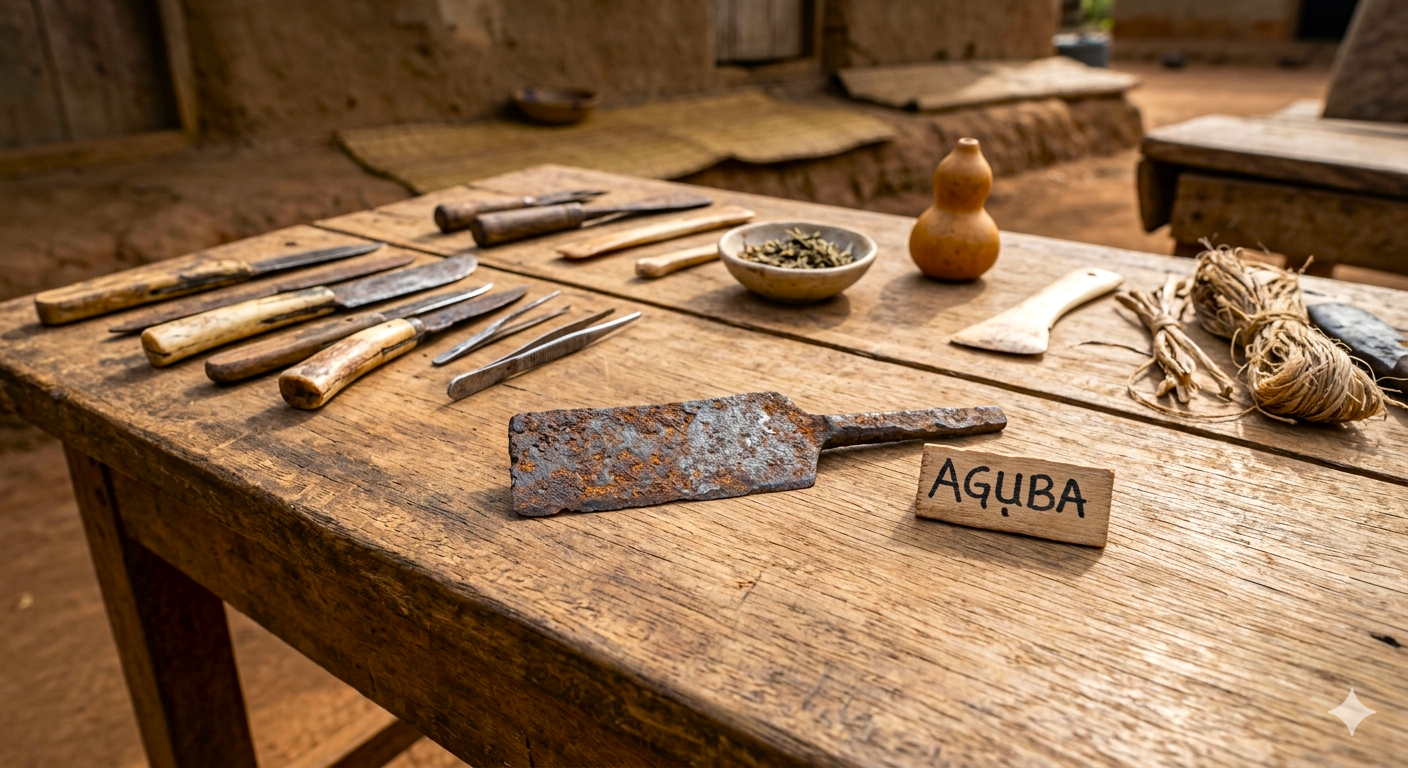
Thus, it is not uncommon to bury a dead man right in his living room or to bury a woman in her bedroom or kitchen. A great man must be buried with some of his key possessions, like his rifle (also bow & arrows), Yam peg, Yam knife, and other cherished personal items. A man very high on the social ladder, like a king, a local hero, or a traditional chief that ruled over a large area, may be buried with live animals. With a female, they might bury her with her hoe, her favourite cooking pot, and other domestic utensils. They believe that this ensures that the dead would have their most cherished possessions with them on their arrival in the afterlife.
There are severe penalties pronounced against families that vehemently refuse, or otherwise failed, to respect the traditions of the land and don’t follow through with the process of íkwá ozu. Igbo tradition contends that without íkwá ozu, the dead would miss their rightful place in the next life. Therefore, íkwá ozu is a foremost event and has arguably impoverished myriads of families.
It is common knowledge that some families have had to borrow large sums of money, give away their land on a pledge, empty their Yam barn, sell off their livestock, and sometimes, even collect a bride price well in advance of their engaged daughter being married, just to complete these ceremonies.
Without organising a rite of passage for their deceased, the family will incur the wrath of the entire village. For example, the community might forbid eligible family members from being conferred with certain traditional titles or holding an important office in the land. Then, when this individual eventually passes away, the family may not receive communal help in arranging íkwá ozu for him or her and must do it all on their own. Worse still, they believe that the spirits (including that of the deceased) will torment any obstinate or uncooperative family by inflicting various disasters on them; from diseases to other untold tragedies.
Therefore, it is very clear that among the Igbo, the event of death triggers several traditional processes, with each a highly ritualised event filled with deep mourning and several unique observations. In many communities, these rites may even include holding one or two-nights wake. The wake lasts through the night and will conclude once they have fired the cannon gunshots (ntu na-ala) the next day. Most of the rituals and rites performed on behalf of the dead serve as preparations for its passage from the world of the living into the spirit world. They insist that it is only after ALL rituals, rites, and ceremonies are successfully observed can the deceased pass from the time of íta okazi (a period of torment), into a supposed state of contentment, peace, and nirvana.
This fixation on life, and the afterlife, helped in great ways to form many of the Proverbs that controlled the core psyche of the ancient Igbo nation. However, in modern times, Christianity and social thinking have deeply infiltrated the attitudes of these rainforest dwellers, that today many of these old customs are on the wane.
(That nothing sinister seems to happen to some who ignored these ancestral observations for the sake of their newly embraced Christian beliefs, goes a very long way to prove that the longstanding obsession with life and the afterlife were misplaced).