The Igbo, The Placenta, and The Umbilical Cord
All the experienced women in an Igbo village can tell, almost immediately, that a young woman has fallen pregnant; and from then on, they monitor her. They will then calculate and predict, with striking accuracy, the time she would go into labour. At that point, they assign her a local ‘midwife’ that will guide her throughout the gestation period. This midwife administers all the needed medical interventions as she visits her regularly. As soon as there are signs that she is going into labour, the midwife is called in, and she stays with her until she gives birth.
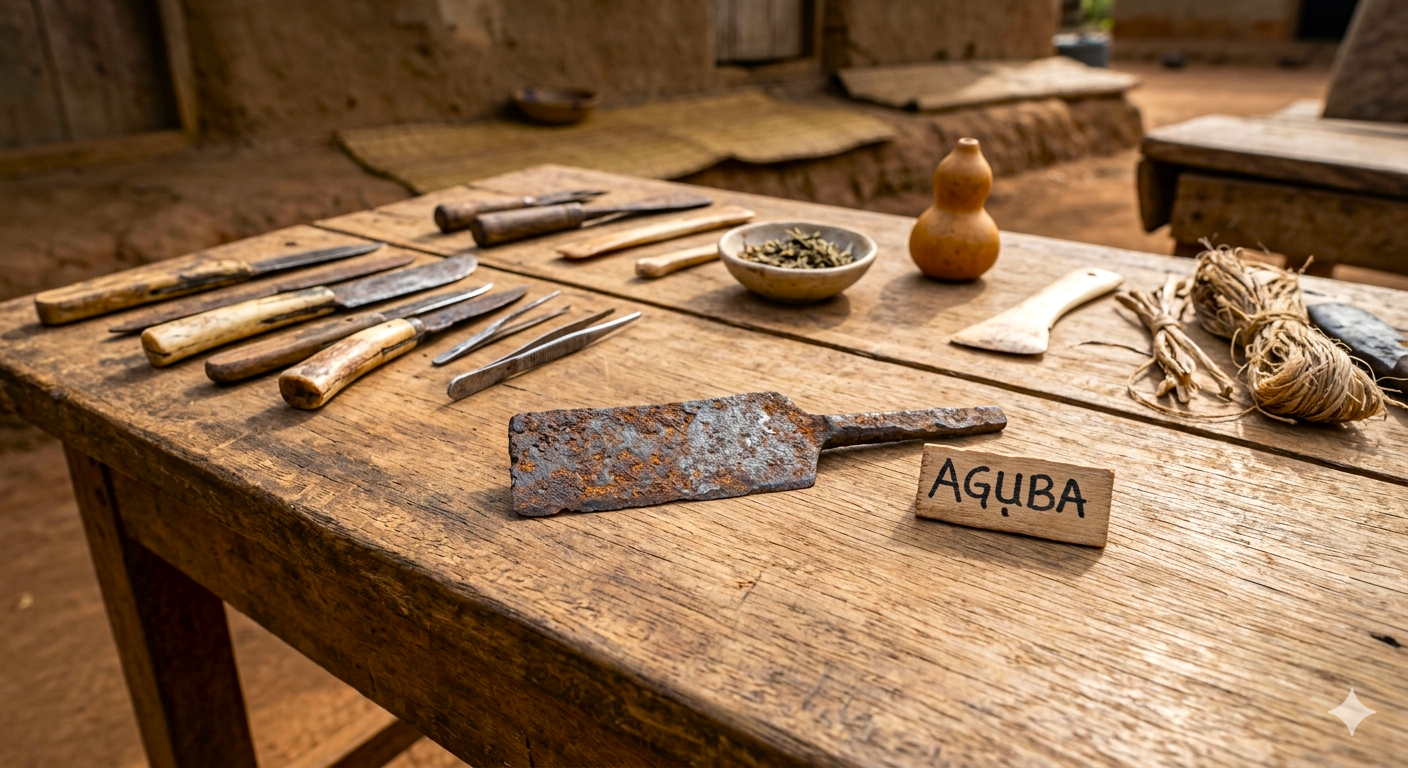
The medieval Igbo regarded the placenta (alọ nwa) to be an important part of the newborn baby; therefore, a minor event had to be observed before they buried it. The removal of the placenta at birth was and is still viewed as a noteworthy event. To carry this out, the pre-selected indigenous midwife picks out a small blade ( agụ̀ba ) from her many collections of natively produced knives. The blade must be razor-sharp and semi-circular. It is sharpened from the tip to the middle, with the base left blunt, as that will serve as a makeshift handle. Immediately after the baby comes out, she will start pretending to be looking for this knife. During that small window (in most cases) the placenta disconnects from the uterus and is delivered as well. With both the baby and the placenta out of the womb, the delivery team is split into two groups; one group attends to the mother, while the other attends to the baby and the placenta.
The midwife first grabs her wooden clamp (a rudimentary stump of dried hardwood that is split halfway through the middle) and opens it up wide enough for the cord to fit into it before she lets go. The cord is now fully clamped. One of the reasons for this traditional method of delivery is to avoid clamping and cutting the umbilical cord too soon after birth. Instead, the midwife’s play means that there must be a waiting period to allow for the placenta to be born before the cord is clamped and cut.
Delaying cord clamping also means that there is enough time for the blood in the placenta to flow to the baby through the cord. Soon though, the indigenous midwife finds the knife she was looking for, she then grabs the blade and pretends to cut too close to the base of the cord (still joined to the baby). But she must then pause (to the fake relief of all in attendance). As she pauses, she asks all the other expert midwives who are attending the delivery:
“Should I cut the cord here?”
In answer, the women would exclaim in a loud refrain:
“Ee-e! (Ọọ-ọ! Or Mba! amongst certain groups),” which means:
“No! No!”
The obstetrician would then try a second time by asking once more:
“Should I cut the cord here?”
And yet again, the response is:
“Ee-e!”
She will continue to ask as she moves her sharp blade from one point of the umbilical cord to the other until her tracing reaches the exact point where the ‘experts’ feel is the right place, which depending on the size of the baby, is anywhere between 4 to 8 inches from the baby’s belly button. The midwife would then cut it at that agreed point before tying it up with a thread. That completes the delivery process. The matriarch among these observers would then bathe the new-born, while all the other women would come out to the centre of the compound, where they form circular lines for a traditional celebratory dance. As they dance, they would sing a local chorus at the top of their voices. Their loud chants ring out across the rainforest to the hearing of other women who would each leave whatever they were doing to come over and join the group that witnessed the delivery.
By the time they conclude the dance, the baby is already wrapped in locally-made and very soft type of Akwete or other clothing material. At that point, they will proceed to bury the placenta. It must be buried somewhere within the compound as ‘the official site of the birth.’
For some Igbo groups, the event of burying the placenta calls for a significant celebration. In most cases, it is buried at the root of a young tree that is locally regarded as a cash tree, and it automatically becomes the kid’s unchallengeable first biological property. There are slight variations in how this event is observed among different groups. Some Igbo sections would now keep both mother and baby secluded from the general members of the village as their carers use this period of seclusion to meticulously tend the other end (stump) of the baby’s umbilical cord until it comes off some days later. To speed up the detaching of the umbilical cord, the carers, or other experienced elderesses, must boil palm oil or palm kernel oil with several herbs and spices, which MUST include negro pepper (Ụda). They would then apply this special oily ointment two or three times a day on the umbilical cord until it falls off in 5 to 10 days.
As in the placenta's case, the umbilical cord stump is also buried in a specific manner; but as always, at the foot of a young, profitable tree.
The adults will dig the hole, and the child, who is now around a year old, is handed the dried-out stump of the umbilical cord. The child then drops it into the hole before they cover it with soil. From then on, that tree becomes the child’s plant or a ‘second’ property.
Several other ritualistic observations and rites would follow as a way of welcoming and integrating the child into the local spiritual and cultural life. Yet again, if the child is a male, there would be a celebration on the eighth day of its birth, which is circumcision day. Irrespective of gender though, other subsequent events are observed depending on the economic position of the family. For example, they might throw a naming party, an age grade celebration, a rite of passage into adulthood celebration, and depending on their part of Igbo land, there could also be a lavish bash to observe the child’s scarification (clannish face marking). The marks on the face were used to identify the subtribe, the family line, and sometimes, the traditional religious affiliation of the clan the child is born into.
This fixation on life helped in great ways to form many of the practices that controlled the core psyche of the ancient Igbo nation. However, in modern times, Christianity and social thinking have deeply infiltrated the attitudes of these rainforest dwellers, that today many of these old customs are on the wane.