Aba and British Rule
A Rare Window into Igbo Resistance, Colonial Power, and the Making of Modern Eastern Nigeria
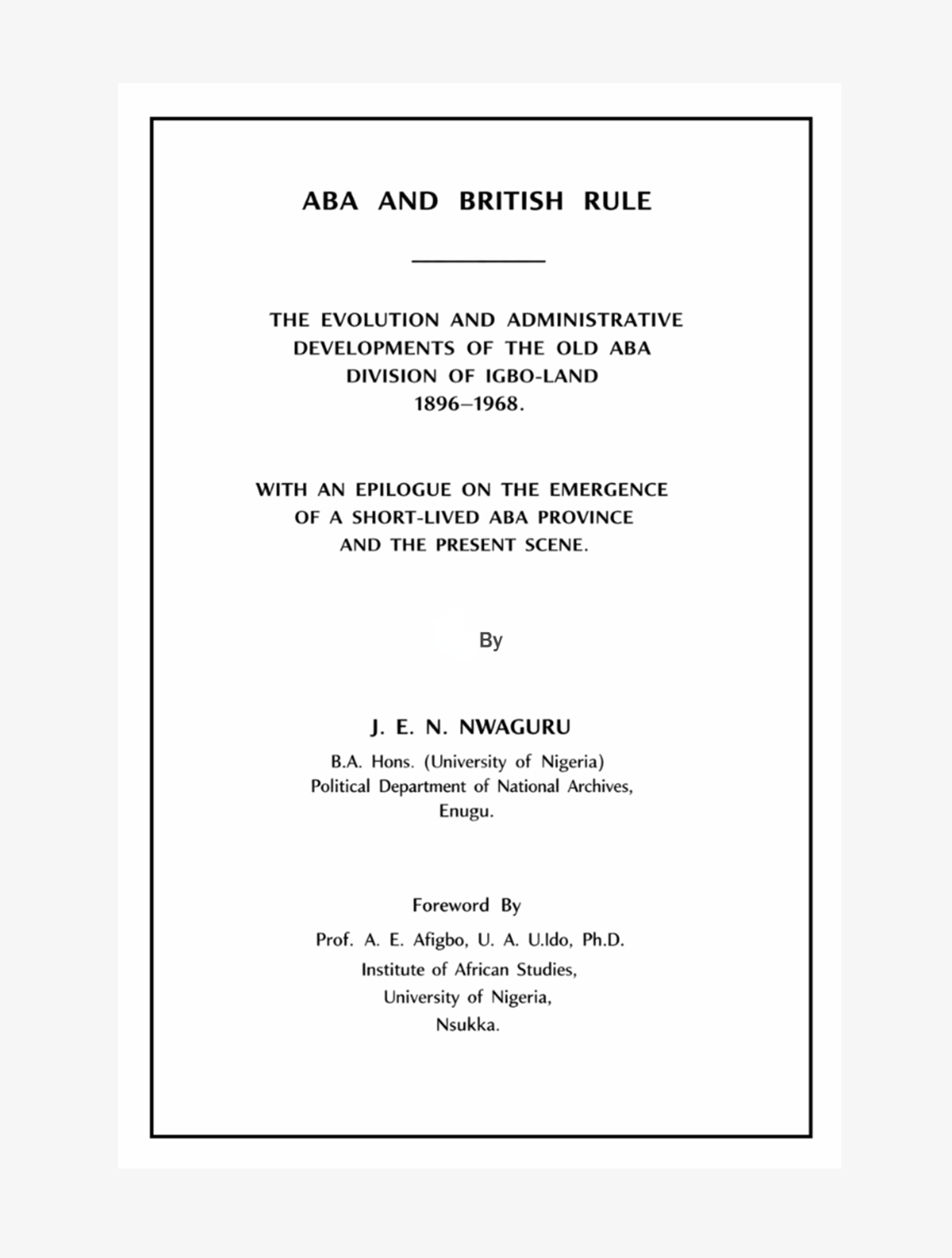
In the pantheon of African historical scholarship, few works achieve the dual distinction of being both a rare bibliographic treasure and an indispensable source for understanding the settler encounter. Nwaguru’s *Aba and British Rule: The Evolution and Administrative Developments of the Old Aba Division of Igboland, 1896-1960* is precisely such a work. Published in 1973 in Enugu, Nigeria, this volume stands as a cornerstone of Igbo chronicle, offering an unrivalled administrative history of one of the most politically volatile regions in colonial Nigeria. More than a mere historical monograph, it serves as a documentary testament to one of the most consequential episodes in Igbo and Nigerian history: the Aba Women’s War of 1929, often described as the first major anti-colonial uprising in West Africa led entirely by women. For the collector, the historian, and the student of empire, this book represents far more than a chronicle of colonial governance; it is a meticulously documented narrative of resistance, adaptation, and the reshaping of indigenous institutions.
The scarcity of Aba and British Rule contributes significantly to its mystique. Printed by a publisher identified only as “[s.n.]” (sine nomine, or “without name”) in Enugu, the book was not produced by a major international academic press but was issued locally, a characteristic typical of many pioneering post-independence African scholarly works. Its distribution was therefore limited, and surviving copies in institutional libraries are few, held primarily in major research collections in Australia and the United States and, presumably, in a handful of Nigerian archives. This rarity stems from several factors: limited initial print runs, restricted circulation that often confined copies to colonial offices or academic institutions, and the loss and deterioration common to publications not preserved under ideal archival conditions. The physical volume itself is a modest yet significant artefact. Extending to 254 pages, it includes a single folded leaf of plates, as well as in-text illustrations and maps that are crucial for visualising the administrative boundaries and geographical context of the old Aba Division. The inclusion of a folded map, often missing in ex-library copies, makes a complete edition particularly desirable for collectors. The book was published with a substantial bibliography spanning pages 247 to 253, attesting to Nwaguru’s exhaustive engagement with primary sources, including colonial reports, correspondence, and oral testimonies.
The authority of Aba and British Rule is anchored in the credentials of its author, Johnson Elewhemba Nnata Nwaguru (1935–2022), and the endorsement of his mentor, the legendary historian A. E. Afigbo, who contributed the foreword. Nwaguru was not an armchair historian; he was a product of the pathbreaking Department of History at the University of Ibadan, the institution that nurtured a generation of nationalist historians who revolutionised the study of African history by centring African agency. The presence of Afigbo’s foreword is a powerful indicator of the book’s intellectual lineage. Afigbo, often called the “dean of Igbo history,” was a towering figure whose own work on the Warrant Chief system and the Igbo hinterland laid the groundwork for Nwaguru’s more focused administrative study.
The book’s full title precisely delineates its scope: *Aba and British Rule: The Evolution and Administrative Developments of the Old Aba Division of Igboland, 1896-1960, with an Epilogue on the Emergence of a Short-lived Aba Province and the Present Scene*. Nwaguru’s project is an exhaustive administrative history, tracing the transformation of a segment of Igbo society from the eve of formal British colonisation to the dawn of Nigerian independence. The work is structured to guide the reader through the labyrinthine processes of colonial state-building. It begins by examining the pre-colonial political and social landscape, providing a necessary baseline from which to measure the disruptions of British rule. The narrative then follows the establishment of colonial control from 1896, detailing the often-violent process of “pacification” and the subsequent imposition of the Native Administration system. A significant portion of the book is dedicated to the controversial Warrant Chief system, a flawed attempt to govern through appointed “traditional” rulers where no centralised pre-colonial authority existed. The Igbo, with their decentralised political systems and strong traditions of communal decision-making, were particularly resistant to these imposed hierarchies. Nwaguru’s analysis, informed by Afigbo’s seminal work, critically exposes how this system fundamentally distorted Igbo political culture, creating authoritarian figures where governance had previously been consensual and diffuse.
Crucially, Aba and British Rule provides the essential administrative context for understanding the pivotal event of the region: the Women’s War of 1929, known in Igbo as Ọgụ Ụmụnwaanyị. This was not merely a protest but a sophisticated mobilisation of thousands of women who leveraged traditional forms of collective action, such as “sitting on a man,” to challenge colonial authority. While other scholars have focused on the social and gendered dimensions of that uprising, Nwaguru’s strength lies in meticulously detailing the colonial policies, particularly the proposed census and taxation of women, that served as its immediate catalyst. The book meticulously documents the imposition of Warrant Chiefs, the introduction of direct taxation which threatened economic autonomy, and the erosion of women’s traditional political institutions, such as the Mikiri and Ụmụada councils. By situating the Aba disturbances within these broader structural pressures, the book reveals the uprising not as a spontaneous riot but as a coordinated, ideologically grounded resistance movement. It highlights the organisational genius of Igbo women, who communicated across vast distances without modern tools, and details the brutal colonial response, including shootings, arrests, and punitive expeditions. Nwaguru situates the war as the inevitable consequence of decades of administrative mismanagement, economic exploitation, and cultural insensitivity. He traces the fallout from the protests, including the abolition of the Warrant Chief system and its replacement by a system of Native Authorities, showing how colonial policy was forced to adapt, however imperfectly, in the face of mass local resistance. The temporal scope extends through the era of indirect rule up to 1960, concluding with an epilogue that reflects on the short-lived Aba Province and the contemporary situation in the early years of Nigerian independence, providing a bridge from the colonial past to the challenges of the post-colonial present.
The importance of Aba and British Rule transcends its administrative detail. It is a classic work in the school of Ibadan historiography, which sought to restore the narrative of African history to Africans. Nwaguru’s work is a direct counterpoint to colonial histories that depicted Africans as passive recipients of British civilisation. Instead, he portrays the people of the Old Aba Division as active agents, whether resisting through the Women’s War, adapting to new economic realities, or navigating the complex political structures imposed upon them. Furthermore, the book serves as a crucial archive; his research drew upon oral traditions and local knowledge that might otherwise have been lost. By documenting the names, lineages, and political manoeuvrings of local figures, he preserved a layer of history often absent from official files. For the Igbo people, whose history was long dismissed by western anthropologists as headless and therefore “ungovernable,” this book provided an empirical foundation for a sophisticated political history, demonstrating the deep logic of their precolonial institutions and the resilience of their social fabric in the face of external pressure.
Once again, Aba and British Rule is indispensable for any serious study of the Women’s War of 1929, an event whose historiography has grown immensely since the book’s publication. While later works, such as those by Judith Van Allen, Marc Matera, Misty L. Bastian, and Susan Kingsley Kent, and the monumental volume by Toyin Falola and Adam Paddock, have provided deeper analyses of the war’s symbolism, gender dynamics, and its place in global Black awakening, they all stand on the shoulders of foundational administrative histories like Nwaguru’s. Van Allen’s seminal essay, “‘Aba Riots’ or Igbo ‘Women’s War’? Ideology, Stratification and the Invisibility of Women,” famously critiqued the colonial nomenclature and restored the agency of the female participants, arguing that the war was a direct result of the colonial system’s blindness to women’s preexisting political institutions such as the Mikiri. Nwaguru’s work provides the granular administrative backdrop against which this “invisibility” was so consequential; detailing the workings of the Native Courts and the Warrant Chiefs that the women targeted, explaining why these institutions were seen as illegitimate. Without this foundational understanding of the colonial administrative framework, the sophistication of the women’s political strategy, including their burning of courts and attacks on specific chiefs, cannot be fully appreciated.
The legacy of Aba and British Rule continues to resonate. In recent scholarship, the Women’s War has been reinterpreted not only as a pivotal anti-colonial moment but also as a foundational event in the history of global Black feminism. As Rodney Coates notes in contemporary discourse, the organising tactics of Nigerian women in the 1929 revolt, leveraging market networks, engaging in mass protest, and challenging patriarchal authority, have been cited as an inspiration for modern movements like the #Metoo, as well as the #EndSARS protests of 2020. This lineage of resistance, which links the market women of Aba to the Feminist Coalition of the twenty-first century, is traceable through the historical record that works like Nwaguru’s helped to establish. For contemporary Igbo communities, the book is a reminder of a proud legacy of resistance, unity, and political sophistication. It preserves the voices of women who refused to be silenced, the complexities of Igbo–British encounters, and the lived realities of communities navigating profound change.
Finally, Aba and British Rule is far more than a rare book for the collector’s shelf; it is a invaluable text that encapsulates a critical moment in Nigerian and African chronicle, and as we have seen, its value lies in its exhaustive detail, its authoritative authorship, and its essential role in documenting the complex interplay between western administrative systems and Igbo societal structures. For anyone seeking to understand the colonial history of south-eastern Nigeria, the roots of the Women’s War, or the intellectual project of reclaiming African history, J. E. N. Nwaguru’s work remains an incisive, authoritative, and indispensable source. To engage with this book is to encounter the intellectual and moral courage of a generation that refused to accept imposed subjugation; it remains a profoundly important work, its rarity only deepening its value as a guardian of memory and a testament to Igbo agency.
– Dandy Ahuruonye
(Dear reader, I am reaching out to the wider community with a sincere and urgent request: If you happen to own a copy (digital or hard copy) of Aba and British Rule or if you know someone who may have access to it, I would be profoundly grateful for your assistance in helping me establish contact. This work is of exceptional importance to my ongoing research into Igbo history and the legacy of anti‑colonial resistance, and locating a copy would be of immense value. Should you have any relevant information, no matter how small, or know of anyone who might be able to help, please kindly get in touch with me at: [email protected]. Thank you in advance for your kindness; your help could make a meaningful contribution to preserving and understanding a vital chapter of our shared history).