
Portrait of a Man with Carved Wooden Door
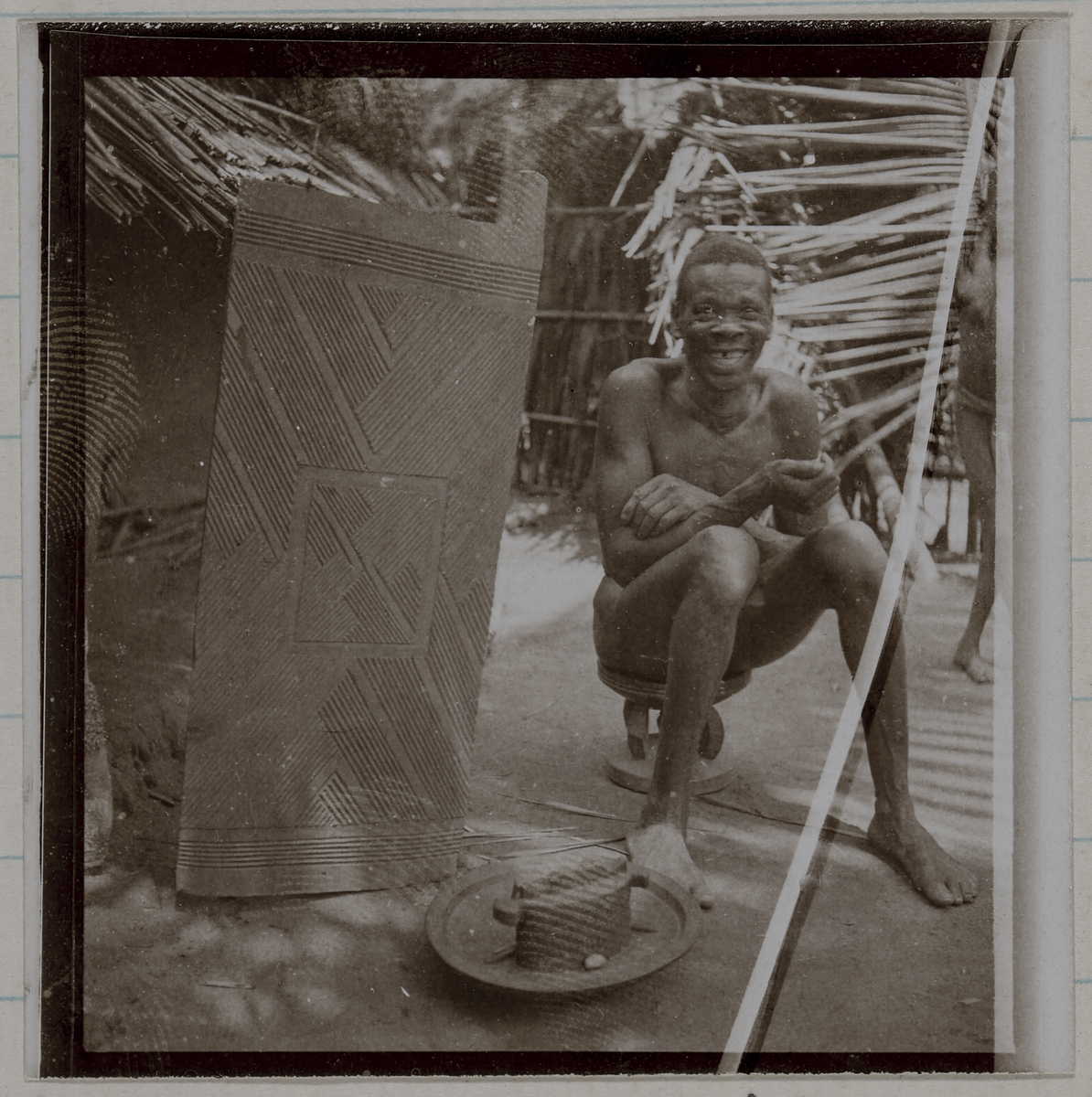
A black-and-white photograph depicting an adult male seated on a low, tripod-style carved wooden stool. To his left is a large, vertical rectangular wooden panel featuring extensive geometric relief carving, including parallel linear grooves, a central square field with intersecting diagonal lines, and chevron patterns. The subject is shirtless and smiling, positioned in front of a structure made of organic materials with a thatched roof and walls of fibrous plant matter. In the foreground, a shallow circular tray and a small cylindrical carved object are visible. The image records the artistic tradition of carved wooden panels, known as mgbo ezi, from Isuochi, Onitsha province, as documented by G.I. Jones between 1932 and 1938.
Community Notes

Onyeka Nwokike
Sep 01, 2026
The carved wooden panels, known as mgbo ezi, were typically crafted from slabs of the sacred, termite-resistant oji tree, also known as African oak or iroko. According to Igbo Carved Doors: Long Lost Precolonial Relics of Ancient Igbo, these panels usually measured between 1 and 1.5 meters in height and nearly a meter in width. Multiple panels were often joined using local metalworks to serve as a gate at the entrance of a home.
Onyeka Nwokike
Sep 01, 2026
These intricately carved doors served as symbols of status and honor, particularly for elders within the Ọzọ institution, which represents the highest spiritual and social stratum in Igboland. As detailed by Anonymous Igbo artist, Panel, "Mgbo Ezi", such panels provided the architectural focus for elaborate walled compounds housing several nuclear families. The geometric sophistication of these works is believed to have been influenced by other Igbo art forms, specifically ichi and uli.
Onyeka Nwokike
Sep 01, 2026
The subject is associated with Isuochi, a community that traces its ancestry to a forebear named Ochi. As noted in Cultural Identity of Isuochi: Origins, Practices, Attractions, and Uri Body Art, Isuochi belongs to the Isu subgroup of the Igbo people.
Log in to add context.
Explore Further
Discover related books and stories to deepen your understanding.

Art of Eastern Nigeria
By G.I. Jones

Igbo Arts: Community and Cosmos
By Herbert M. Cole and Chike G. Aniakor

Groundwork of the History and Culture of Onitsha
By S. I. Bosah

The King in Every Man: Evolutionary Trends in Onitsha Ibo …
By Richard N. Henderson

IKENGA QUEST: One Man's Quest for His African Heritage
By Gerald Oluchi Ibe

An Introduction to Nigerian Traditional Architecture: South-Eastern Nigeria: The Igbo-speaking …
By Z.R. Dmochowski

An African Popular Literature: A Study of Onitsha Market Pamphlets
By Emmanuel N. Obiechina
A Man of the People
By Chinua Achebe

Lessons From Vernacular Architecture in Nigeria
By Joyce Lodson
Drums, Dust, and Departure: Cultural Meanings of Death among the …
By Dandy Ahaoma Ahuruonye
The Igbo, The Placenta, and The Umbilical Cord
By Dandy Ahaoma Ahuruonye
You May Also Like
Market Scene with Yams
Construction of Brick Buildings by the Royal Niger Company
By William Henry Crosse
Interior View of a Chief's Compound
Nwamno Figure from Ogume Village
By G.I. Jones
Landscape of the Niger River near Asaba
By William Henry Crosse
Group Portrait at a Royal Niger Company Station
By William Henry Crosse
Igbo Musical Band in Cross River Area
By G.I. Jones
Two Ikenga Figures from Nri Awka Igbo
By G.I. Jones
Portrait of an Igbo Man
By G.I. Jones
No comments yet. Be the first to share your thoughts!