

Earthwork Structures and Wooden Barrels along the Niger River

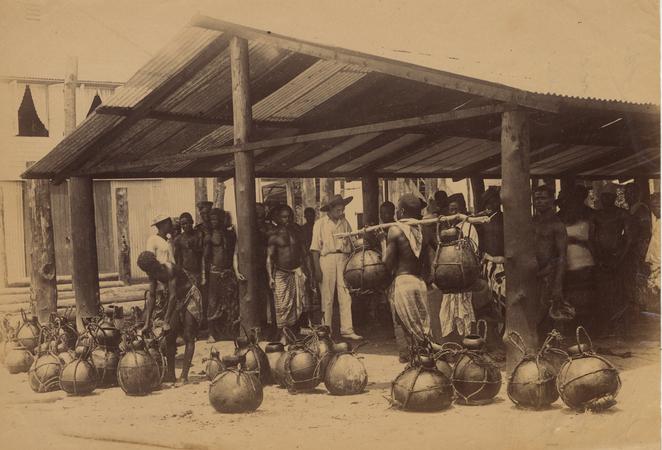
A photograph depicting a site featuring linear earthwork enclosures or partitioned embankments made of compacted soil. Several cylindrical wooden barrels are placed upright or tilted near the center, with one positioned horizontally in a depression. A temporary shelter consisting of light-colored fabric over a frame is visible on the right. The landscape includes tropical vegetation with palm-like trees and a large body of water in the background. The image was captured by William Henry Crosse during his time as Principal Medical Officer for the Royal Niger Company.
Community Notes

Onyeka Nwokike
Apr 27, 2026
During this period, the company maintained a monopoly on the salt trade, importing bulk salt to exchange for local produce. Infrastructure at primary depots, such as Akassa, typically featured salt stores and these puncheons along the riverbanks. This trade environment was marked by volatility, exemplified by the 1895 Akassa Raid where local Brass people burned the company's oil and salt stores.
Onyeka Nwokike
Apr 27, 2026
Palm oil was the original oil driving commerce along the Niger River long before crude oil took over. The Royal Niger Company built its monopoly by controlling this exact trade. The wooden barrels in the photograph are puncheons. Shippers used them to transport millions of gallons of palm oil and kernels to Europe. Overseas factories relied on this oil to make soap and grease heavy machinery during the Industrial Revolution.
Log in to add context.
Explore Further
Discover related books and stories to deepen your understanding.

Trade Winds on the Niger: Saga of the Royal Niger …
By Geoffrey L. Baker

Under the Udala Trees
By Chinelo Okparanta
Happiness, Like Water
By Chinelo Okparanta

Chike and the River
By Chinua Achebe

The Rise of British Colonialism in Southern Nigeria, 1700-1900: A …
By Kalu E. Ume

The Gospel on the Banks of the Niger: Journals and …
By Samuel Crowther and John Christopher Taylor

Igbo market literature
By Sebastian Okechukwu Mezu
Encyclopaedia of Igbo Artefacts
By Dandy Ahaoma Ahuruonye

The House of Skulls: A Symbol of Warfare & Diplomacy …
By Nkparom C. Ejituwu and Stanley I. Okoroafor
You May Also Like
Feathered Headdress Ogonya Play
By G.I. Jones
Interior View of a Chief's Compound
Ikem Masquerade Play in Umuahia
By G.I. Jones
Ugie Ewere Festival Song
By Northcote Thomas
Study of Igbo Wooden Mask
Portrait of a Woman in Striped Cloth
By William Henry Crosse
Questionnaire on Dolls
By Northcote Thomas
Pyramids at the Nsude Village Shrine, Abaja Igbo, Northern Igbo
By G.I. Jones
Group Portrait of Titled Igbo Men
No comments yet. Be the first to share your thoughts!