
Ngbangba Ikoro Masquerade at Abiriba
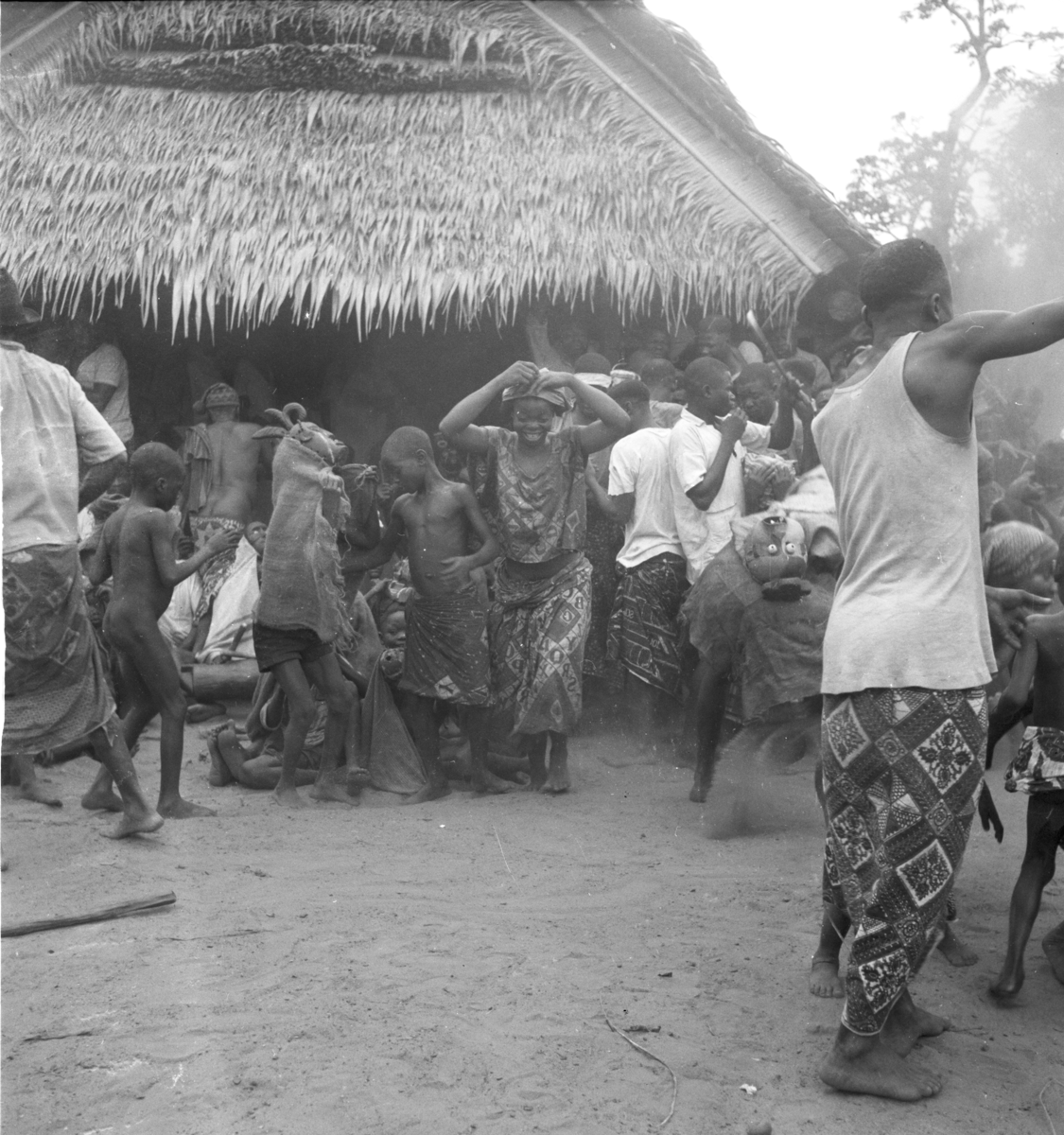
This black-and-white photograph by G.I. Jones shows the Ngbangba Ikoro masquerade at Abiriba, circa 1930s. The scene depicts performers and spectators outside a traditional thatched building. One figure wears a dark wooden mask painted white with horns, attached to woven sackcloth. A young boy touches this character. Another rounded mask with white bulbous eyes appears upside down. The audience includes women, men, and children wearing printed cloths. Jones documented that Abiriba carvers created masks for this masquerade, with copyright shared among carving families. The principal dancer, Otiri, wore a mask on his head adorned with feathers, his face covered by a raffia bag, with arms and legs painted in white chalk and yellow.
Community Notes

Onyeka Nwokike
Apr 19, 2026
Abiriba was a hub for craftsmen and traders, producing carvers who worked in both a local style and one they insisted was Ibibio. The town is also noted for the introduction of Ukara, a resist-dyed imported baft cloth. According to MAA Cambridge, the community also specialized in the production of ornamental bowls, dishes, and drums.
Onyeka Nwokike
Apr 19, 2026
The Ngbangba Ikoro performance involved a band of over twenty boys and young men who used metal gongs and clappers. In addition to the principal dancer, the ensemble included two clowns who wore masks over their faces. For the dancer Otiri, specific ritual colors were applied: white chalk (Nzu) on the right arm and left leg, and yellow (Odo) on the opposite limbs. This performance is linked to the Iri Ama festival.
Onyeka Nwokike
Apr 19, 2026
Within the Abam and Ohaffia regions, many communities adopted Ekpe (Egbo) masquerades and the Cross River-style skin-covered heads known as Ajonku. In contrast, the Ngbangba Ikoro of Abiriba featured masks carved in local variations of the Lower Niger style. As detailed by Ozikoro, these distinctions reflect a complex network of cultural exchanges and local identities.
Log in to add context.
Explore Further
Discover related books and stories to deepen your understanding.

Art of Eastern Nigeria
By G.I. Jones

Igbo Art And Culture: And Other Essays
By Simon Ottenberg

Mbari: Art and the Life Among the Owerri Igbo
By Herbert M. Cole

On Black Sisters' Street
By Chika Unigwe

Igbo Arts: Community and Cosmos
By Herbert M. Cole and Chike G. Aniakor

Half of a Yellow Sun
By Chimamanda Ngozi Adichie

DIRT ON WHITE SPECTRUM: Myths, Travails and Legacies of Eze …
By Chukwuemeka Ifeanacho Onyesoh

Lessons From Vernacular Architecture in Nigeria
By Joyce Lodson

Igbo (Visions of Africa Series)
By Herbert M. Cole
You May Also Like
Entrance to an Igbo Farmer's House near Nnewi
By Edward Harland Duckworth
Painted Courthouse Mural at Nri
By Edward Harland Duckworth
Dancer Wearing Fish Mask
By G.I. Jones
Family Group Portrait by William Henry Crosse
By William Henry Crosse
Igbo Dancer Performing Agaba Masquerade
By Edward Harland Duckworth
Boys' Initiation Dance in the Nri Akwa Area
By G.I. Jones
Aro Women
By Rev. William T. Weir
Portrait of Soldiers Outside Barracks
By William Henry Crosse
An Igbo Elder from Awka, Wearing a War Helmet and …
By Northcote Thomas
No comments yet. Be the first to share your thoughts!