

Preserving the Past,
Inspiring the Future
Explore the rich cultural heritage of the Igbo people through our comprehensive digital archives, community lore, and educational resources.
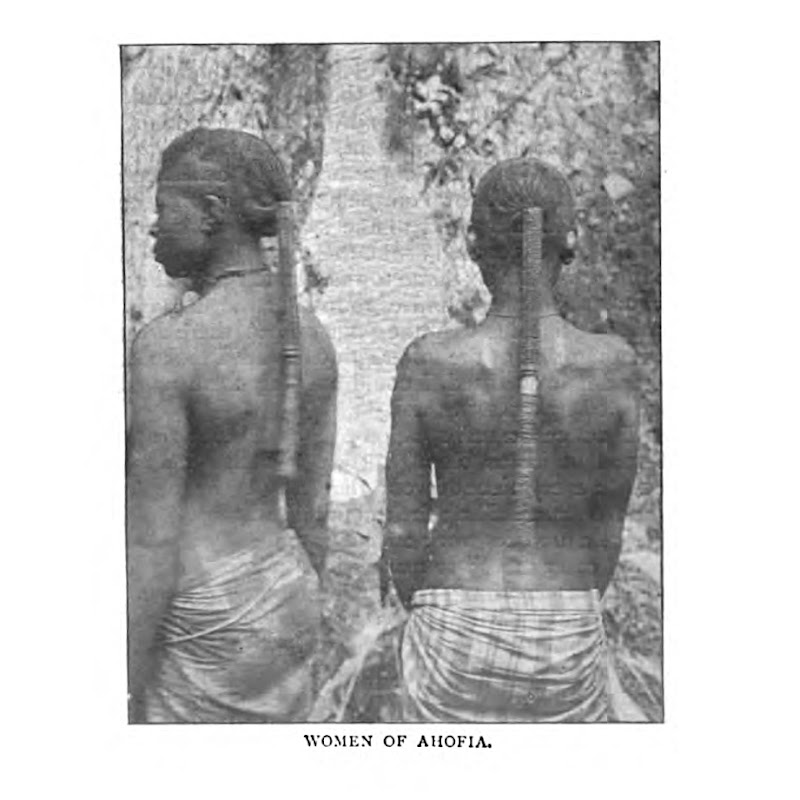
Ohafia Women with Traditional Long Braids
A photograph depicting two Ohafia women from a posterior perspective, showing traditional long braids that extend from the head down the spinal column. The subjects have bare upper torsos and wear light-colored fabric wraps around the hips. The image originates from The Women's Missionary Magazine of the United Free Church of Scotland, 1904. This cultural practice is associated with Ohafia, where historical records and folktales mention women warriors known as dike nwaàmị̀.
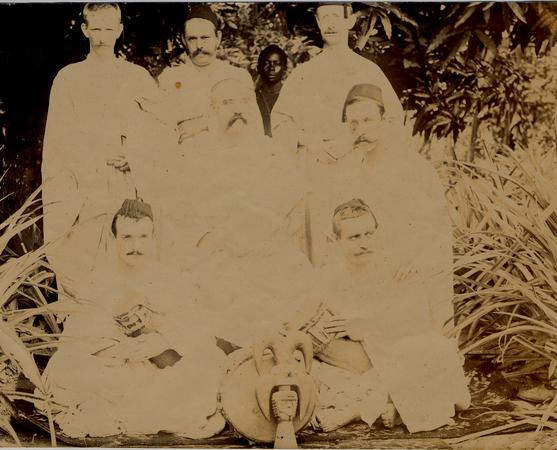
Group Portrait with Igbo Masquerade Headdress at Fort Salisbury
A black-and-white albumen print photograph depicting a staged group of approximately eight men in an outdoor tropical setting with dense foliage. The group includes subjects standing, seated, and kneeling, with several men wearing light-colored, long-sleeved collared tunics and two wearing dark, cylindrical headgear. Two men seated on the ground hold drums, and an Igbo masquerade headdress with circular features and carved ocular cavities rests on the ground in front of a drum. The image exhibits chemical degradation and fading in …
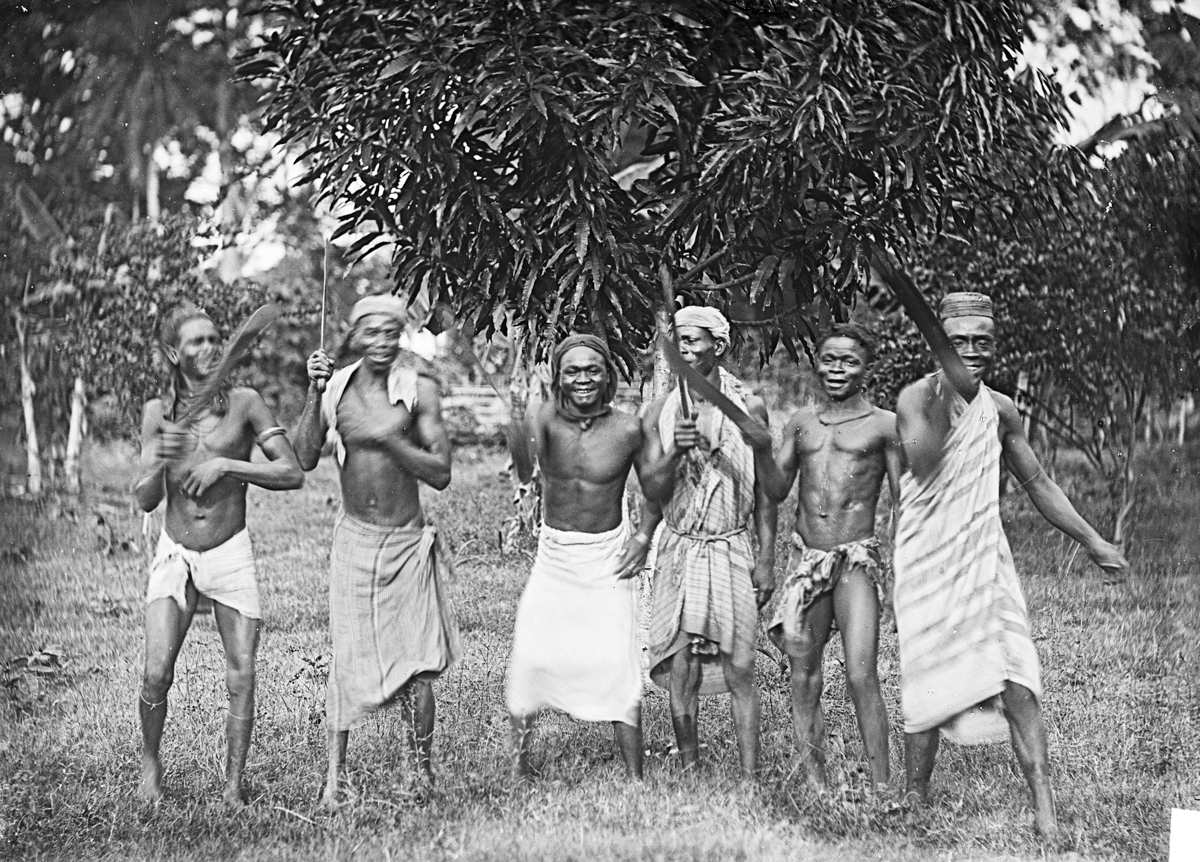
Group Portrait of Six Men in the Onitsha Area
A monochromatic photograph from circa 1886 to 1895 showing six male subjects in a linear arrangement in a wooded outdoor environment. The subjects wear various waist wraps, some featuring geometric patterns, and several utilize headwraps or caps. Two subjects hold large, curved, single-edged blades, while others hold long, thin rods or implements. The image was taken by William Henry Crosse, Principal Medical Officer of the Royal Niger Company, and was later identified by G.I. Jones as depicting individuals in the …
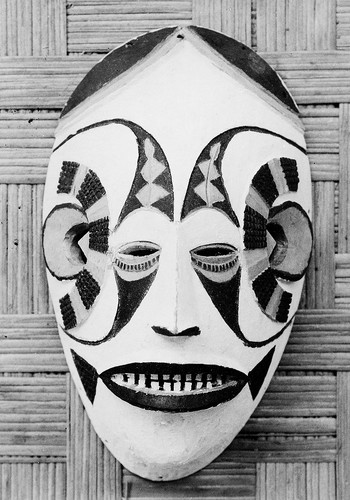
Agbogho Mmo Maiden Spirit Mask
A photograph depicting an anthropomorphic mask, identified as an Abogho Mmo (maiden spirit) mask. The mask is characterized by an elongated, ovoid silhouette with a pointed peak and bilateral symmetry. It features a light-valued base, likely white pigment, with dark, high-contrast markings including symmetrical arcs and geometric diamond motifs on the cranial region. The ocular region consists of two almond-shaped apertures with downward-sweeping lines, and the mouth is a wide, horizontal oval containing a row of light-valued rectangular shapes simulating …
Igbo Woman with Elaborate Geometric Hairstyle
This photograph, taken by Northcote Thomas around 1910 as part of his anthropological documentation, features an Igbo woman with an elaborate geometric hairstyle. In Igbo culture, hairstyles often signified age, social status, and marital status, offering insight into personal adornment practices in early 20th-century Igbo society.

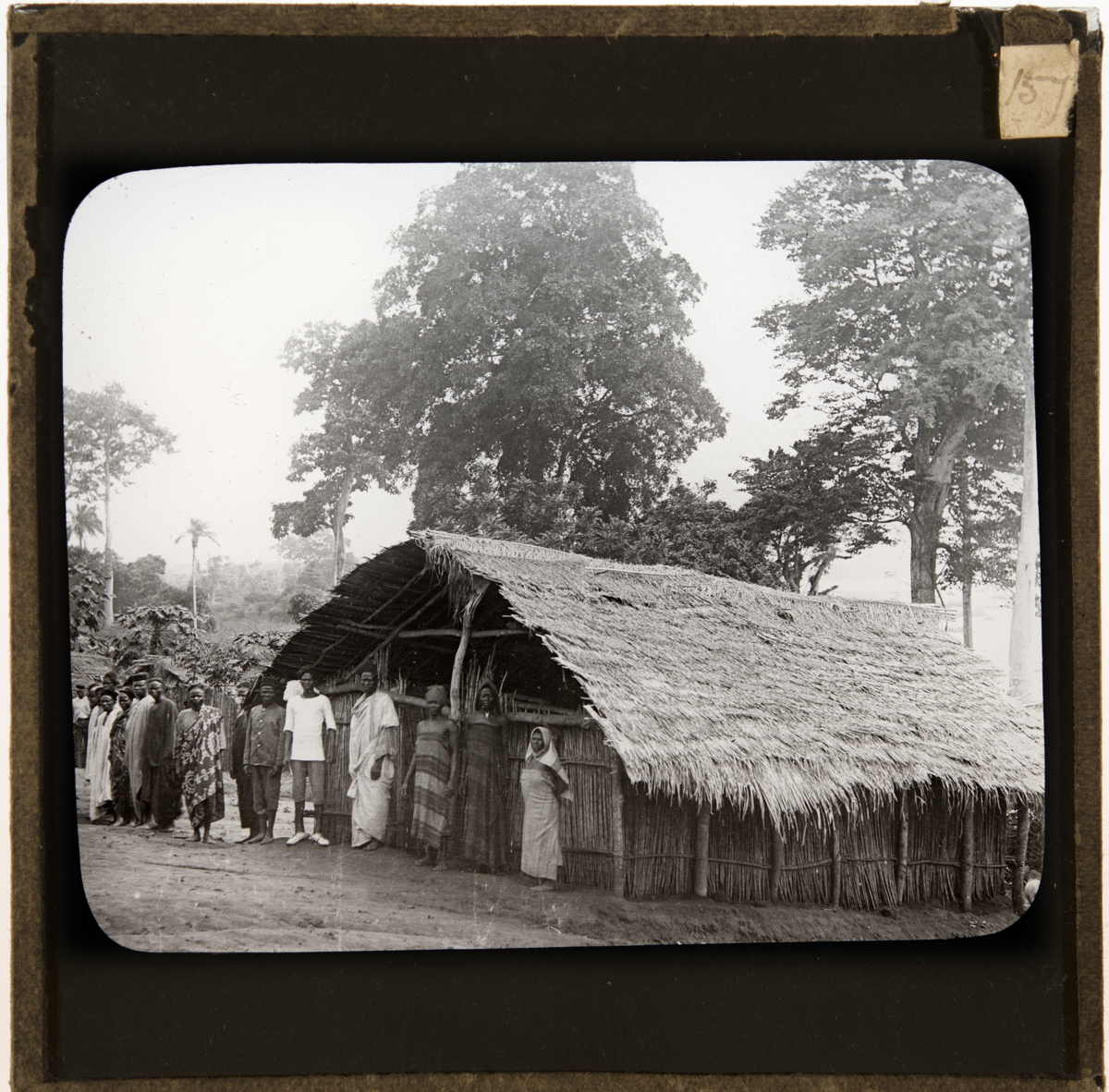
Group Portrait from Royal Niger Company
A photograph depicting approximately 13 individuals standing in a horizontal line before a long, low-profile building. The structure features a steeply pitched gabled roof made of thatch or plant fibers and walls constructed from vertical organic elements such as reeds or wooden poles. The subjects exhibit a variety of clothing, including traditional wrapped textiles with geometric or organic motifs, and Western-influenced attire such as button-down shirts, shorts, and trousers. The setting is characterized by a flat, unpaved earth surface and …
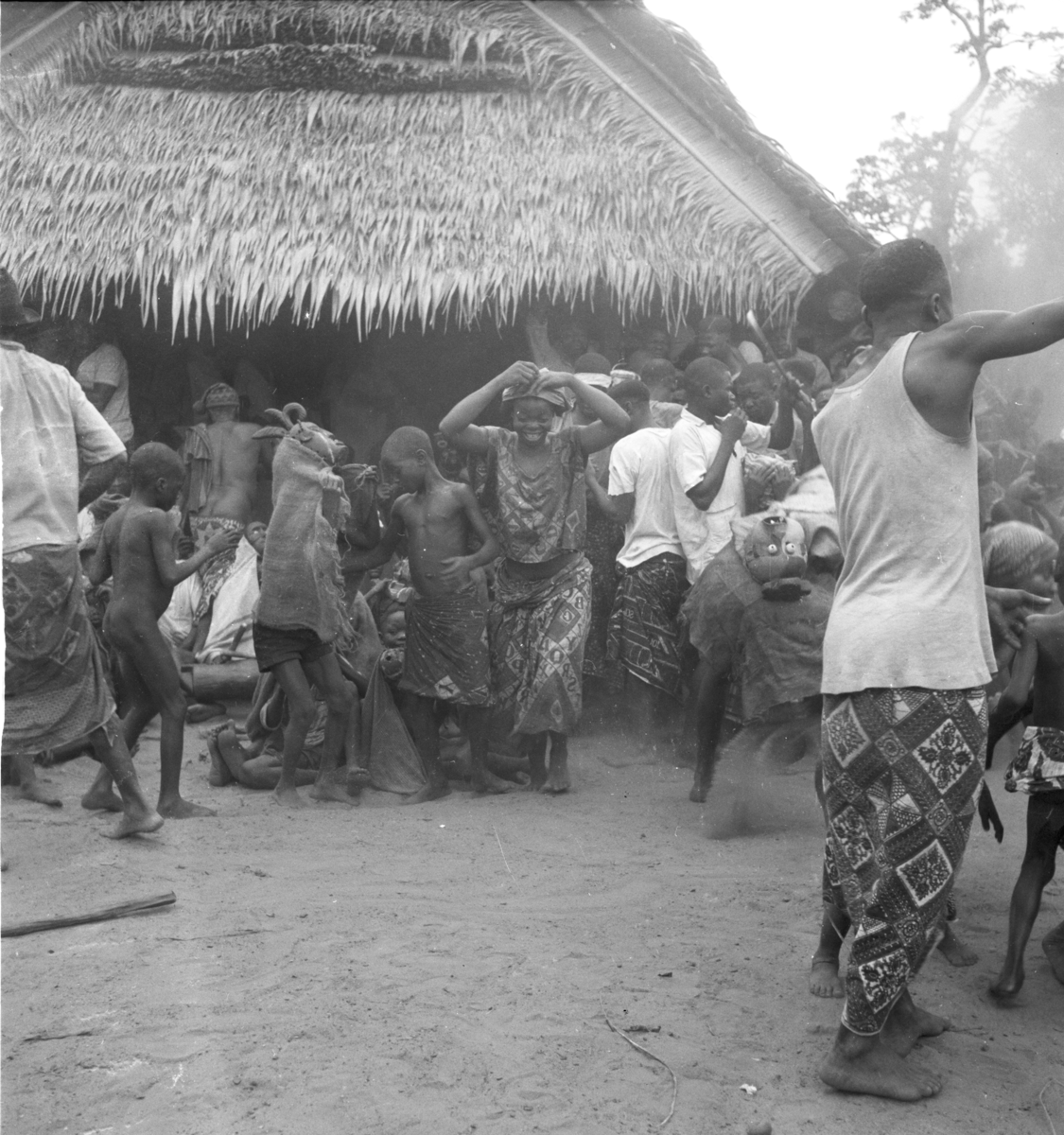
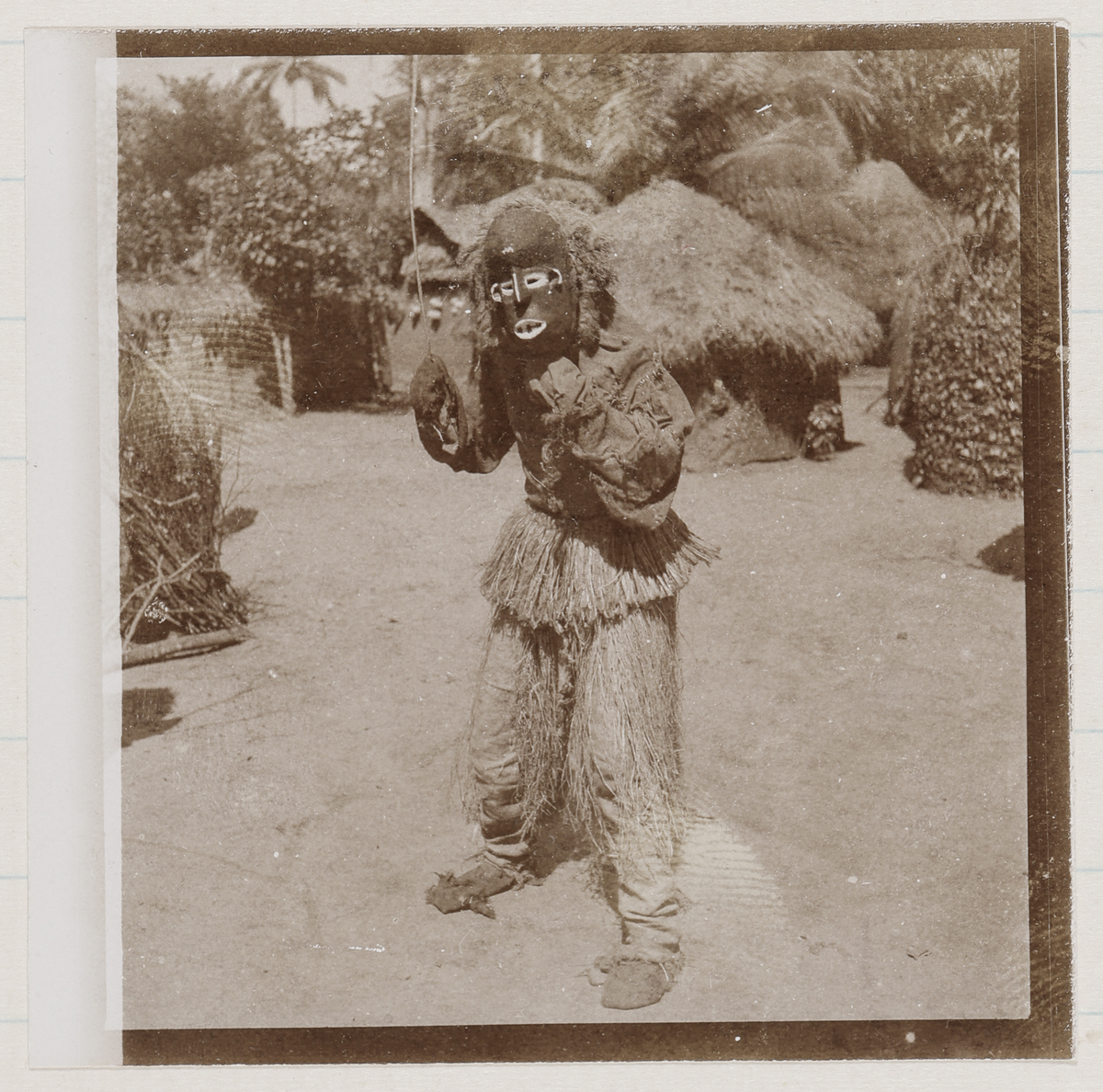
Ngbangba Ikoro Masquerade at Abiriba
This black-and-white photograph by G.I. Jones shows the Ngbangba Ikoro masquerade at Abiriba, circa 1930s. The scene depicts performers and spectators outside a traditional thatched building. One figure wears a dark wooden mask painted white with horns, attached to woven sackcloth. A young boy touches this character. Another rounded mask with white bulbous eyes appears upside down. The audience includes women, men, and children wearing printed cloths. Jones documented that Abiriba carvers created masks for this masquerade, with copyright shared …
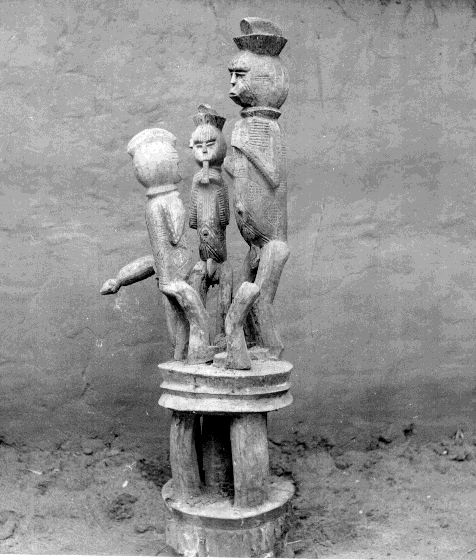
Nwamno Figure from Ogume Village
A photograph depicting a multi-tiered vertical wooden sculpture from Ogume village in South Ika. The object consists of a circular base supporting three vertical pillars, which in turn support a platform for a sculptural grouping of three anthropomorphic figures. The figures vary in scale and postural orientation, featuring stylized facial features with deeply set eye cavities and tiered headdresses. The surface of the carvings exhibits rhythmic horizontal and vertical incisions on the torsos and necks, indicating a precise carving technique. …
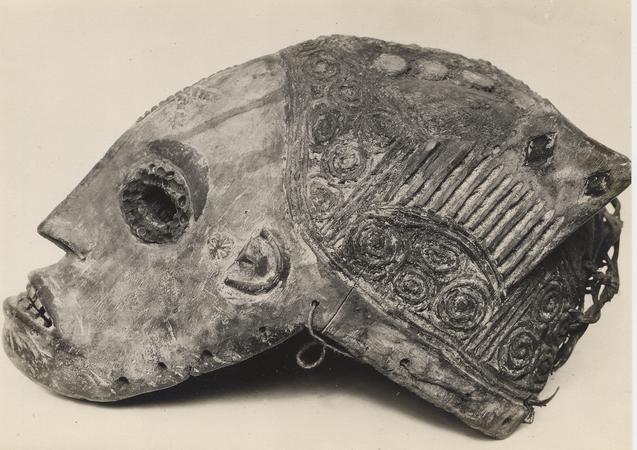
Agbhogho Mmanwu Maiden Mask
A photograph depicting a profile view of an Agbhogho Mmanwu maiden mask. The object is a stylized human head carved from wood and painted, featuring a prominent nose, thick lips, and a slightly open mouth revealing segmented teeth. The cranium is adorned with high-relief carvings, including parallel vertical ridges, spiral motifs, and dotted patterns. Perforations at the base and posterior edge indicate the mask was intended for attachment. The image is a monochromatic gelatin silver print set against a neutral …
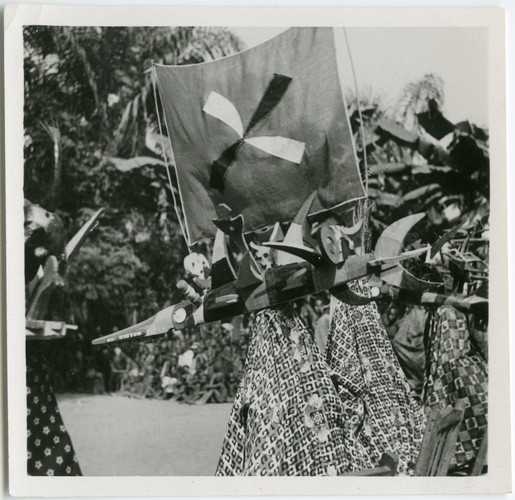
Dancer Wearing Fish Mask
A photograph depicting a dancer wearing a ceremonial mask representing a fish. The apparatus is an elongated, tapered horizontal structure with a crest-like form, featuring small, stylized facial motifs and light-colored decorative accents. A rectangular textile banner with a central four-pointed motif is mounted atop the structure. The dancer and other participants wear wrap-around garments with dense, repetitive geometric patterns of interlocking squares and diamonds. The scene is set outdoors in a tropical environment with dense vegetation and a crowd …
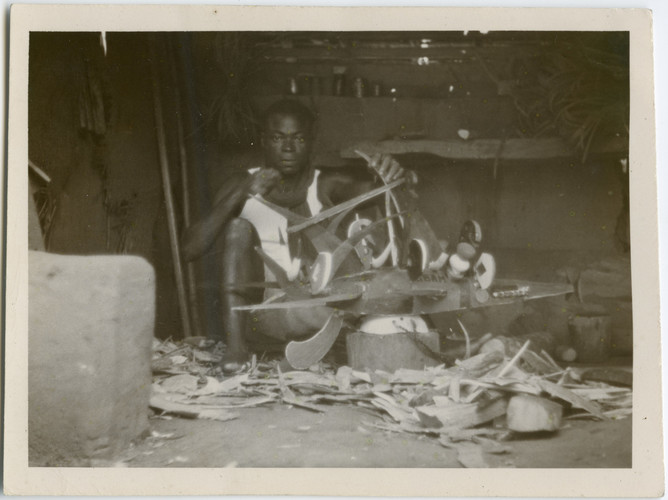
Mask Maker in Workshop with Fish Mask
A photograph depicting a male mask maker in his workshop, holding a completed wooden mask representing a fish. The subject is seated on the ground, wearing a light-colored sleeveless garment, and is surrounded by wood shavings. The image, taken circa 1935, was provided by G. I. Jones to the Pitt Rivers Museum.
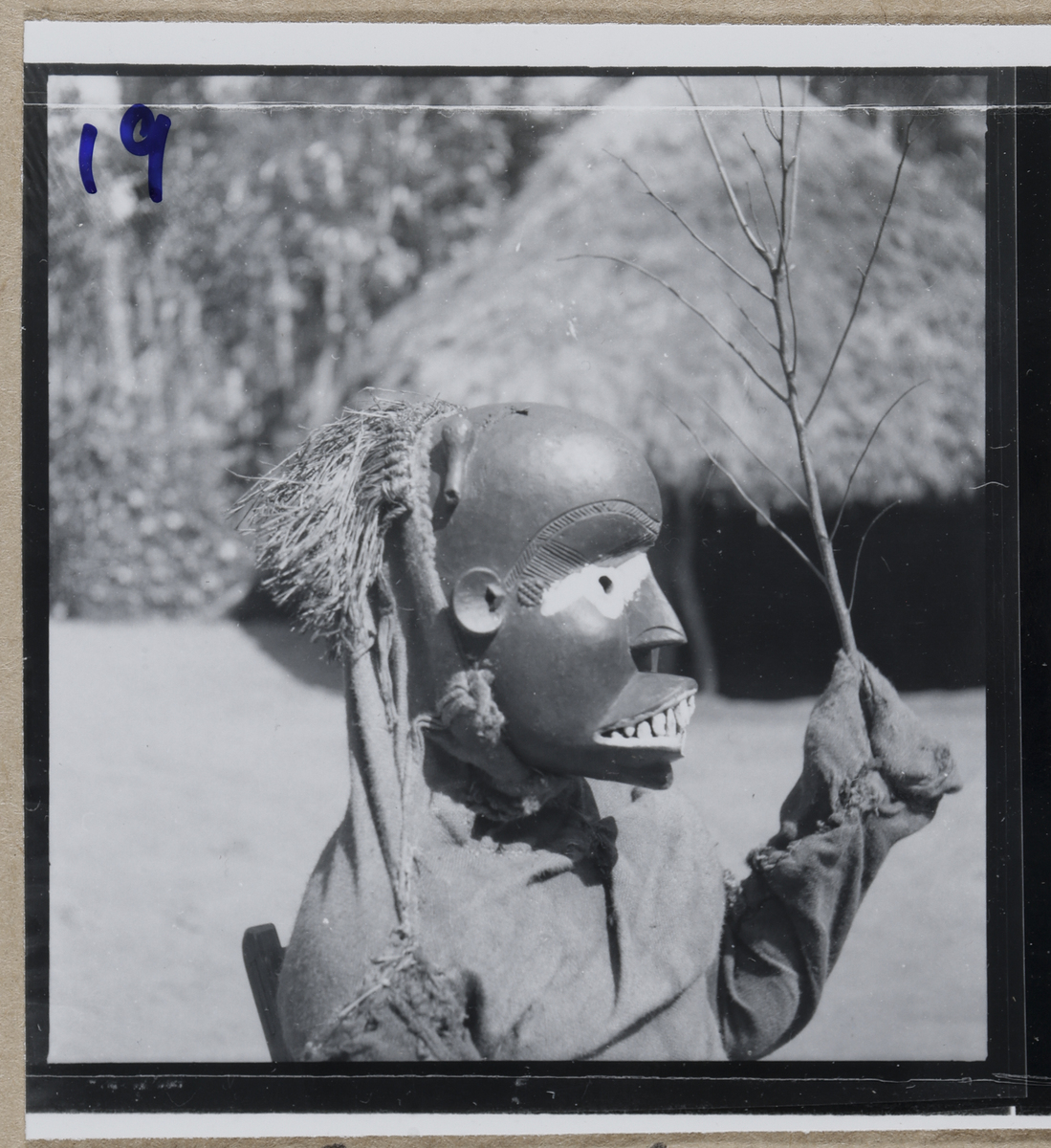
Ogbugulu Mau (Ghost) Masquerade: Iro Ekpetu (Merciless)
A close up view of Iro Ekpetu (Merciless) wearing a black wooden face mask during an Ogbugulu Mau (Ghost) masquerade. The forehead is incised with decoration, the eyes consist of two small holes accentuated with white paint, and the mouth and teeth are also accentuated with white paint. Raffia hair is attached to the back of the mask, and a protrusion is visible on the head. The masquerader wears a cloth top and holds a stick switch. In the background, …
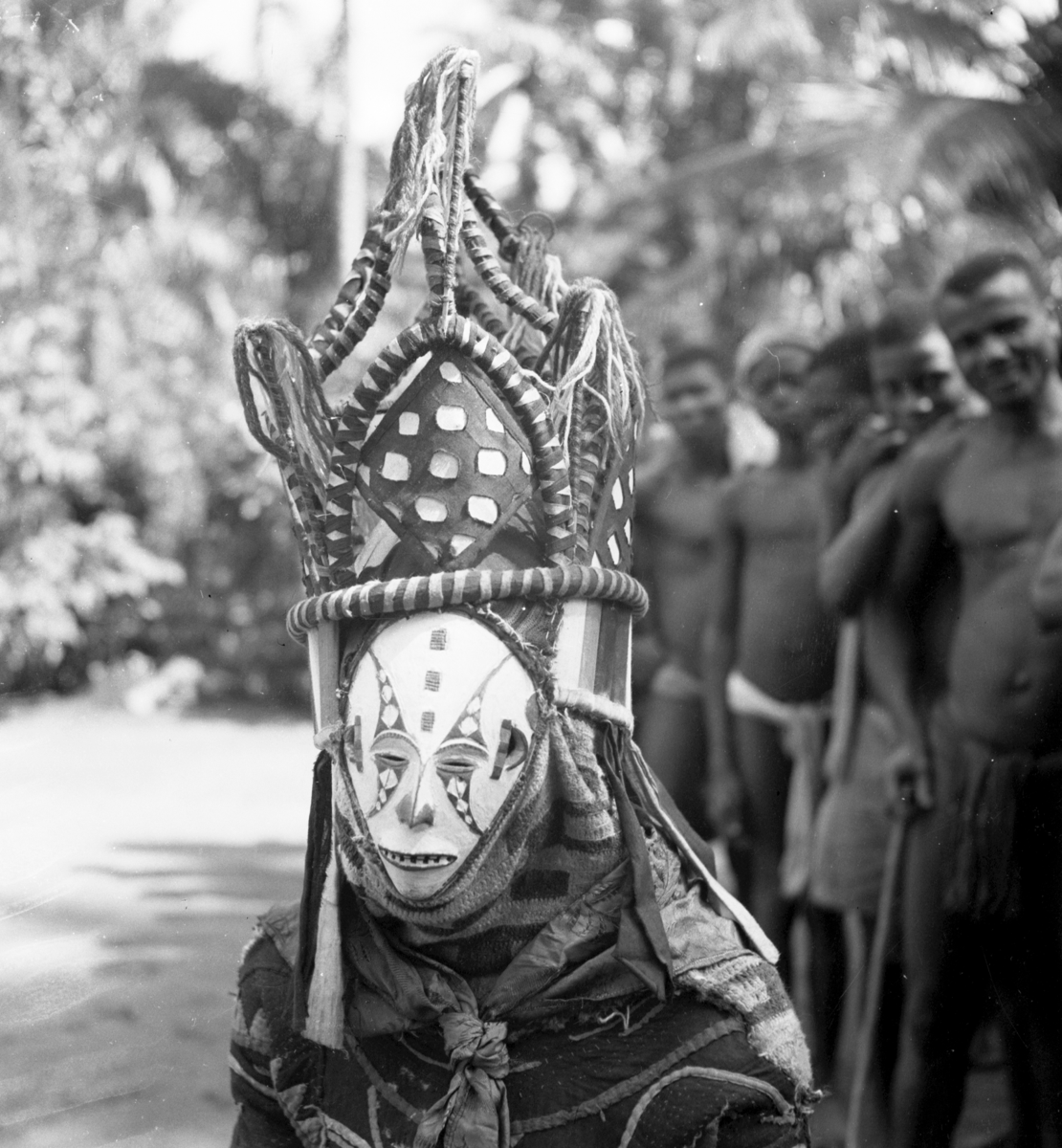
Obugulu Mau Masquerade: Egu Agu
A photograph depicting a close-up portrait of a masquerader known as Egu Agu (Money Finish) during an Obugulu Mau (Ghost) masquerade. The figure wears a helmet mask with a complex superstructure decorated with cloth, tassels, and fibrous material. The mask is pale with symmetrical dark geometric patterns on the cheeks and forehead. The masquerader is dressed in a brightly coloured, harlequin-like costume featuring a cloth cloak tied around the neck over a woven or net cloth attached to the mask. …
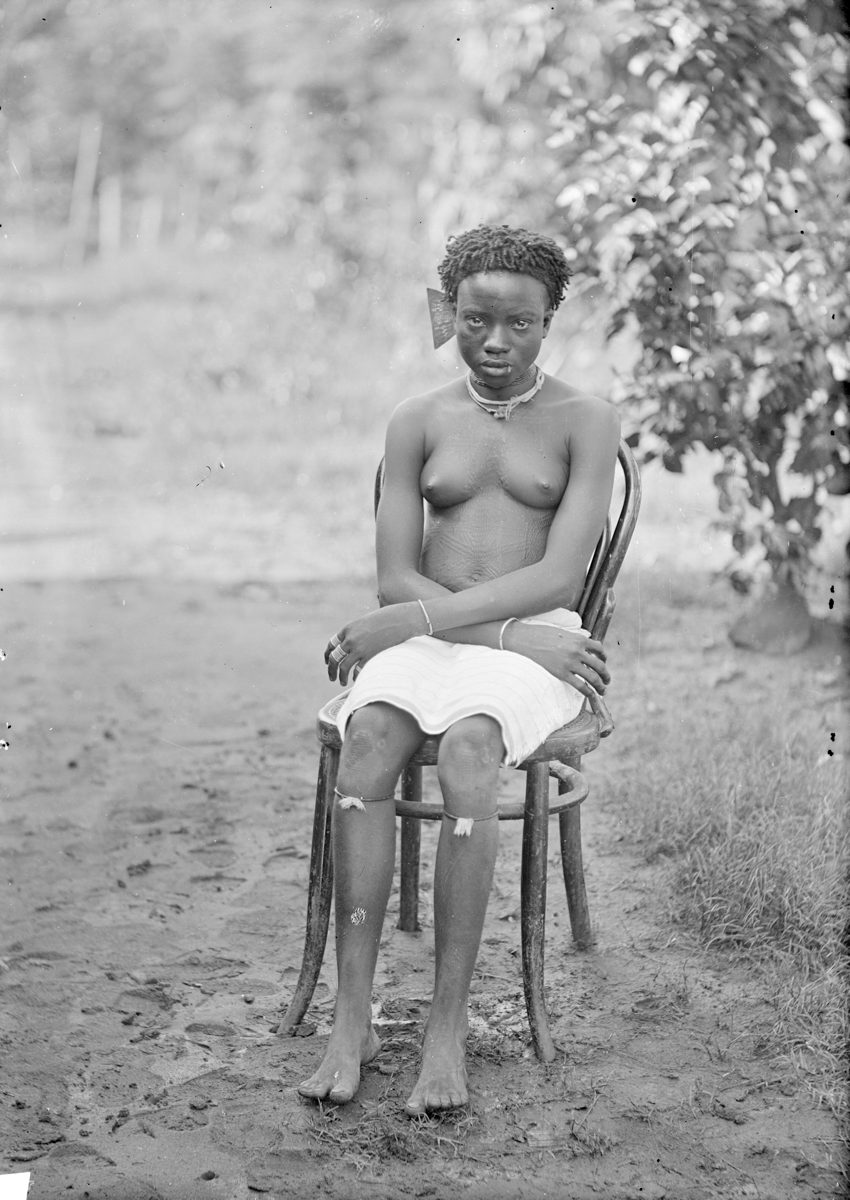
Portrait of a Woman Seated on a Bentwood Chair
A monochrome photograph of a seated woman posing in an outdoor setting. The subject is bare-chested and wears a white cotton wrap-style waist cloth. Her adornments include a narrow necklace, bracelets on both wrists, a ring on her right hand, and bands with white fibrous attachments around her ankles. Repetitive patterned markings, consistent with scarification, are visible on her abdomen. She is seated on a bentwood-style chair on a dirt surface with dense vegetation in the background.
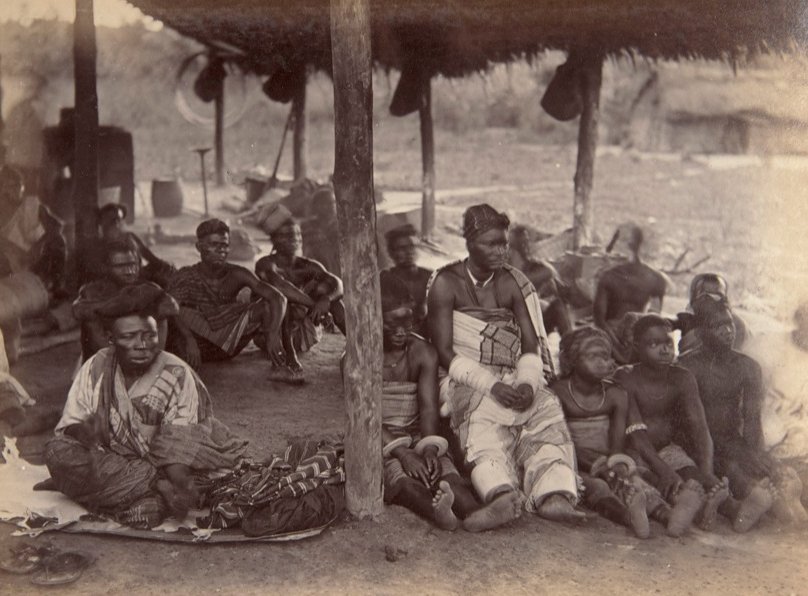
Trader from Timbuctou and Rich Trading Woman
This photograph, taken by G.F. Packer in 1889 and housed in the Pitt Rivers Museum, features a trader from Timbuktu on the right and a rich trading woman on the left, possibly a member of the Onitsha women's Otu Odu (ivory group) society or an Omu, the female counterpart to the king. The woman wears large ivory anklets, indicative of high socio-economic status in this traders' group. The image illustrates long-standing trade connections across West Africa and Igbo commerce along …
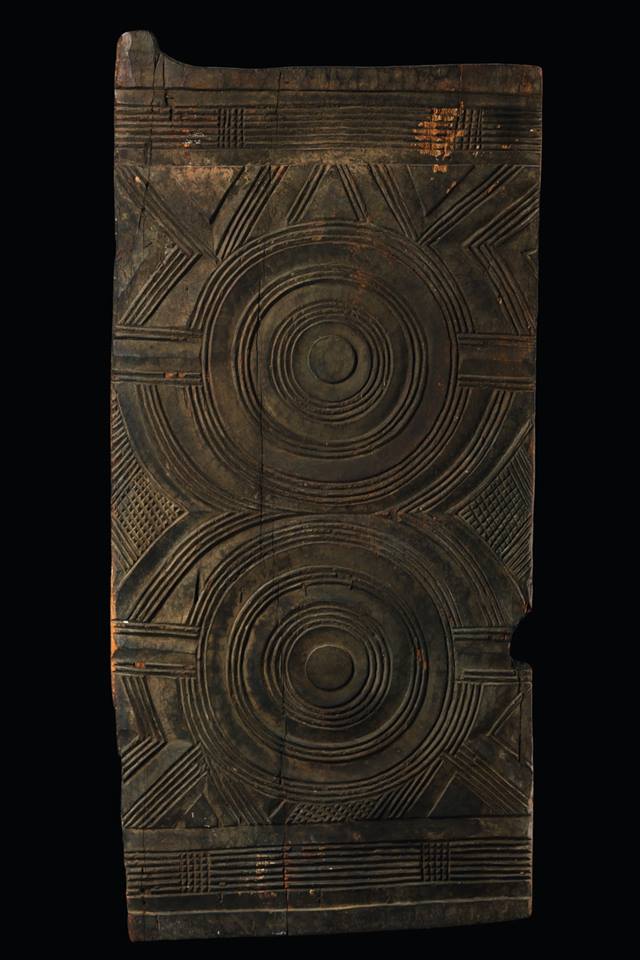
Heavy Wood Door from Nri Awka
This heavy wooden door from the Nri-Awka region, known as ḿgbó èzí, is an example of traditional Igbo wood carving from the 19th-20th century. Carved from sacred hardwood like iroko with symbolic motifs and patterns, such doors served as entrances to compounds of influential families, conveying stories, status, and spiritual beliefs.
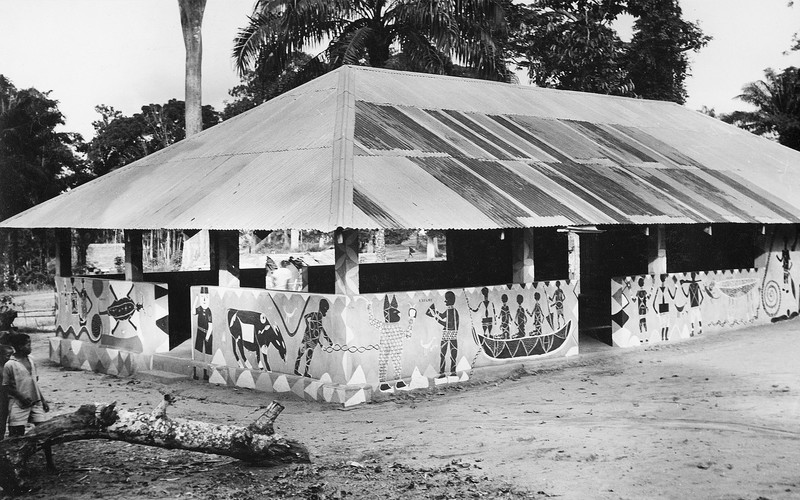
Painted Courthouse at Nri
A black-and-white photograph from 1938 depicting a single-story open-sided courthouse structure in Nri, Onitsha Province. The building features a corrugated metal hipped roof supported by vertical pillars and low-set perimeter panels serving as canvases for high-contrast, stylized murals. These murals include figurative motifs such as a large tortoise, a bovine, a figure in official attire, a figure holding a chain attached to another figure, and a series of figures in linear progression, some associated with a vessel. The background shows …
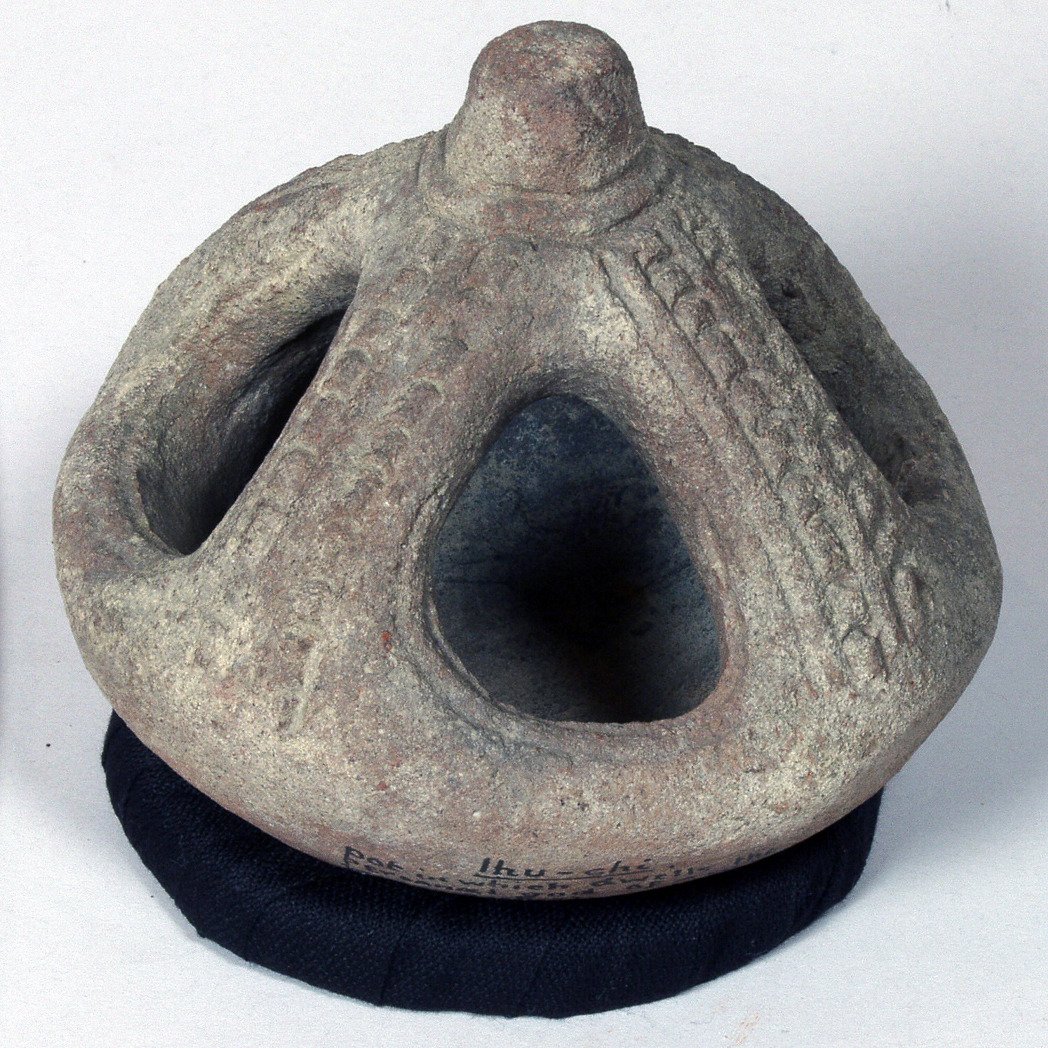
Pot believed to hold the personal spirit (chi)
This decorated pot, known as Ihu Chi, from Ekpeye in 1916, is believed to hold an individual's personal spirit or chi, a central concept in Igbo cosmology often translated as guardian angel or spirit-double. In Igbo belief, chi is a fractal of the supreme creator, Chineke or Chukwu, influencing personal destiny and authenticity.
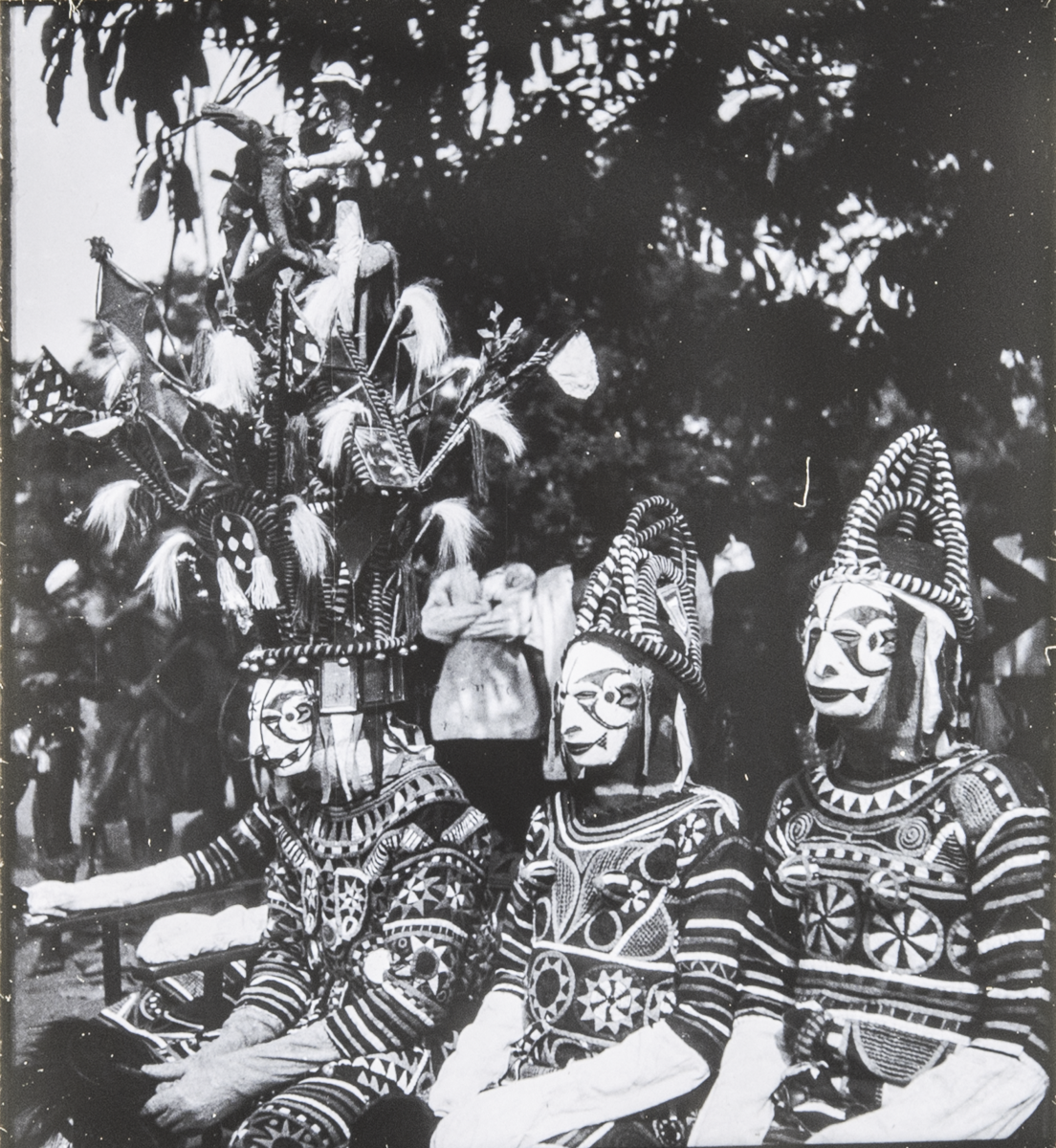
Obugulu Mau Masqueraders at Amobia Village
This colour transparency from the Jones Collection shows Obugulu Mau masqueraders seated in Amobia village, Nri Awka, Onitsha province. The masqueraders wear white face masks with black markings around the eyes, nose, and mouth, accentuating the eyebrows and cheeks. Their elaborate headdresses consist of colourful felt, string, and tassels. They are dressed in harlequin-like costumes. Spectators and trees are visible in the background. The photograph was taken by G.I. Jones, a British colonial administrator and ethnographer who documented Igbo culture …
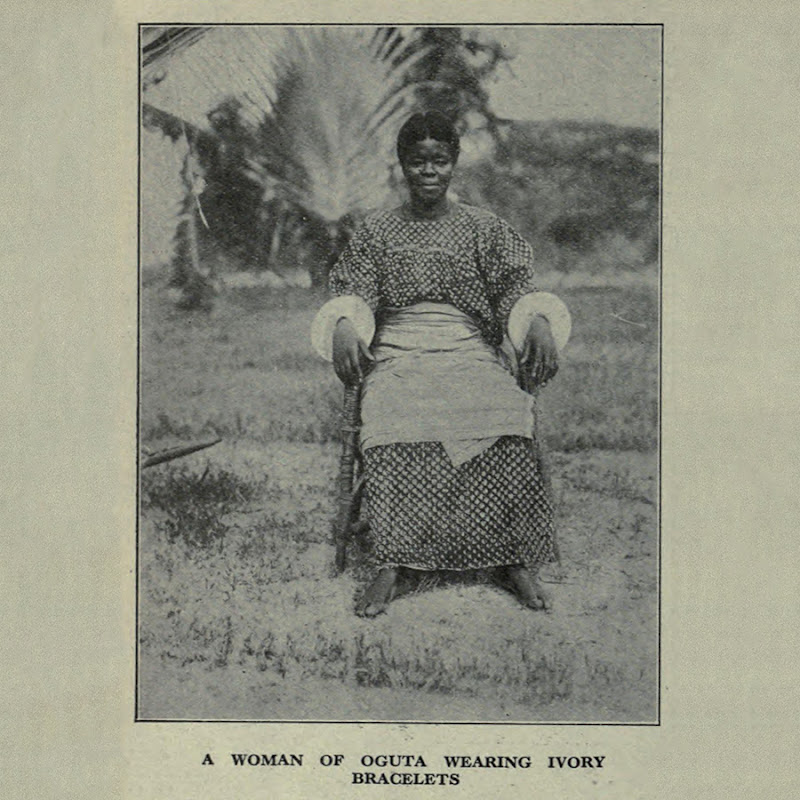
A Lady of Ụgwụtā wearing Ivory
A photograph depicting a woman from Ụgwụtā (Oguta) in the Òru area, dating from the early 20th century. The subject is seated on a wooden chair in an outdoor setting with palm-like vegetation. She is dressed in a patterned blouse and matching full-length skirt with small light-colored dots, complemented by a light-colored waist wrap. Two thick ivory rings are worn on her wrists. The source indicates that wealthy traders in the riverine Òru region, who utilized waterways for commerce, wore …
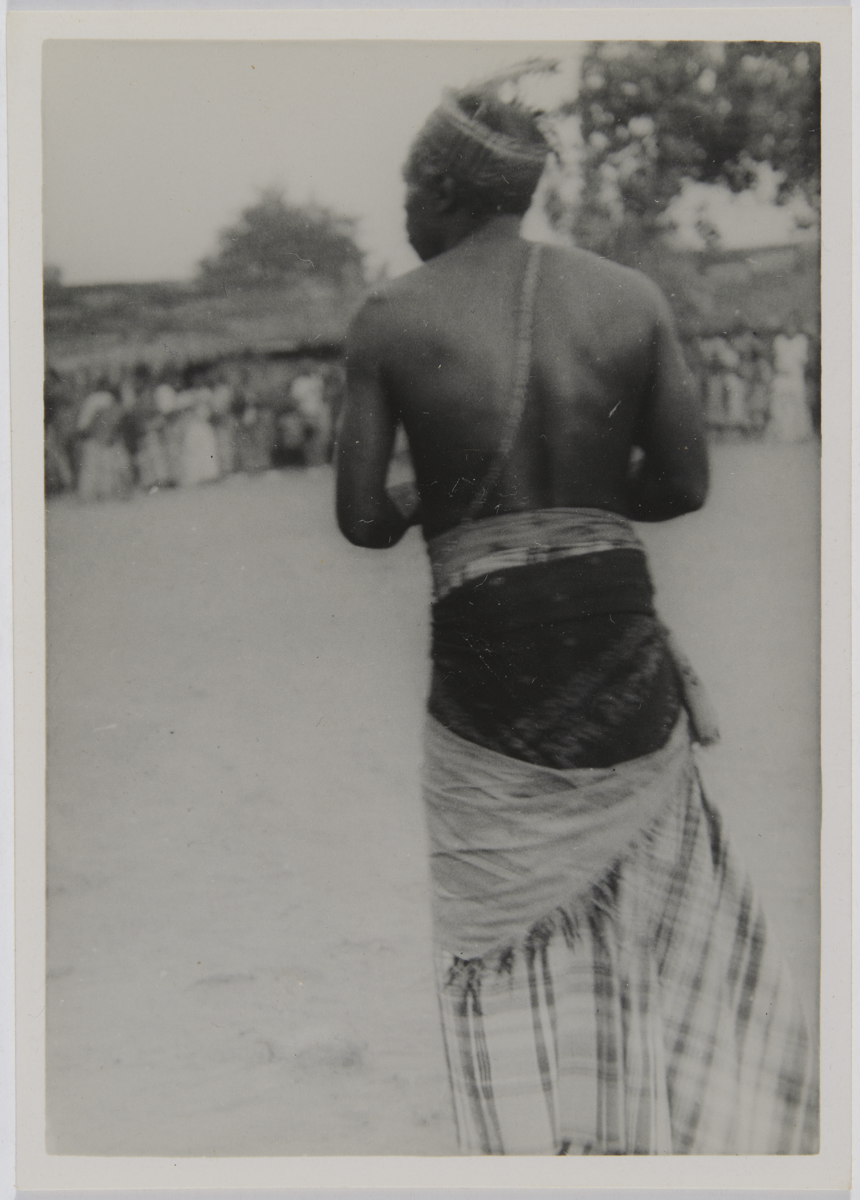
Igbo Man at Masquerade Event
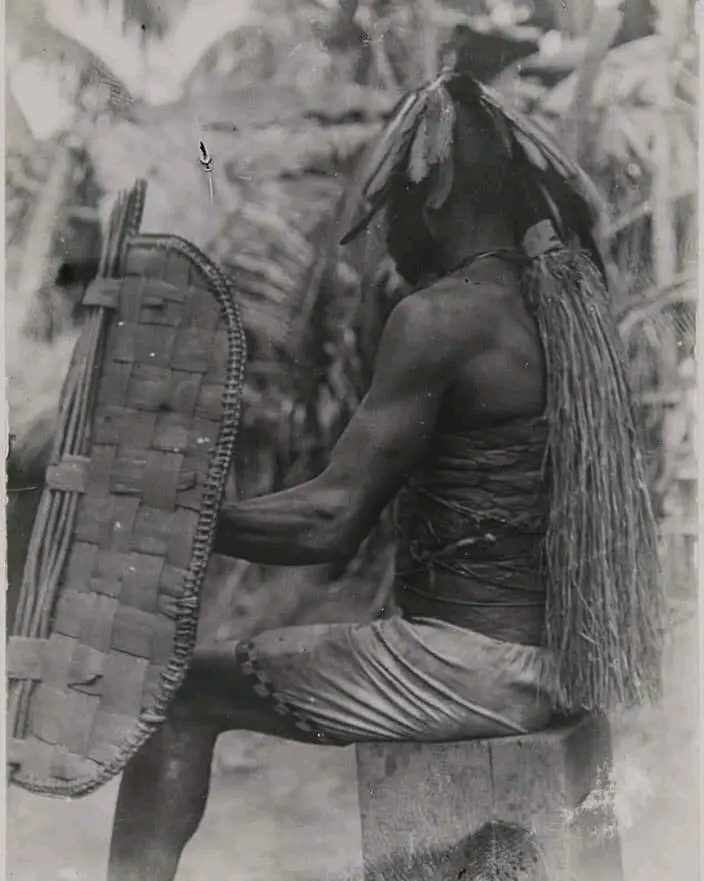
This black-and-white photograph from the Jones Collection shows a bare-chested man photographed from behind during a masquerade event. He wears a cloth headband with a feather tucked into the front, woven materials around his waist and legs, and a narrow band of material, possibly leather, over his right shoulder to his left waist. The image forms part of G.I. Jones's documentation of Igbo and South Ikwerri cultural practices between 1932 and 1938.
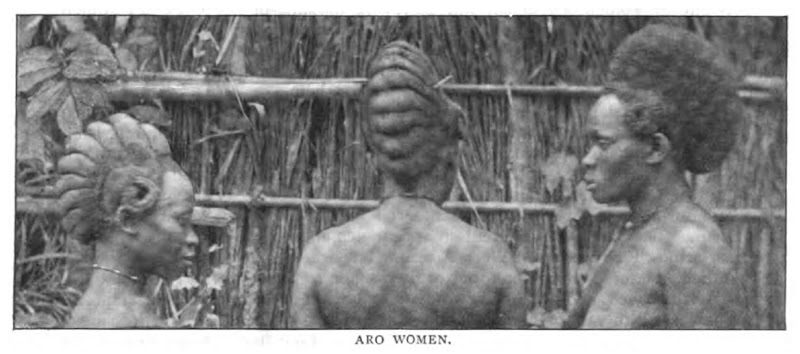
Aro Women
A photograph depicting three Aro women with distinct cranial hair styling. The subjects are positioned in a row in front of a vertical structure of thin, dried organic stalks and horizontal poles. One subject is shown in profile facing right with layered, horizontal hair ridges and a light-colored necklace. A second subject is shown from a posterior view with a tall, vertical, segmented columnar hair structure. The third subject is in profile facing left with a large, voluminous, and rounded …
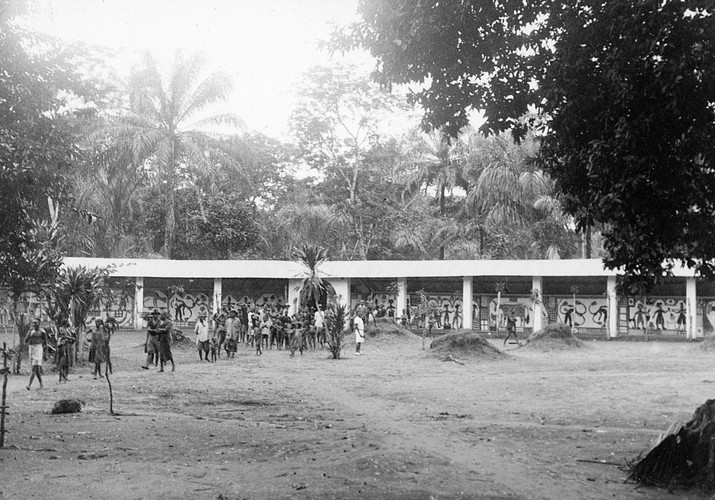
Mural Building at Okwu
A monochromatic photograph depicting a long, single-story building with a flat roof and a colonnade of vertical support columns. The wall behind the columns features large-scale graphic murals showing repetitive, stylized silhouettes of human figures in dynamic and rhythmic poses. A group of approximately 25 to 35 individuals, including adults and children in varied attire such as light-colored wraps and Western-style shirts and trousers, is gathered in the cleared earthen foreground. The scene is set against a backdrop of dense …
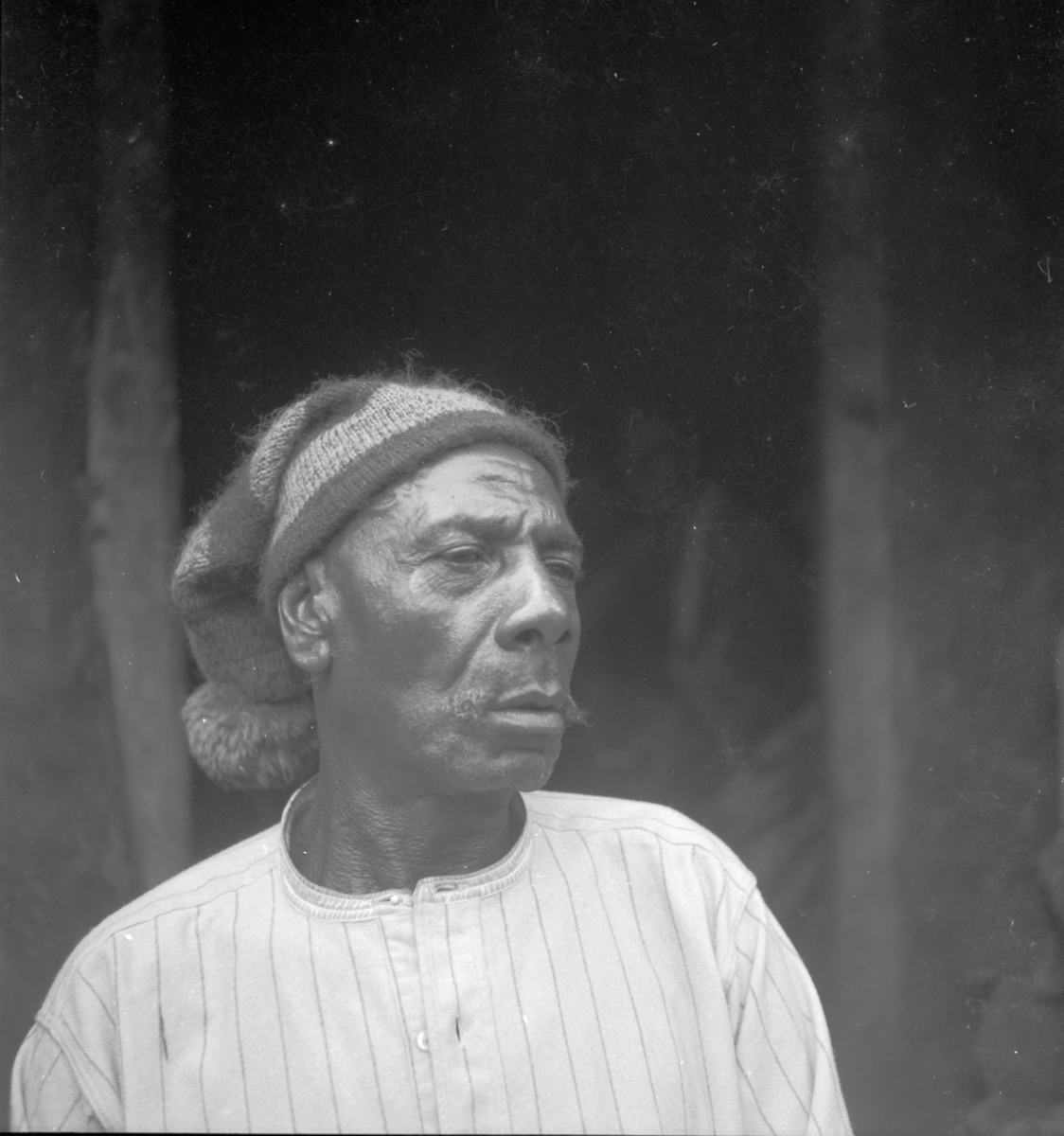
Igbo Elder in Knit Hat Portrait
This black-and-white photograph from the 1930s by G.I. Jones shows a close-up portrait of an elderly Igbo man. He wears a white tunic shirt and a distinctive striped knit hat with a pom-pom. The man's weathered face displays pronounced wrinkles, suggesting advanced age, with a neutral expression. The dark background with vertical elements appears to be natural vegetation or architectural features. This image is part of a series of portraits (N.13292.GIJ to N.13316.GIJ) for which no prints have been found. …
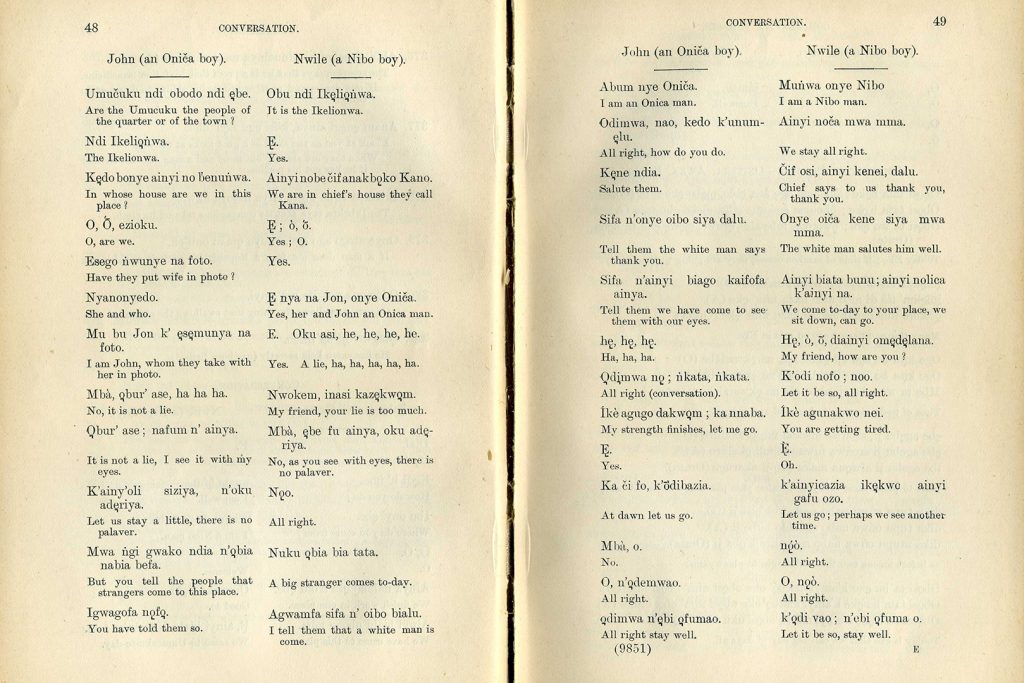
Conversation between John and Nwile
A photograph of two facing pages, 48 and 49, from Northcote Thomas's Anthropological Report on the Ibo-Speaking Peoples of Nigeria, Part III: Proverbs, Narratives, Vocabularies and Grammar. The pages display a transcribed and translated dialogue between two young men: John, identified as an Onitsha boy, and Nwile, identified as a Nibo boy. The text is organized into two columns with the original Igbo language using specialized diacritical marks for phonetic values, followed by English translations. The conversation documents a visit …
Ohaffia Masquerader in Okwanku Performance, Akanu Village
Close-up view of an Ohaffia Igbo masquerader during the Okwanku performance in Akanu village. The wooden face mask displays a high forehead, slit eyes, elongated nose and mouth, all coated with white pigment. Long raffia strands form a fringe around the mask and hang over the performer’s chest. Spectators appear in soft focus behind. According to Jones, Okwanku masqueraders enacted a comic drama in which the character Dibia poisoned and revived the Rain Driver. The mask type, known as Otili, …

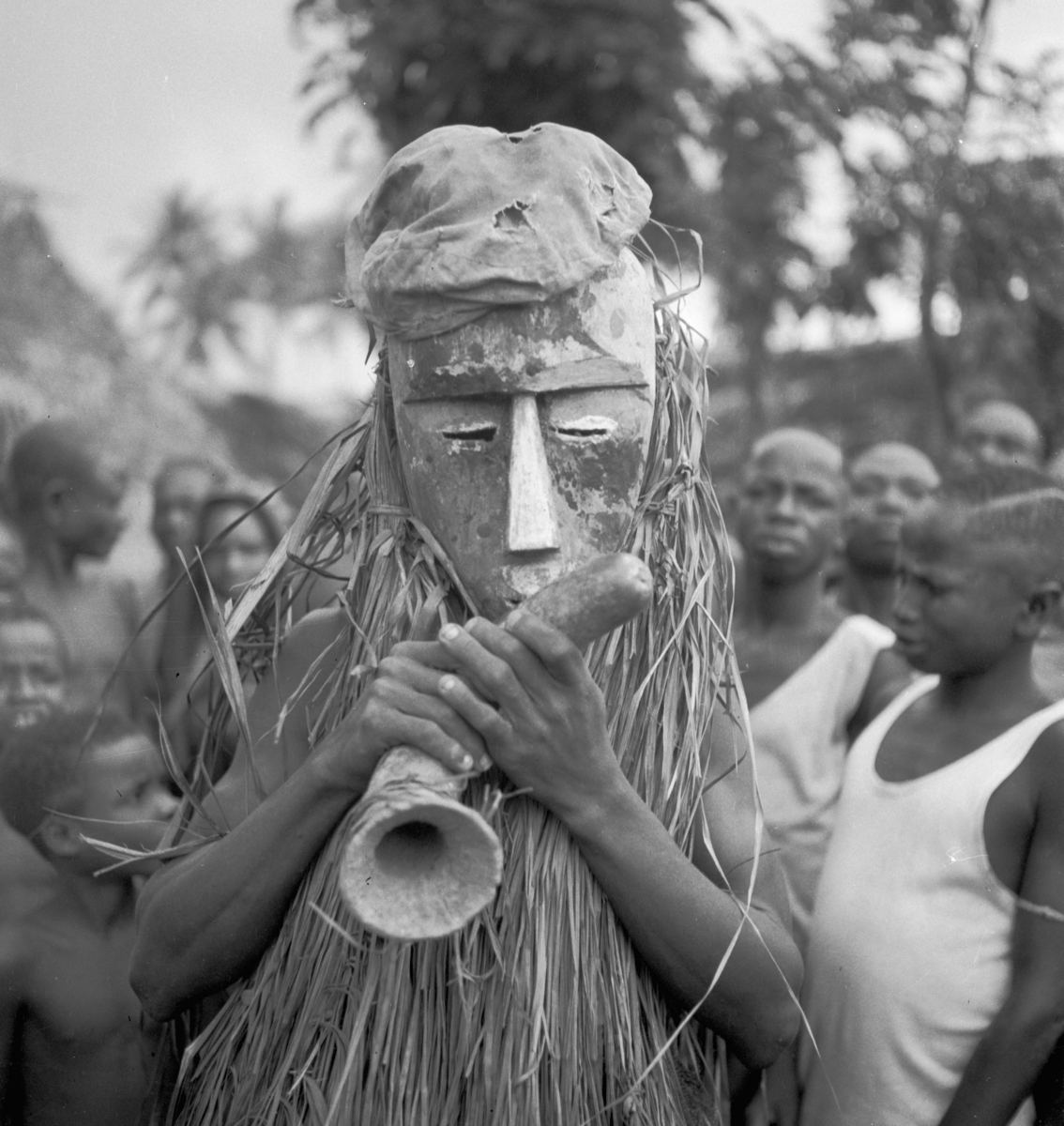
Ohaffia Masquerader Performing in Okwanku Masquerade, Akanu Village
Black-and-white photograph by G.I. Jones showing a masked Ohaffia performer in the Okwanku masquerade at Akanu village. The figure wears a wooden face mask with white pigment, high forehead, slit eyes, long nose and mouth, surmounted by a hat, with long raffia hair hanging down. The performer plays a horned instrument while spectators watch in the background. Jones recorded that Okwanku masquerade characters performed comic dramas, including one in which the Dibia (Doctor) character poisoned and revived the Rain Driver. …
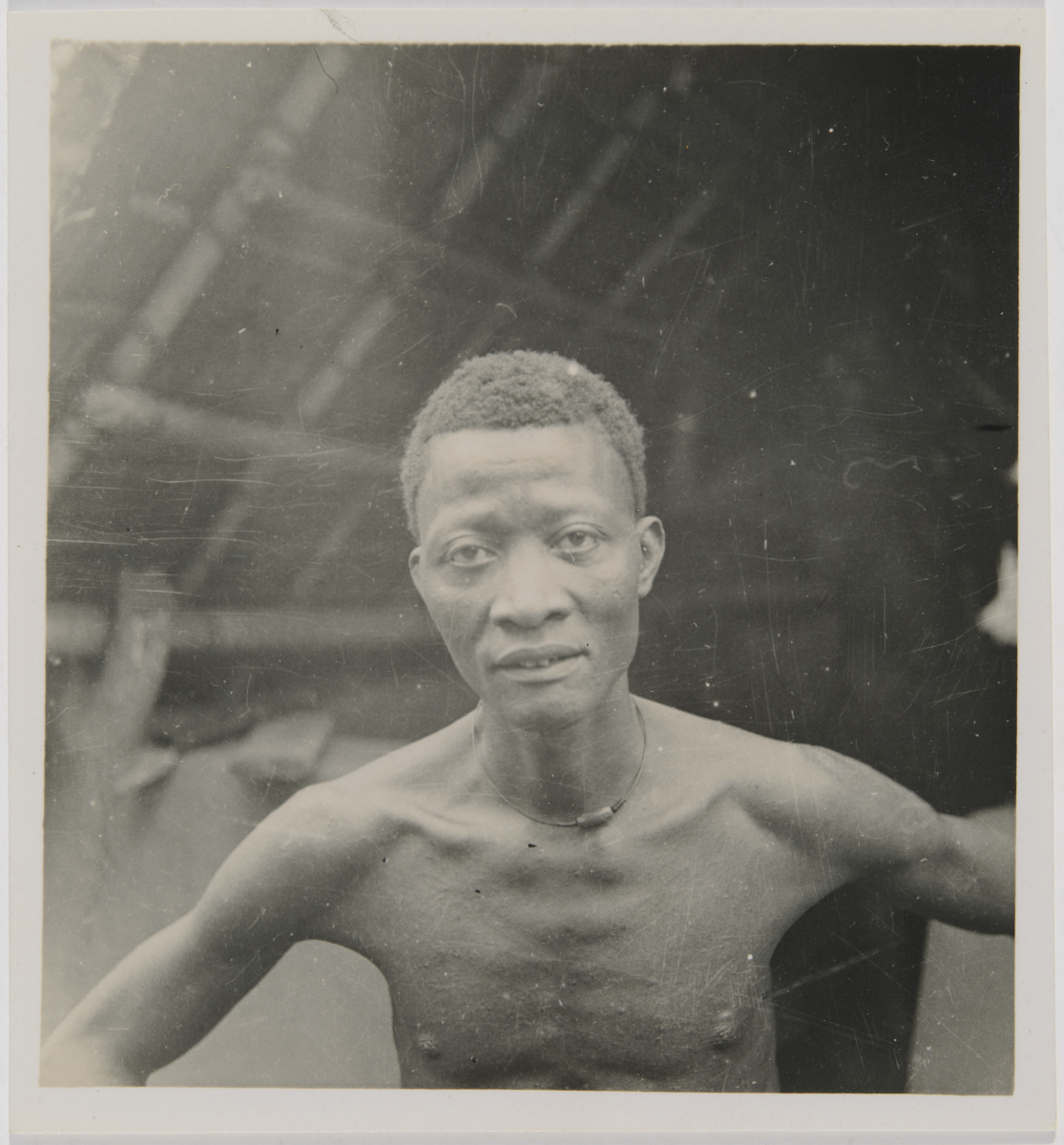
Portrait of a Man in a Roofed Building
A photograph depicting a half-length portrait of an adult male with dark skin pigmentation and short, textured hair. The subject is shirtless, wearing a thin, dark, cord-like necklace with a single, small, cylindrical or bead-like element centered over the sternum. He is positioned centrally in a medium close-up shot against a background showing the internal structural framework or rafters of a roofed building. The image is a monochrome print showing signs of physical aging, including fine linear scratches and particulate …
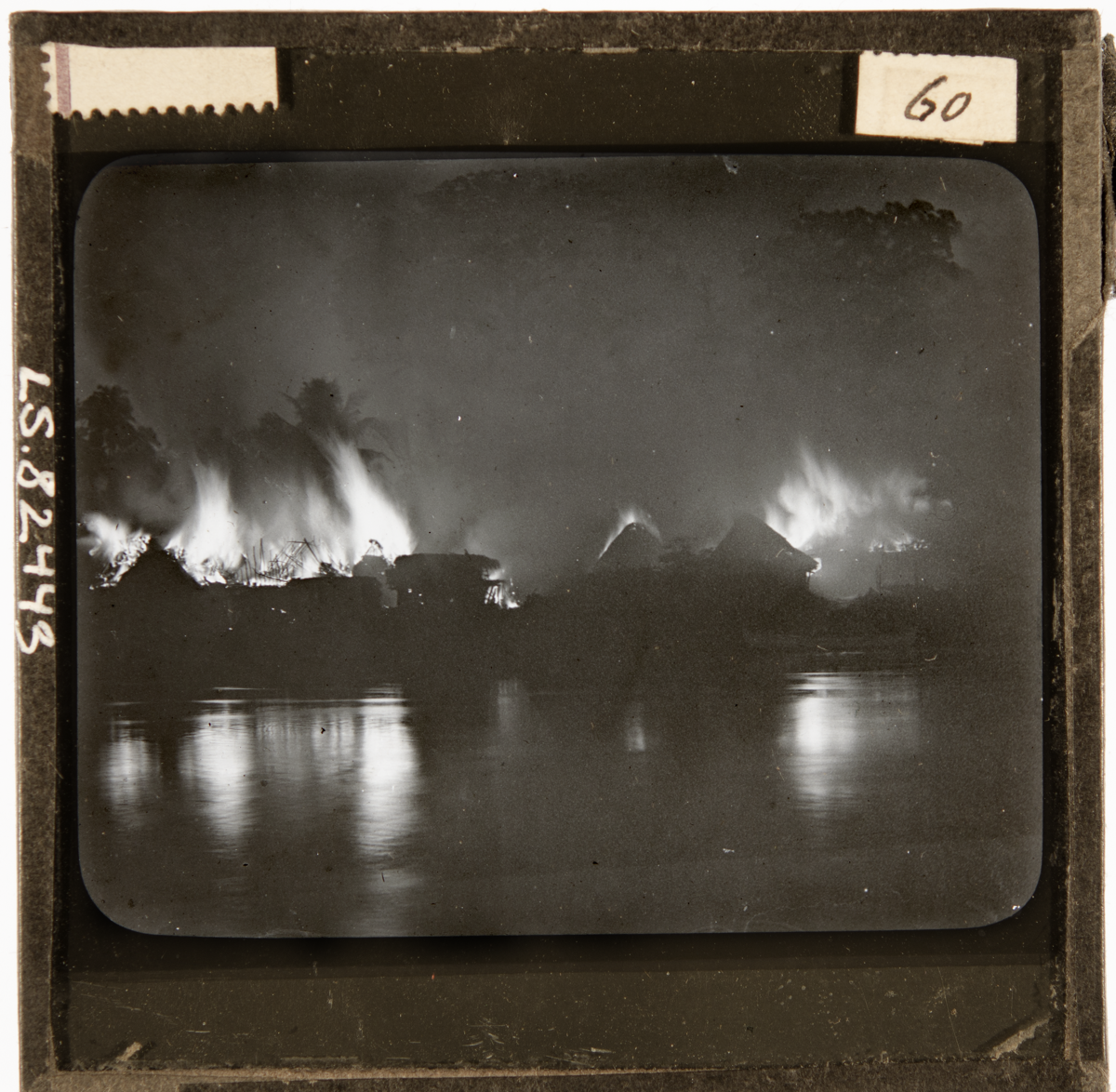
Burning of a Village along the Niger River
A monochrome photograph depicting the burning of a village as seen from the river, likely the result of a punitive expedition. The image shows multiple points of intense combustion among traditional architectural structures with pitched rooflines along the shoreline. Smoke and haze obscure the background sky, while vertical light streaks from the fires are reflected on the calm surface of the water. This image is part of the Crosse Collection, documented as being taken between 1886 and 1895 by William …
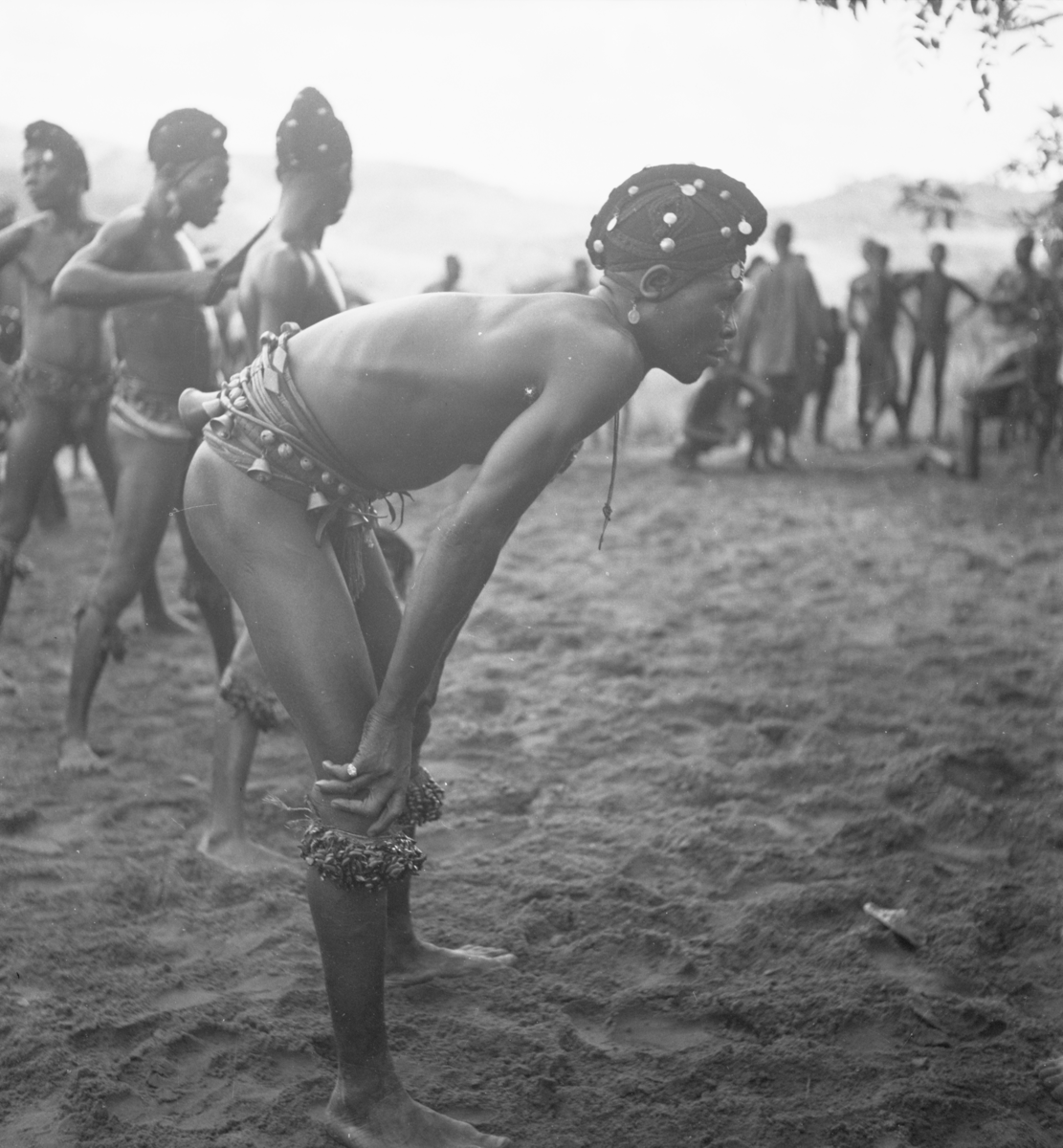
Boys' Initiation Dance in the Nri Akwa Area
A photograph depicting a boys' initiation dance in the Nri Akwa area. The male initiates are adorned with tight loin cloths decorated with bells around the waist, knee bands made of seeds or metal, and black caps styled as coiffure and studded with round metal decorations. Some individuals wear necklaces. In the background, spectators observe the ceremony. The image captures the physical posture of the initiates, including one subject in the foreground leaning forward at the waist with hands near …
Onu Kamma Masqueraders at Nimo
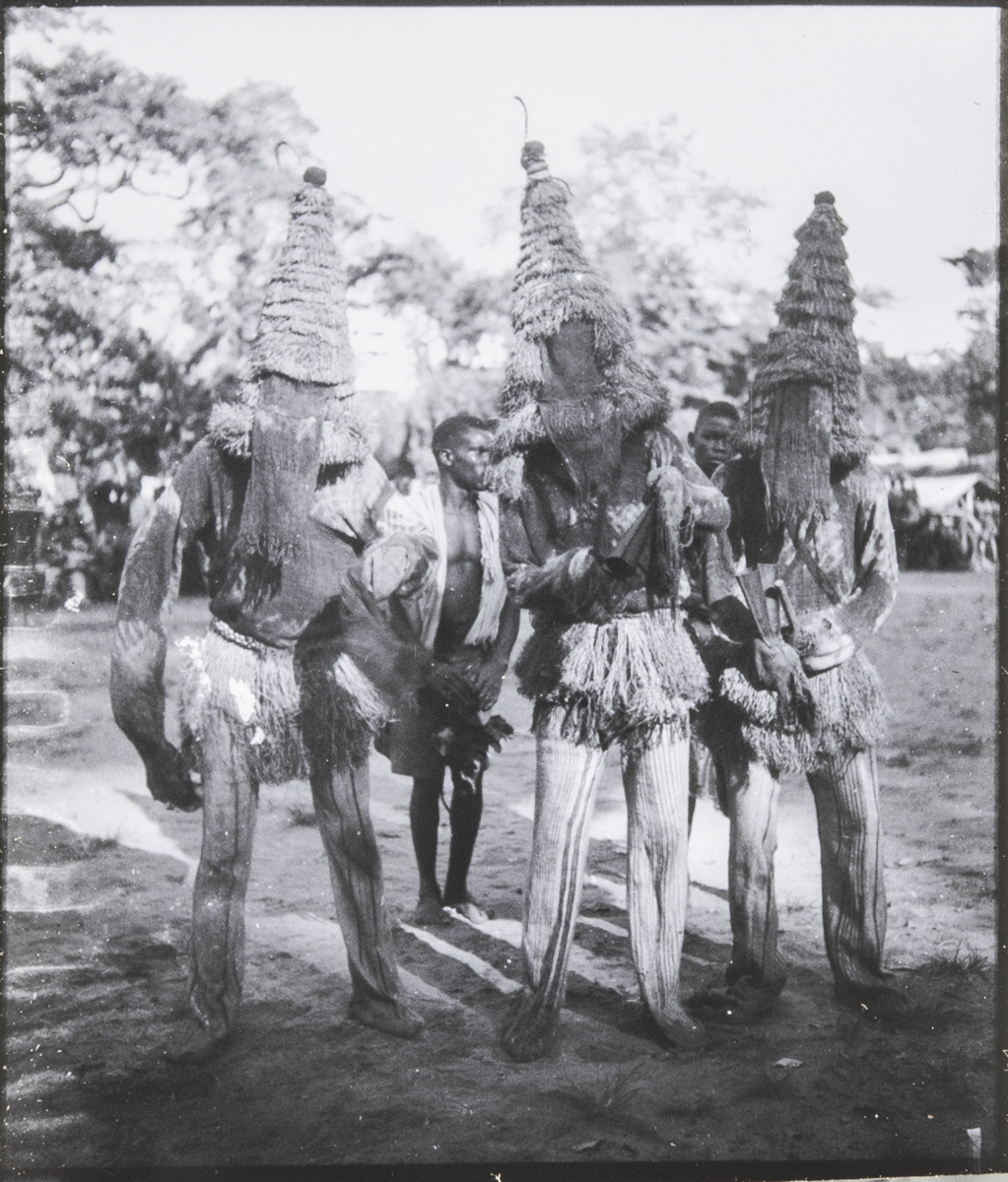
Black-and-white photograph showing three Onu Kamma (Mouth stronger than sword) masqueraders at Nimo, Nri Awka, Onitsha province. Each figure wears a large conical faceless mask constructed from layered fibre with a cloth panel at the front. Their attire includes tie-dyed or batik upper garments, striped woven cloth trousers, and fibre skirts secured at the waist; cowrie shells are visible on the rightmost performer. Two masqueraders hold metal gongs, one striking his with a stick. A sizable crowd of bystanders observes …
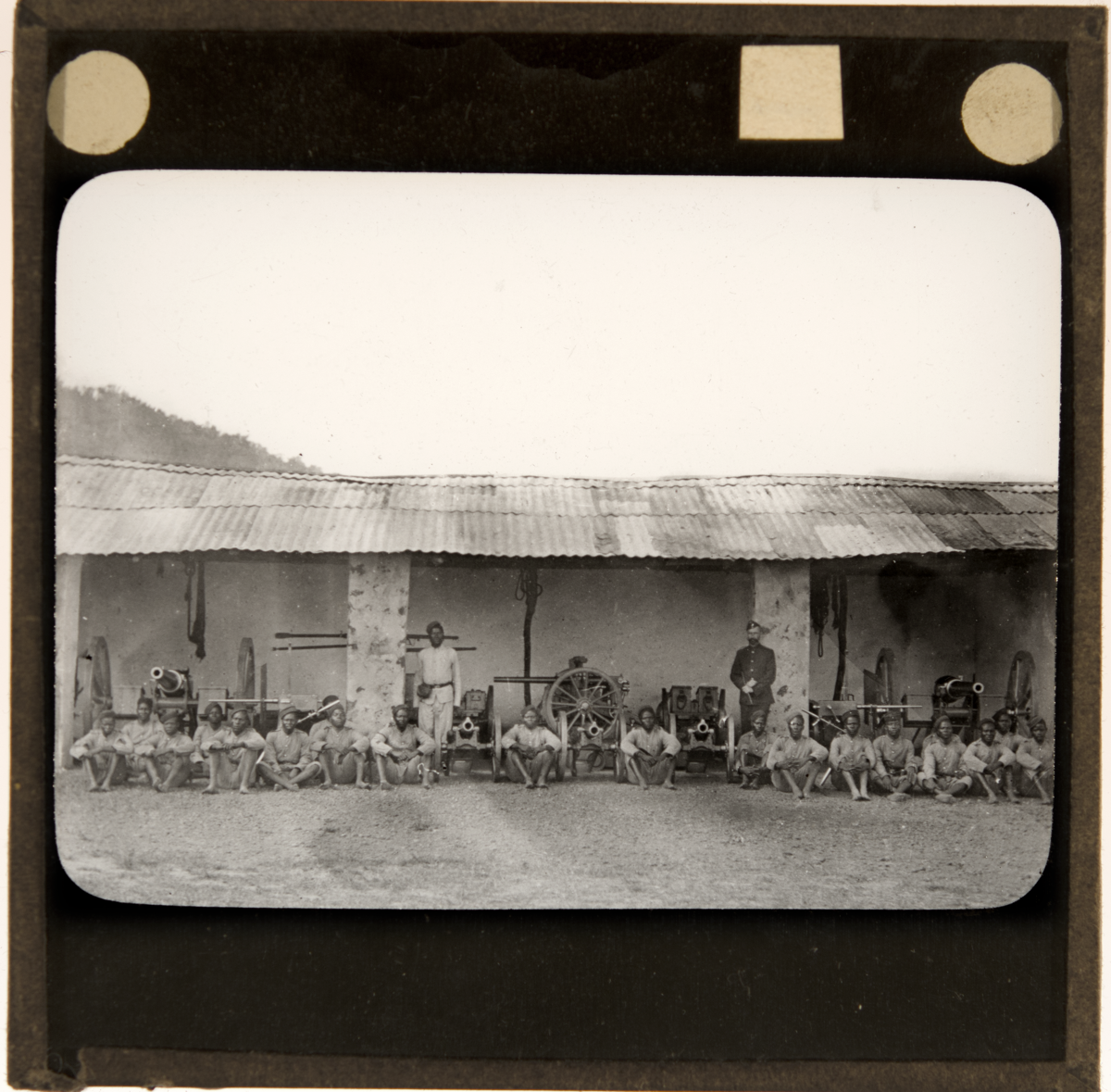
Portrait of Soldiers Outside Barracks
A photograph depicting approximately 18 to 20 men seated in a row outside a long, open-sided structure with a corrugated roof. The seated men wear light-toned, loose-fitting garments and some wear head coverings. Behind the group, several pieces of mobile artillery with large wooden-spoked wheels are visible. One man stands to the right, wearing a dark-toned military uniform and a peaked cap. The scene is set on flat ground with a hillside in the background. The image was captured during …
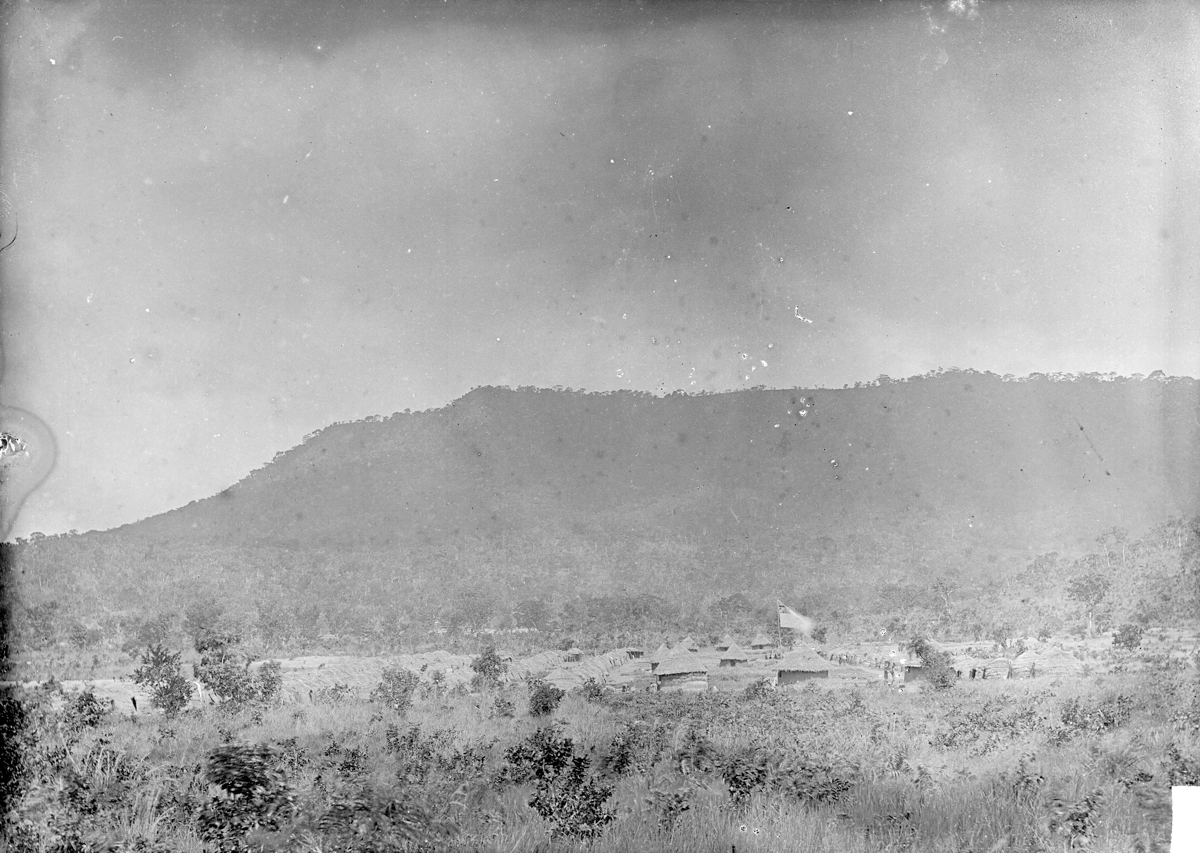
Landscape of an Escarpment Area along the Niger River
A monochromatic photograph from the late 19th century depicting a landscape view of an escarpment area along the Niger River. The foreground consists of dense, low-lying shrubbery and grasses on sloping terrain. In the midground, a cluster of vernacular structures with steeply pitched conical thatched roofs is situated, featuring a single light-toned flag positioned near the primary buildings. The background is dominated by a prominent, elongated forested ridge spanning the horizon under a hazy sky. The image was captured by …
An Igbo couple from Asaba
This studio portrait from around 1900 depicts an Asaba man in riding gear or English recreational dress posing with his wife, illustrating the blend of traditional and colonial influences in Asaba. Asaba was a site of resistance to European invasion by the Igbo in the early 19th century, where British explorers Richard and John Lander were taken captive in 1830 during their expedition to trace the course of the Niger River. Later, Asaba became a trading post and administrative headquarters …

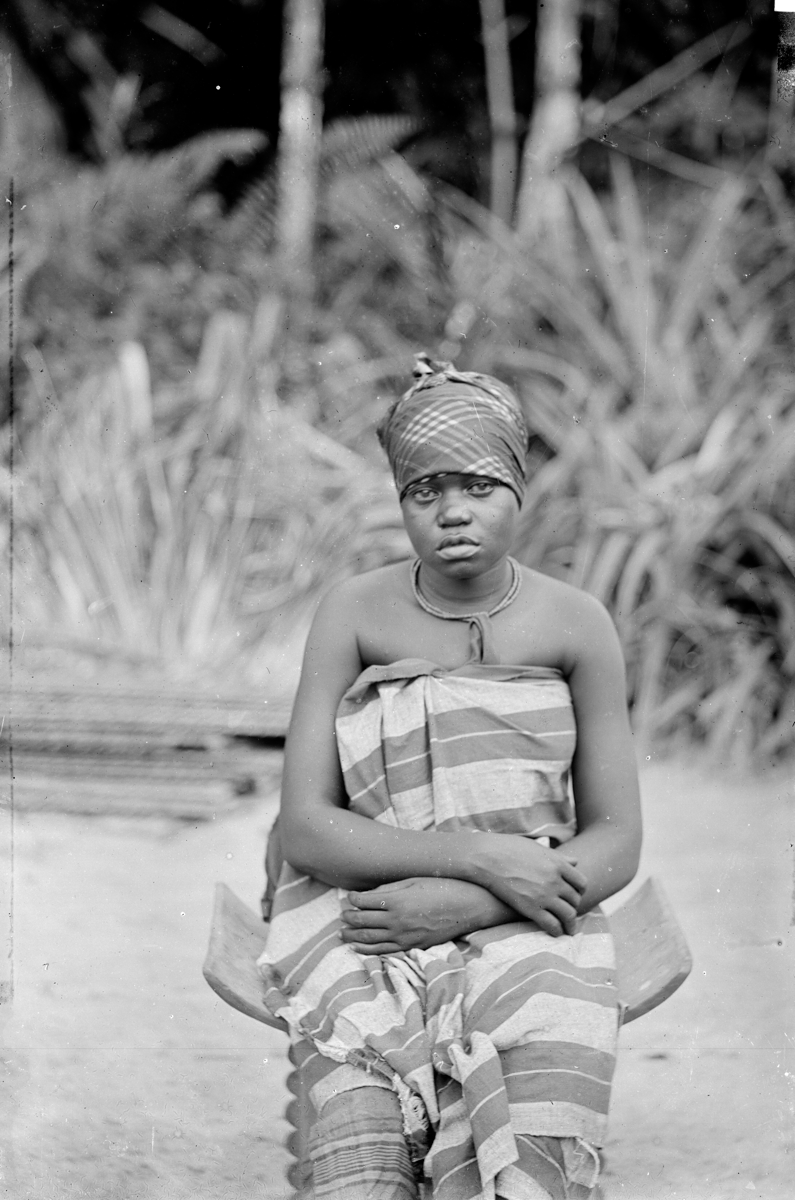
Portrait of a Woman in Striped Cloth
A photograph depicting a woman seated on a low, curved wooden stool, posing for the camera. She wears a fabric wrap or turban with a geometric pattern and a large piece of textile with wide, dark, horizontal stripes wrapped around her chest and lower body. A singular, light-colored circular ring or torque is positioned around the base of her neck. The subject is situated outdoors against a background of dense, blurred vegetation and is seated on a light-colored, granular surface. …
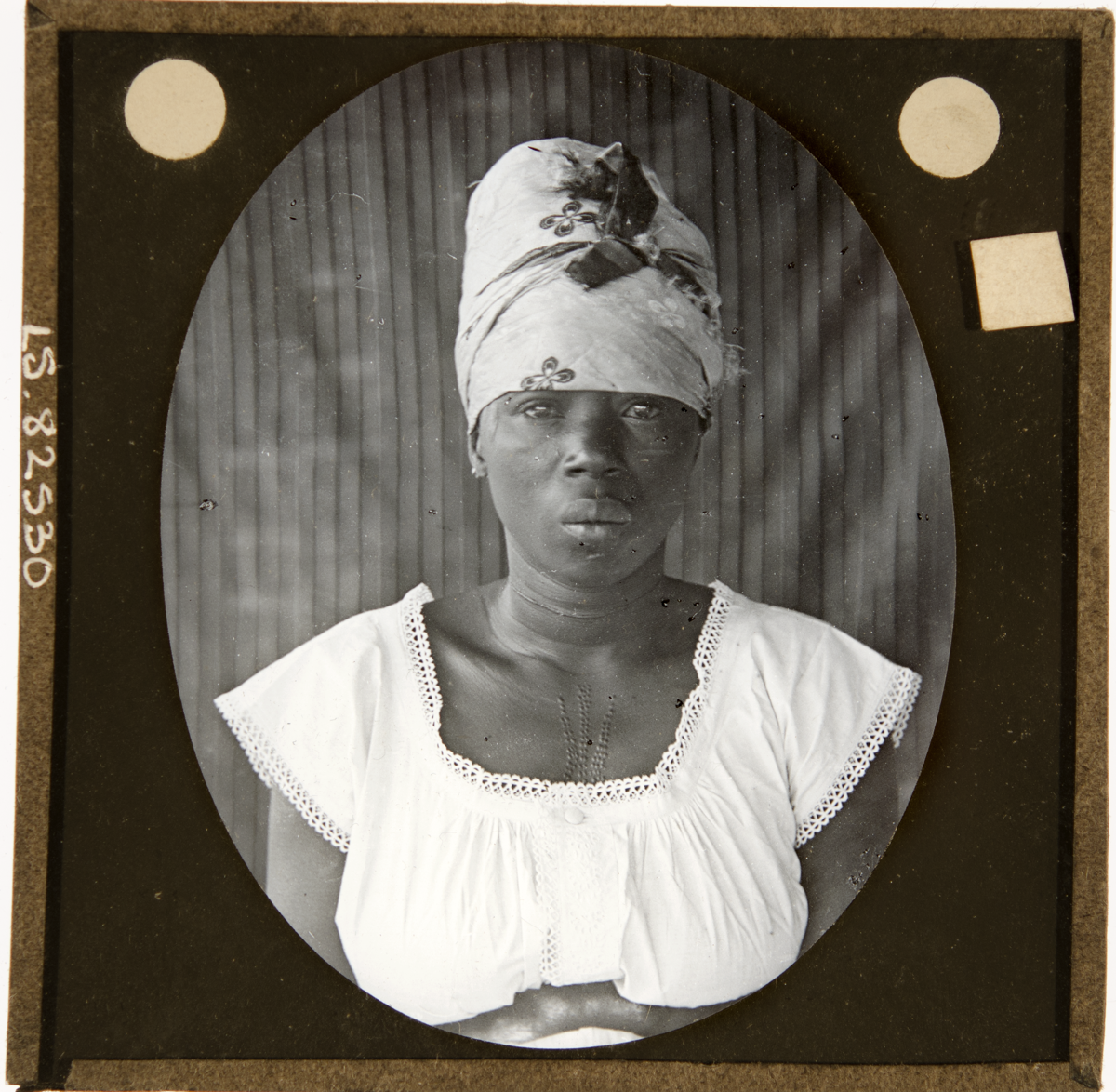
Oji Onu Masquerade with Janus-Faced Helmet Mask
This black-and-white photograph shows a close-up view of a seated masquerade character in the oji onu masquerade, photographed by Gwilliam Iwan Jones between 1932 and 1938 in Akama, Anambra State, Nigeria. The masquerader wears a janus-faced helmet mask featuring two distinct faces: one with deep-set eyes, a hooked nose and wide open mouth, the other with a hooked nose and long downward curving beak. Both faces are painted white with features highlighted in dark pigment. The mask is topped with …
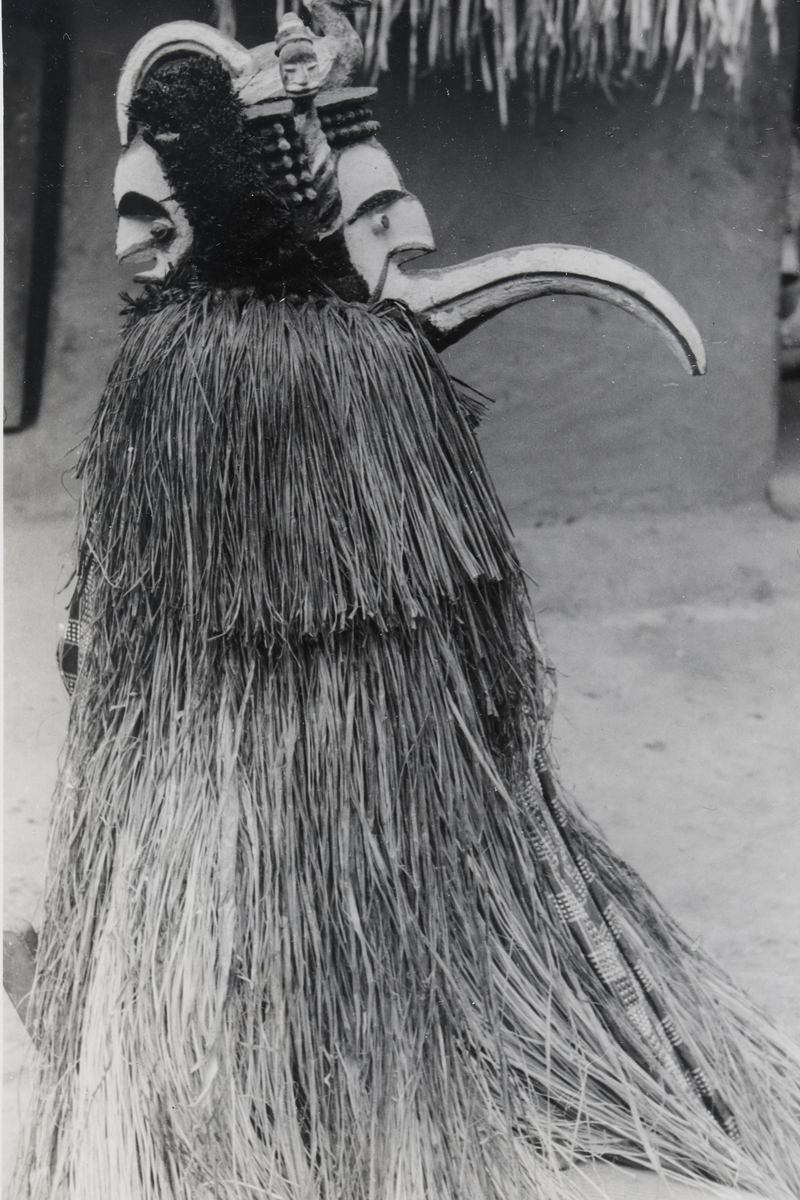
Ika Igbo Wooden Carvings from the Western Igbo Region
A black-and-white photograph featuring five hand-carved wooden objects from the Ika Igbo (Western Igbo) region. The arrangement includes two anthropomorphic figures and three cylindrical columns. The humanoid figures exhibit vertical striations on the torso and stylized facial features, with one featuring a patterned headpiece. The cylindrical columns vary in detail, with one displaying a carved zigzag motif and another featuring a high-relief anthropomorphic figure on its front face. Several columns are topped with small perpendicular pegs. These objects include Ofo …
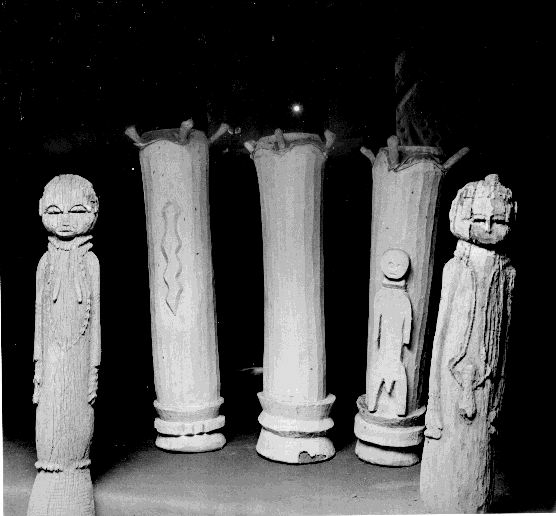
Group Portrait from Royal Niger Company
This group portrait, photographed by William Henry Crosse between 1886 and 1895, captures Igbo individuals associated with the Royal Niger Company along the Niger River. The image provides insights into colonial trade interactions and social dynamics in the region during the company's operations.
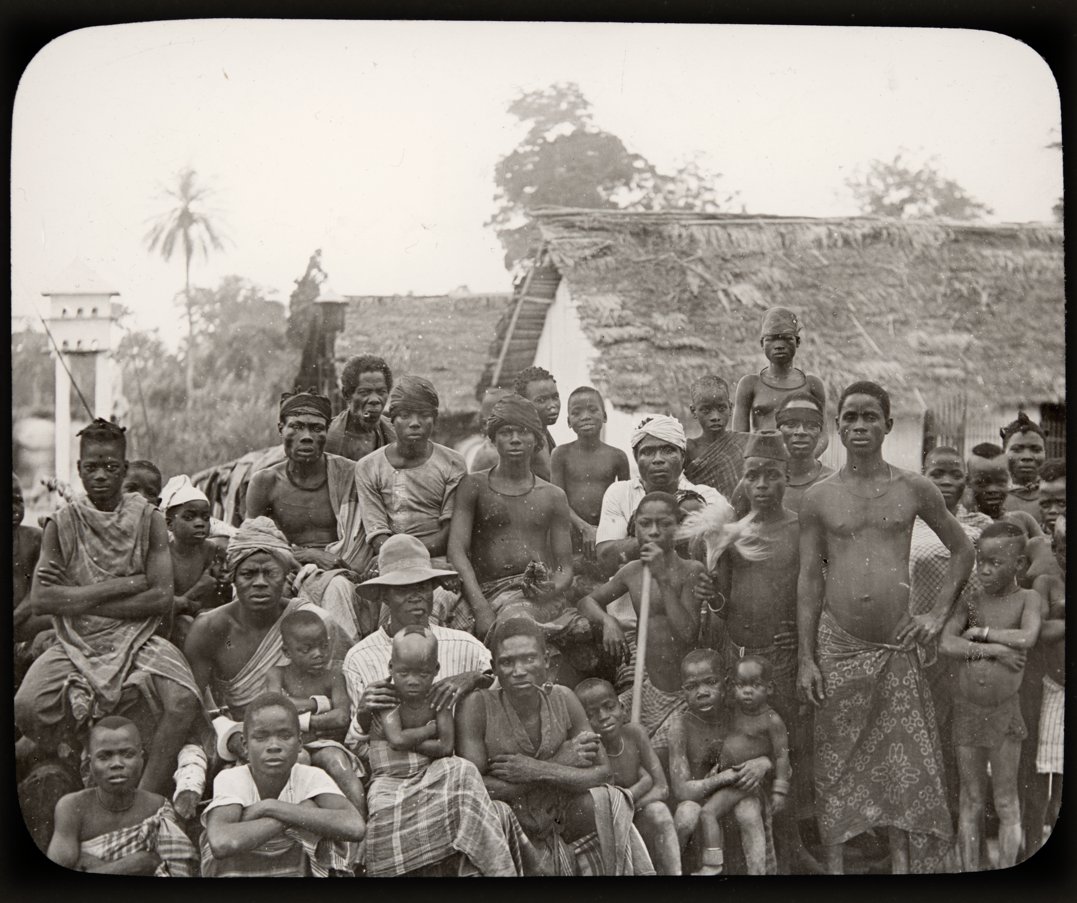
Portrait of an Igbo Woman
A photograph depicting a bust-length portrait of an Igbo woman in a frontal pose. She wears a light-colored, voluminous headwrap with dark repetitive decorative motifs and a light-colored short-sleeved blouse with a scooped neckline, decorative lace trim, and a single button. Visible dark, linear markings are present on her upper chest and sternum area. The image is presented as an oval vignette within a rectangular border. The photograph was taken by Dr. William Henry Crosse during his tenure as Principal …
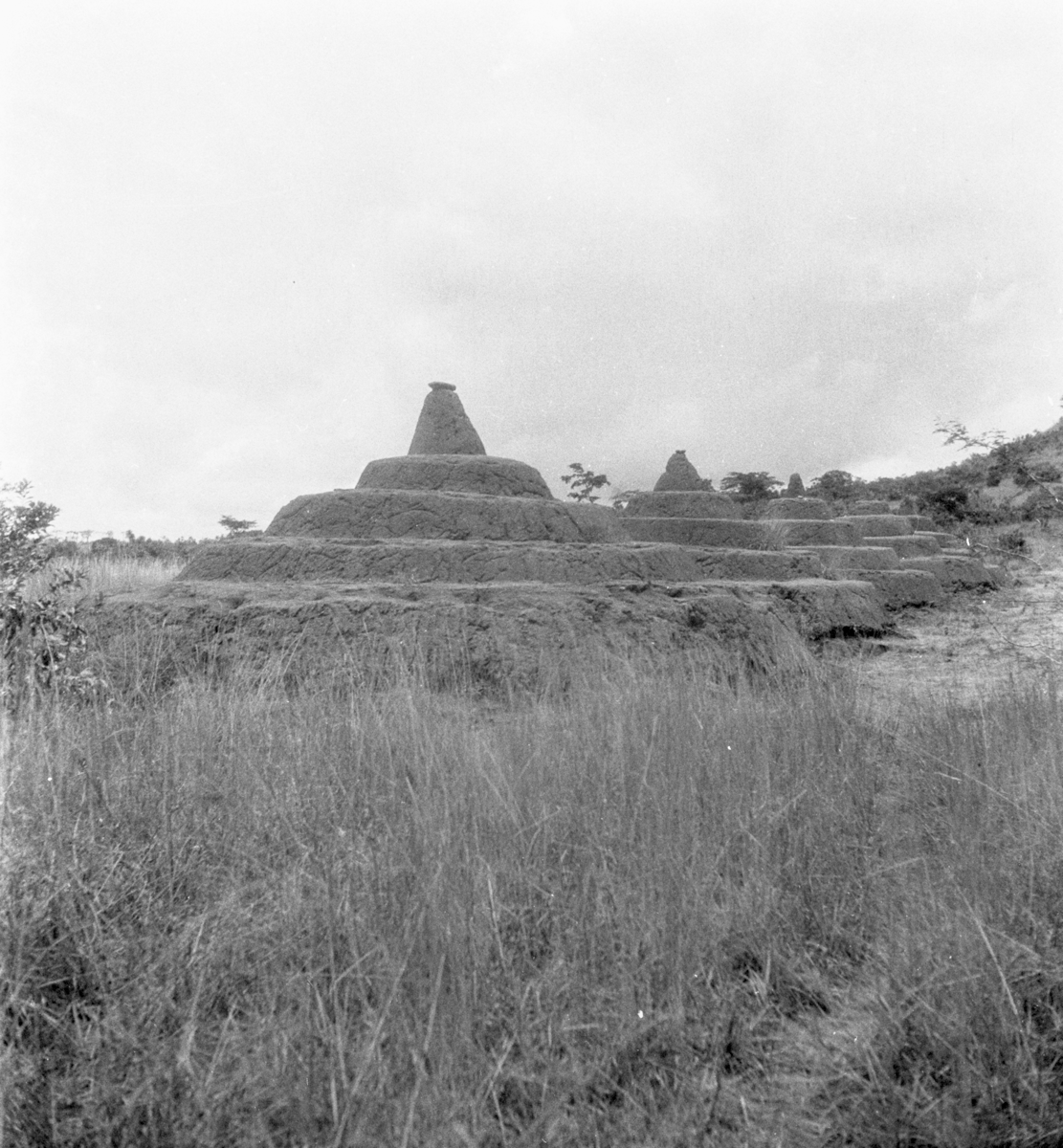
Pyramids at the Nsude Village Shrine, Abaja Igbo, Northern Igbo
This black-and-white photograph from the 1930s by G.I. Jones shows a series of stepped earthen pyramids at the Nsude village shrine in Abaja Igbo, Northern Igbo. The pyramids, constructed of mud, feature rounded graduated levels decreasing in size and culminating in a pointed top. Tall grasses and vegetation surround the structures, which are strategically placed on elevated ground. The image documents the architectural and religious significance of these shrine pyramids, which were associated with the Uto deity and represent important …
Iro Ekpetu of the Ogbugulu Mau Masquerade
This photograph by G.I. Jones documents the Ogbugulu Mau masquerade in Amuda village, featuring Iro Ekpetu ('Merciless'). The masquerader wears a black carved mask with white painted eyes and protruding teeth, a raffia hairpiece and skirt, and cloth top and trousers. The performance, held during the dry season usually in December, involved eight masked characters accompanied by two bands and a chorus of young men. Jones noted that these masks threatened the crowd with wands or sticks while wearing loose …
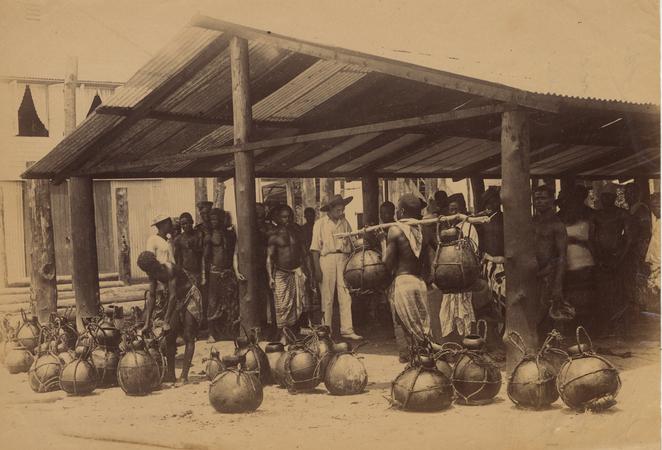
Palm Oil Market Scene in Akwete
A monochromatic photograph depicting a market scene in Akwete. The image shows a group of approximately 15 to 20 individuals, primarily Igbo men wearing waist-wrapped garments, gathered under an open-sided structure with a corrugated roof. Several large, spherical vessels encased in rope netting are visible on the ground, with one individual carrying two such vessels using a wooden yoke. A single individual is depicted in Western-style clothing, consisting of a long-sleeved shirt, trousers, and a wide-brimmed hat, appearing to be …
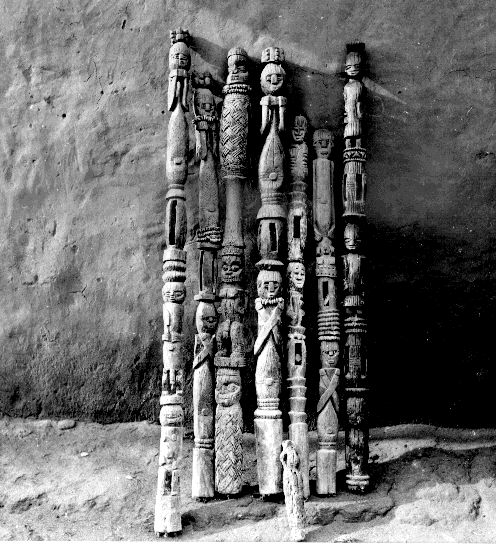
Uxurhe Staffs
A monochrome photograph depicting a collection of approximately eight carved wooden vertical shafts, identified as Uxurhe staffs. The shafts are slender and cylindrical, featuring relief carvings of anthropomorphic figures, including large-scale carved heads at the terminals and smaller human forms interspersed along the length. Decorative elements include horizontal bands, circumferential rings, and textural patterns such as chevrons and cross-hatching. The objects are shown leaning against a coarse, textured wall, with a strong light source from the left creating high-contrast shadows …
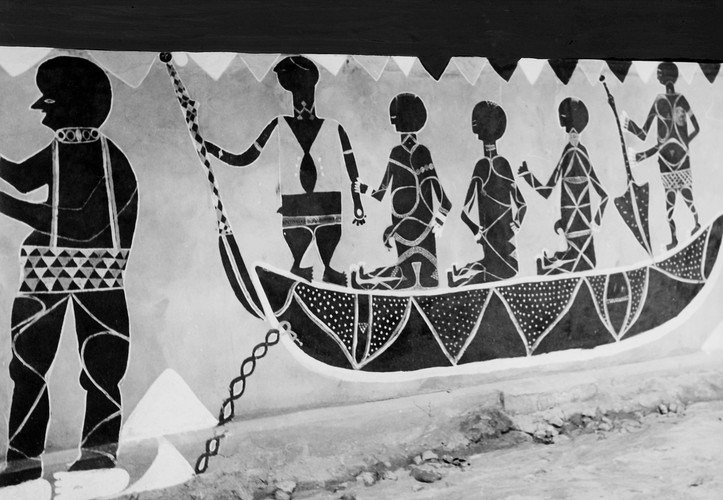
Painted Courthouse Mural at Nri
A photograph depicting a monochromatic mural on a flat, textured surface, located at a courthouse in Nri, Onitsha Province. The composition features six stylized human figures and a vessel, arranged in a linear progression from left to right. The figures are rendered as dark silhouettes overlaid with high-contrast white geometric patterns, including triangles, diamonds, and stippling, characteristic of the Uli art tradition. A large-scale figure anchors the left side, while a group of smaller figures is positioned within and around …
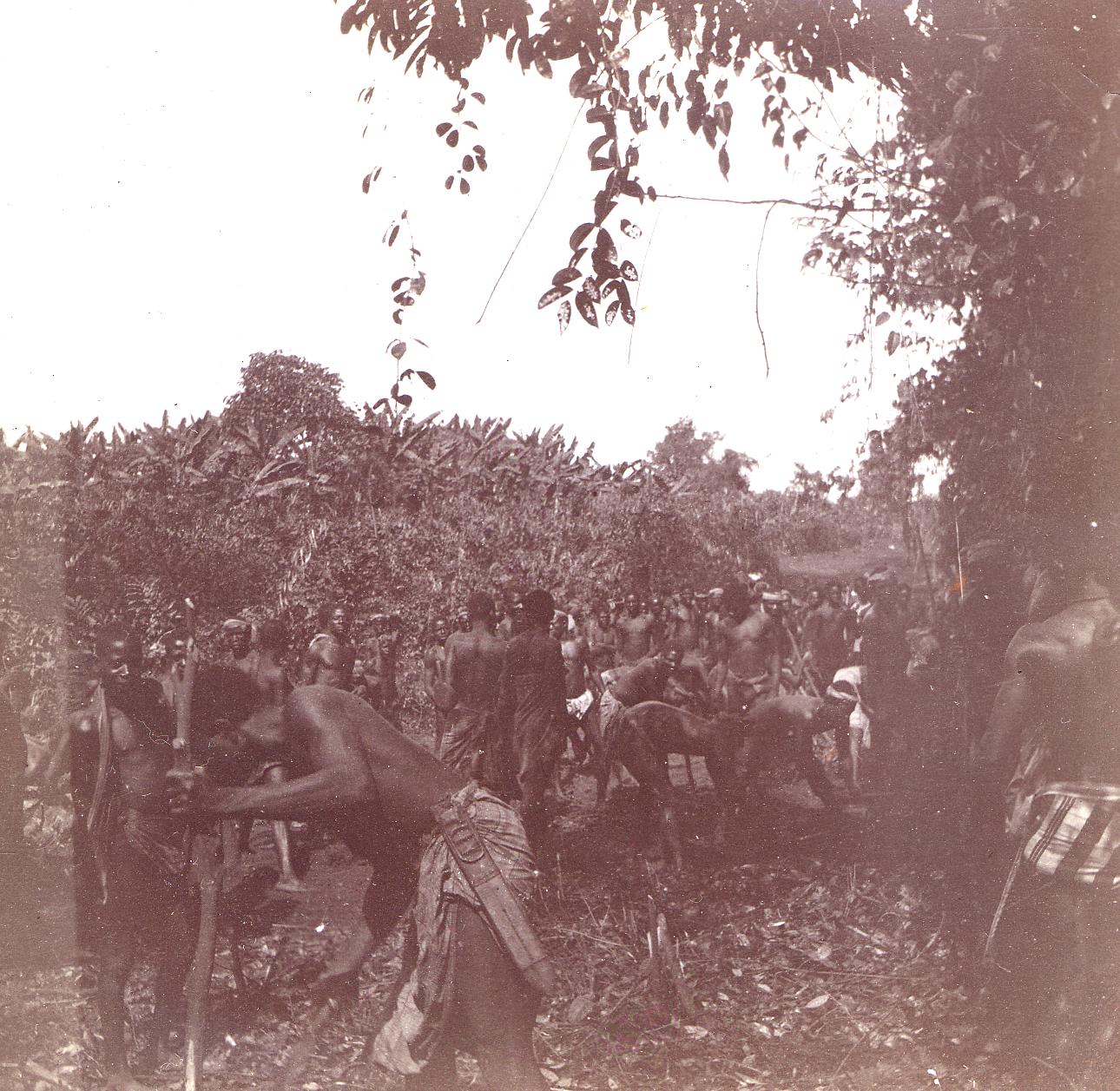
Aro men in loincloths clearing thick forest overgrowth under direction of colonial forces
This photograph, taken by Donald A. MacAlister as part of a series from the Aro Punitive Expedition, shows a group of Aro men clearing forest vegetation with machetes to facilitate British colonial troop movement during the Anglo-Aro War of 1901. The war sought to dismantle the Aro Confederacy and the Ibini Ukpabi (Long Juju) oracle, marking a significant event in British colonial efforts against indigenous powers in eastern Nigeria.
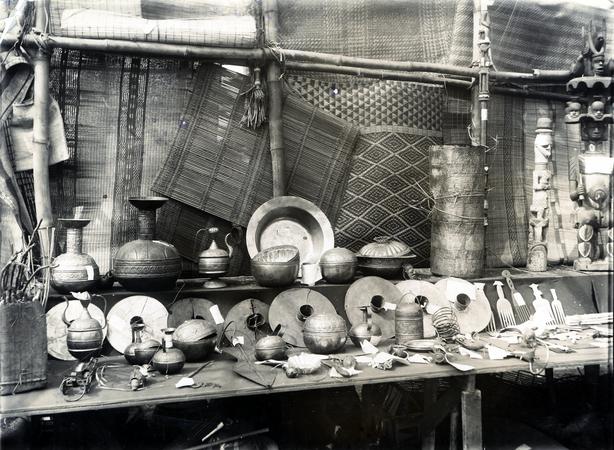
Exhibition Stall of Local Produce
A photograph depicting an exhibition stall housed within an open structure of bamboo poles. The display features a two-tiered wooden shelving system containing various artifacts, including Igbo carvings, Nupe brasswork, Igbo ankle-ornaments, Igbo combs, and mats. Two swords from Benin are also present alongside a musical instrument. The background and upper sections of the stall are lined with woven mats featuring geometric diamond and triangular motifs. The image is a gelatin silver print from the British Museum collection, part of …
G.I. Jones at Nsude Village Shrine Pyramid
A black-and-white photograph from the 1930s showing anthropologist G.I. Jones seated in front of a stepped earthen pyramid at the Nsude Village Shrine in Abaja, Northern Igbo region. The pyramid structure consists of rounded graduated steps decreasing in size and culminating in a pointed apex. The structure, made of mud, stands in an open area surrounded by grasses and vegetation. Jones is wearing shorts, a white shirt, and a pith helmet. The Nsude pyramids were temples dedicated to the deities …

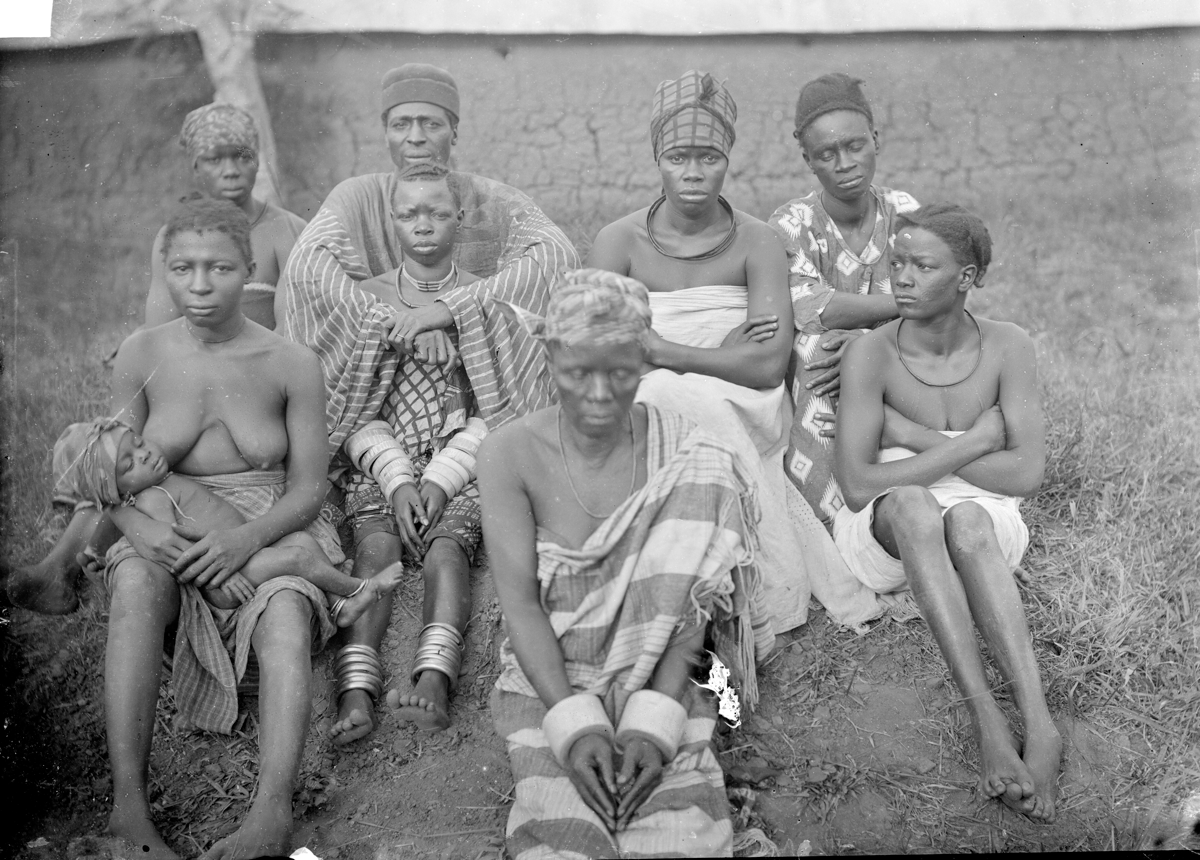
Family Group Portrait by William Henry Crosse
A monochrome photograph of a family. They are seated on an earthen incline against a textured vertical wall. Several individuals wear wrapped cloths with linear stripes or geometric patterns, and some women have bare upper torsos. Personal adornment is prominent, featuring thick cylindrical metallic bangles, wide metallic cuffs, and various necklaces. One adolescent girl wears multiple bracelets and metal ankle rings. The photograph was taken by Dr. William Henry Crosse, Principal Medical Officer of the Royal Niger Company, between 1886 …
An Igbo Elder from Awka, Wearing a War Helmet and Holding a Shield
This photograph, taken by Northcote Thomas around 1913, shows an Igbo elder from Awka wearing an okpu agha, a fibre 'crash' helmet plaited from coarse fibre of Colocasia antiquorum stems for defense against weapons, and holding an ekpeke, a woven shield. These items represent elements of traditional Igbo martial attire and protection in warfare.
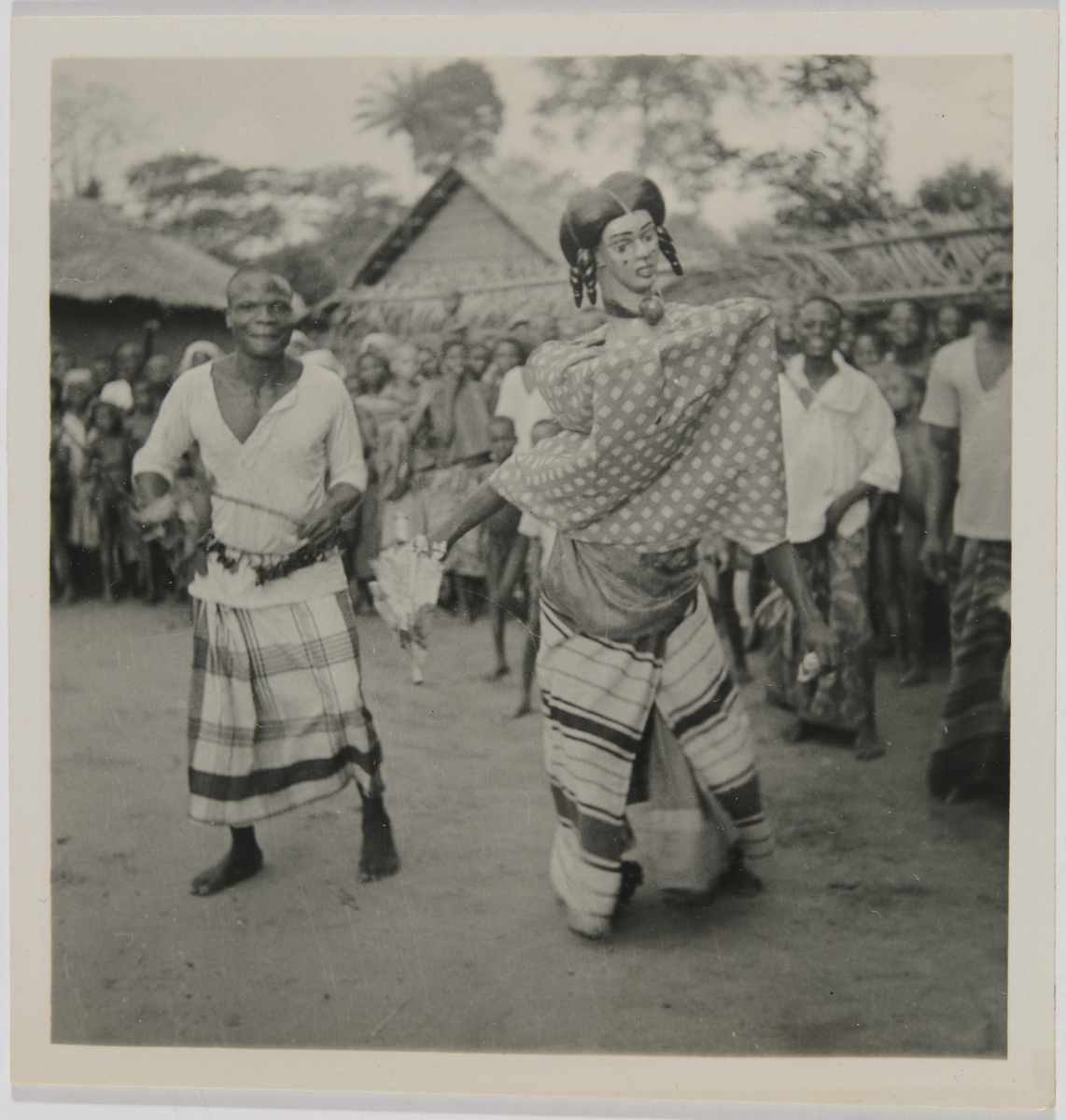
Ikem Masquerade Play in Umuahia
A black-and-white photograph depicting an Ikem masquerade play. The central figure is a masquerader wearing an Anang carved female face mask featuring naturalistic human features, dark eyebrows, a fine nose, and marks on the cheeks, topped with an elaborate black coiffure in large plaits. The mask is mounted over a square frame covered in printed cloth, and the masquerader wears a striped wrapper. The figure holds an umbrella in one hand and a handkerchief in the other. To the side …
Discover Our Platform
A comprehensive digital platform dedicated to preserving and celebrating Igbo culture, history, and heritage for future generations.
Cultural Archives
Explore our extensive collection of photographs, documents, artifacts, and historical records that tell the story of Igbo people.
Browse ArchivesCommunity Lore
Read and share perspectives on Igbo culture, traditions, and contemporary issues. Connect with writers preserving our heritage.
Read LoreBook Reviews
Discover and review books about Igbo culture, history, language, and literature. Build your knowledge through curated recommendations.
Browse BooksIgbo Archives AI
Chat with our AI assistant to learn about Igbo culture, get translations, analyze images, and receive personalized cultural lore.
Try AI AssistantCommunity
Join a vibrant community of culture enthusiasts, historians, and learners. Share knowledge and preserve our heritage together.
Join NowSupport Us
Help us preserve Igbo heritage for future generations. Your contribution keeps this platform running and growing.
DonateWhy Igbo Archives?
Preserve Heritage
Digitally preserve Igbo cultural artifacts for future generations
Global Access
Connect Igbo people worldwide with their roots and heritage
Educational
Comprehensive resources for learning and research
Community-Driven
Built by the community, for the community