
Anthropological Report on the Ibo-Speaking Peoples of Nigeria, Vol. 2: English-Ibo and Ibo-English Dictionary
by Northcote Thomas

Book Author / Creator
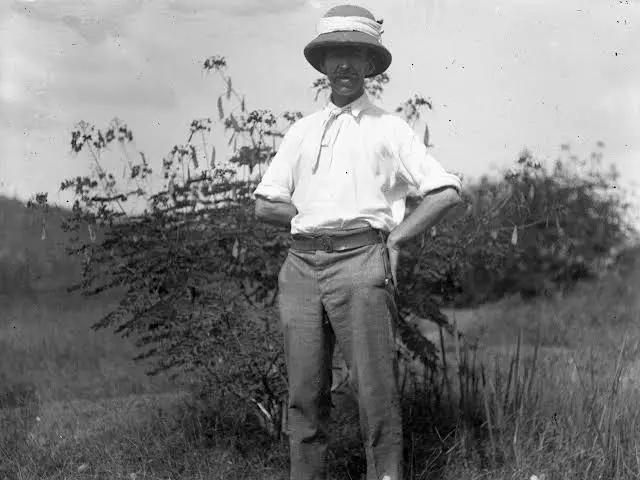
Northcote Whitridge Thomas (1868–1936) was a British anthropologist and the first person to be appointed as a Government Anthropologist by the Colonial Office. From 1909 …
Read full bio →A Linguistic Time Capsule
Anthropological Report on the Ibo-Speaking Peoples of Nigeria, Vol. 2 serves as the dictionary component of Northcote Thomas's comprehensive survey. Published in 1913, this English-Ibo and Ibo-English dictionary is one of the earliest extensive lexicographical works on the language. It captures the state of the Igbo language at a pivotal moment—just as colonial administration and mission schools were beginning to standardize (and sometimes distort) the various dialects into a 'Union Ibo.' As such, it acts as a linguistic time capsule, preserving words and meanings that have arguably shifted or disappeared in contemporary usage.
Awka and Onitsha Dialects
A key feature of this dictionary is its focus on the Awka and Onitsha dialects, which Thomas identified as the most commercially and politically significant at the time. Entries are often marked with 'A' or 'O' to denote regional specificity. This distinction is vital for linguists and historians, as it documents the subtle differences in vocabulary and pronunciation between these two major Igbo centers. For example, it highlights variations in terms for household tools, titles, and ritual objects, providing evidence of the rich dialectal diversity that existed before the emergence of 'Central Igbo.'
Scope and Methodology
The dictionary was compiled based on material collected directly from native informants during Thomas's tour in 1911. It covers a wide range of vocabulary, from everyday agricultural terms to complex religious and legal concepts. While the orthography (spelling system) differs from the modern 'Onwu' standard used today, the phonetic notations offer clues to historical pronunciation. The English-Ibo section was designed to assist colonial officers in learning the language, making it a record of the colonial interface—showing which concepts the British deemed important enough to translate and interact with.
Significance for Researchers
Today, this volume is less of a practical tool for learning modern Igbo and more of a scholarly resource. It allows researchers to trace the etymology of words and understand how the Igbo lexicon adapted to early colonial contact. It is also an essential companion to Thomas's other volumes; to fully understand the native texts in his 'Proverbs' and 'Law and Custom' reports, one often needs to consult this dictionary. It stands as a monument to the early efforts to codify one of West Africa's major languages.


You May Also Like
Who Fears Death
By Nnedi Okorafor
Lake Goddess
By Flora Nwapa
Dear Ijeawele, or A Feminist Manifesto in Fifteen Suggestions
By Chimamanda Ngozi Adichie
Toads for Supper
By Vincent Chukwuemeka Ike
Juo Obinna
By Tony Uchenna Ubesie
Encyclopaedia of Igbo Artefacts
By Dandy Ahaoma Ahuruonye
Binti
By Nnedi Okorafor
Sanctificum
By Christopher Abani
The Agwu deity in Igbo religion
By Jude C. U. Aguwa