

Preserving the Past,
Inspiring the Future
Explore the rich cultural heritage of the Igbo people through our comprehensive digital archives, community lore, and educational resources.
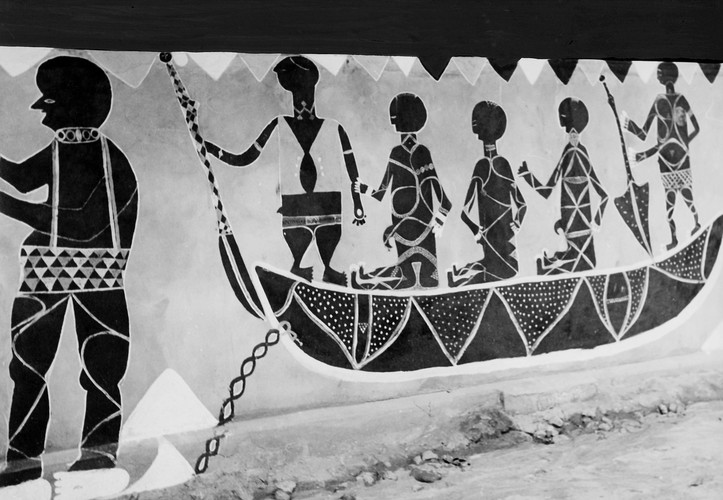
Painted Courthouse Mural at Nri
A photograph depicting a monochromatic mural on a flat, textured surface, located at a courthouse in Nri, Onitsha Province. The composition features six stylized human figures and a vessel, arranged in a linear progression from left to right. The figures are rendered as dark silhouettes overlaid with high-contrast white geometric patterns, including triangles, diamonds, and stippling, characteristic of the Uli art tradition. A large-scale figure anchors the left side, while a group of smaller figures is positioned within and around …
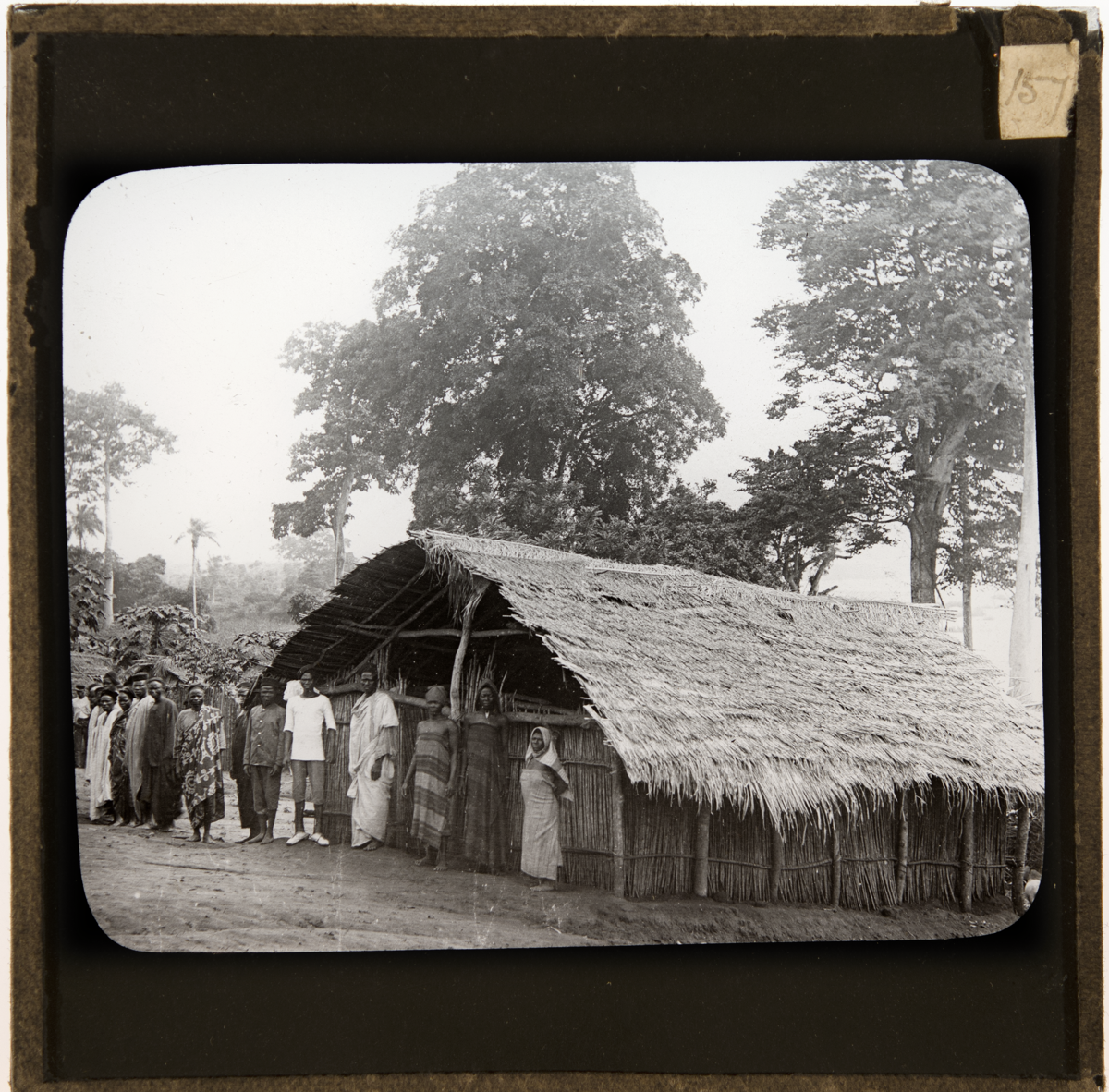
Group Portrait from Royal Niger Company
A photograph depicting approximately 13 individuals standing in a horizontal line before a long, low-profile building. The structure features a steeply pitched gabled roof made of thatch or plant fibers and walls constructed from vertical organic elements such as reeds or wooden poles. The subjects exhibit a variety of clothing, including traditional wrapped textiles with geometric or organic motifs, and Western-influenced attire such as button-down shirts, shorts, and trousers. The setting is characterized by a flat, unpaved earth surface and …
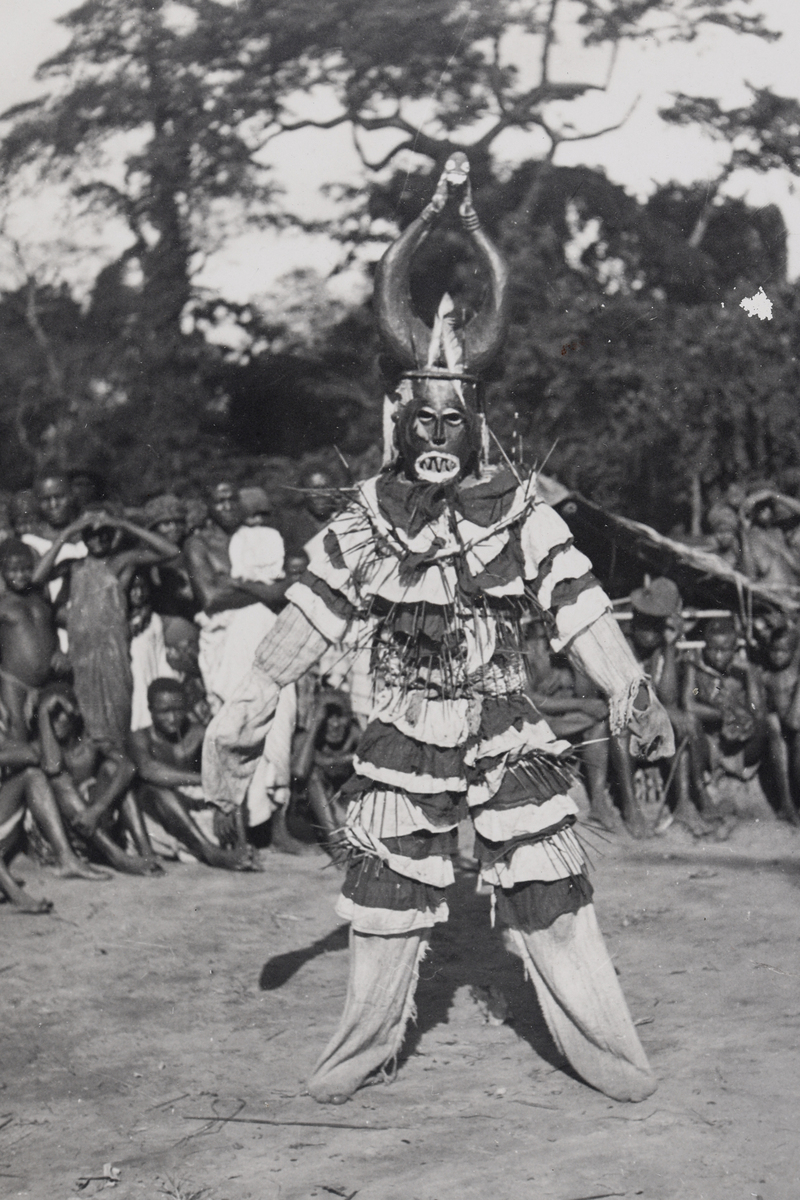
Oganochi Mgbedike Masquerader, Nimo
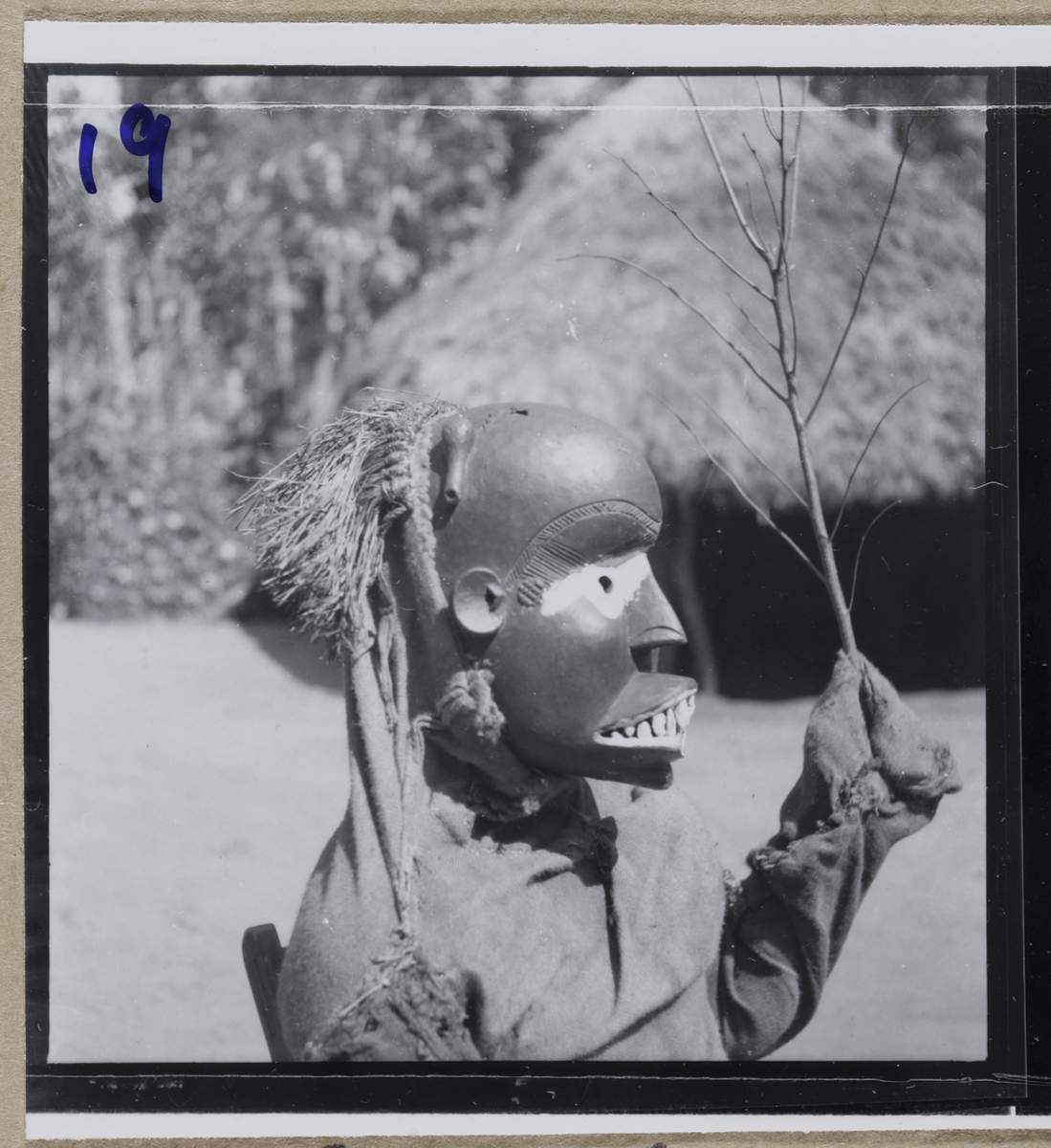
This black-and-white photograph shows an Oganochi mgbedike masquerader standing and facing the camera. The masquerader wears a full-length cloth costume with light and dark striped ruffles on the body, upper arms, and legs. Porcupine quills hang from the edges of the ruffles. The dark wooden helmet mask features white paint accentuating the mouth, teeth, and eyes. Two feathers are held in the front of the band at the bottom of the horns. Four carved horns curl inwards on top of …
G.I. Jones at Nsude Village Shrine Pyramid
A black-and-white photograph from the 1930s showing anthropologist G.I. Jones seated in front of a stepped earthen pyramid at the Nsude Village Shrine in Abaja, Northern Igbo region. The pyramid structure consists of rounded graduated steps decreasing in size and culminating in a pointed apex. The structure, made of mud, stands in an open area surrounded by grasses and vegetation. Jones is wearing shorts, a white shirt, and a pith helmet. The Nsude pyramids were temples dedicated to the deities …

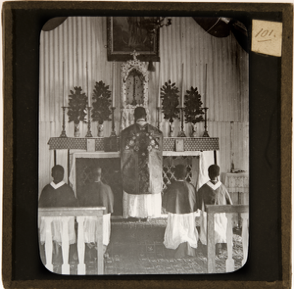
African Priest and Altar Boys at a Christian Church
A photograph depicting an African priest and four altar boys worshipping at a Christian church. The priest wears a white alb and a dark embroidered chasuble with floral motifs. The four boys are dressed in dark short capes over white ankle-length garments with lace-like edging. The church interior is constructed from corrugated iron. The altar is decorated with candles, floral garlands, and a patterned cloth, with a rug featuring geometric motifs on the floor.
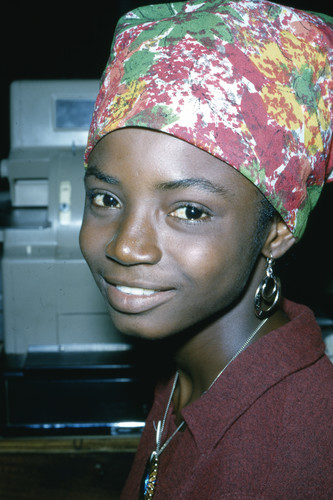
Portrait of an Igbo Woman Clerk in Maiduguri
A photograph depicting a young Igbo woman employed as a clerk in Maiduguri. The subject is shown in a three-quarter profile, facing left, with a smile. She wears a multicolored, mottled textile head wrap with red, green, yellow, and white pigments, large metallic-toned hoop earrings, and a metallic-toned chain necklace with a rounded dark pendant. Her garment is burgundy with a visible collar. The background is an indoor setting with low ambient light, featuring a blurred mechanical or electronic device …
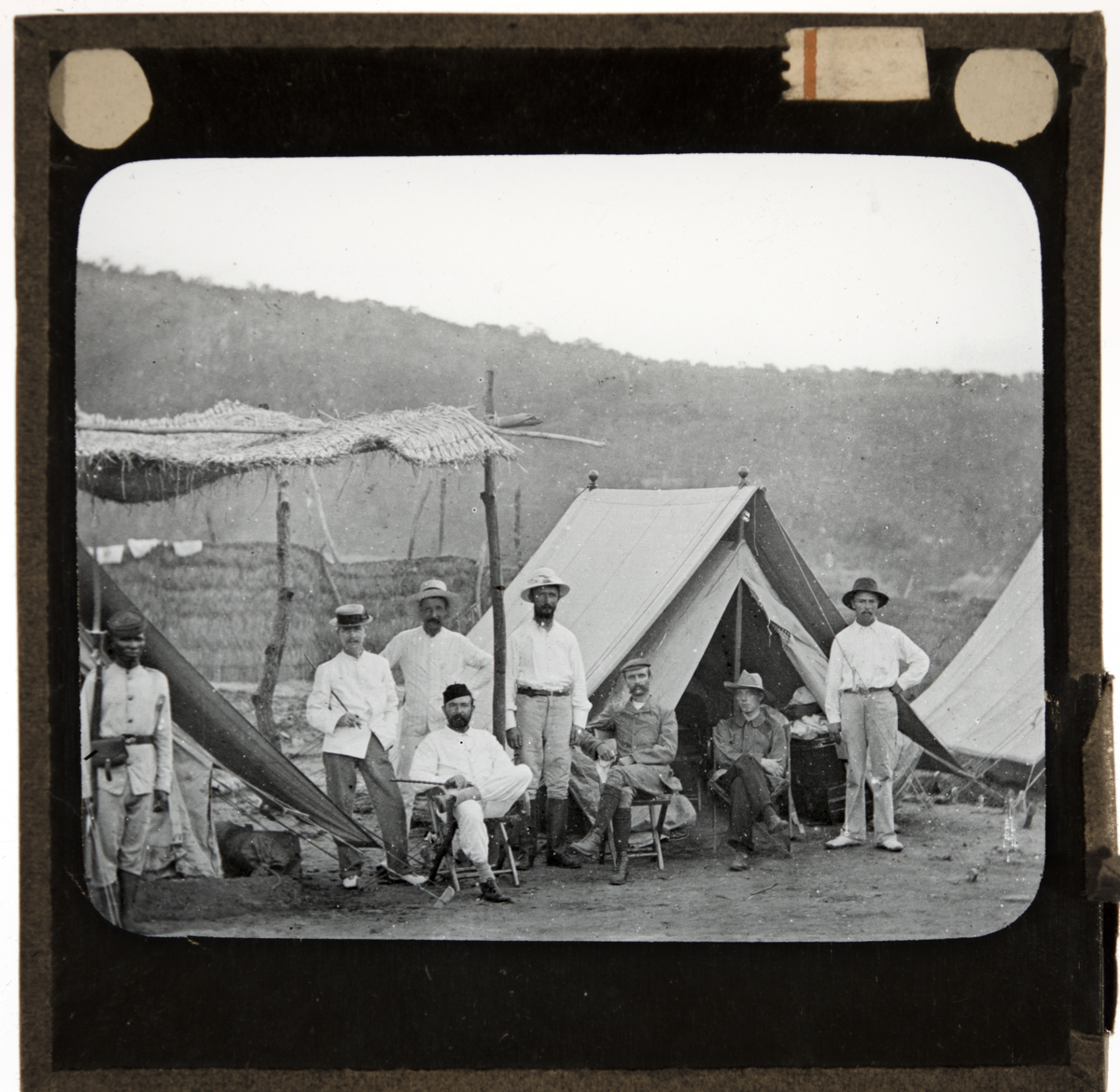
European Men and African Man at a Royal Niger Company Encampment
A photograph depicting a group of eight men at a temporary encampment. Seven light-skinned men are positioned standing and seated, wearing utilitarian warm-weather attire including pith helmets, boater hats, and white tunics. A dark-skinned man in a light-colored jacket and structured cap stands at attention on the left. The setting includes a large A-frame canvas tent, a thatched structure, and woven perimeter fences against a backdrop of a sloping, vegetated hill. The image is part of the Crosse Collection, associated …
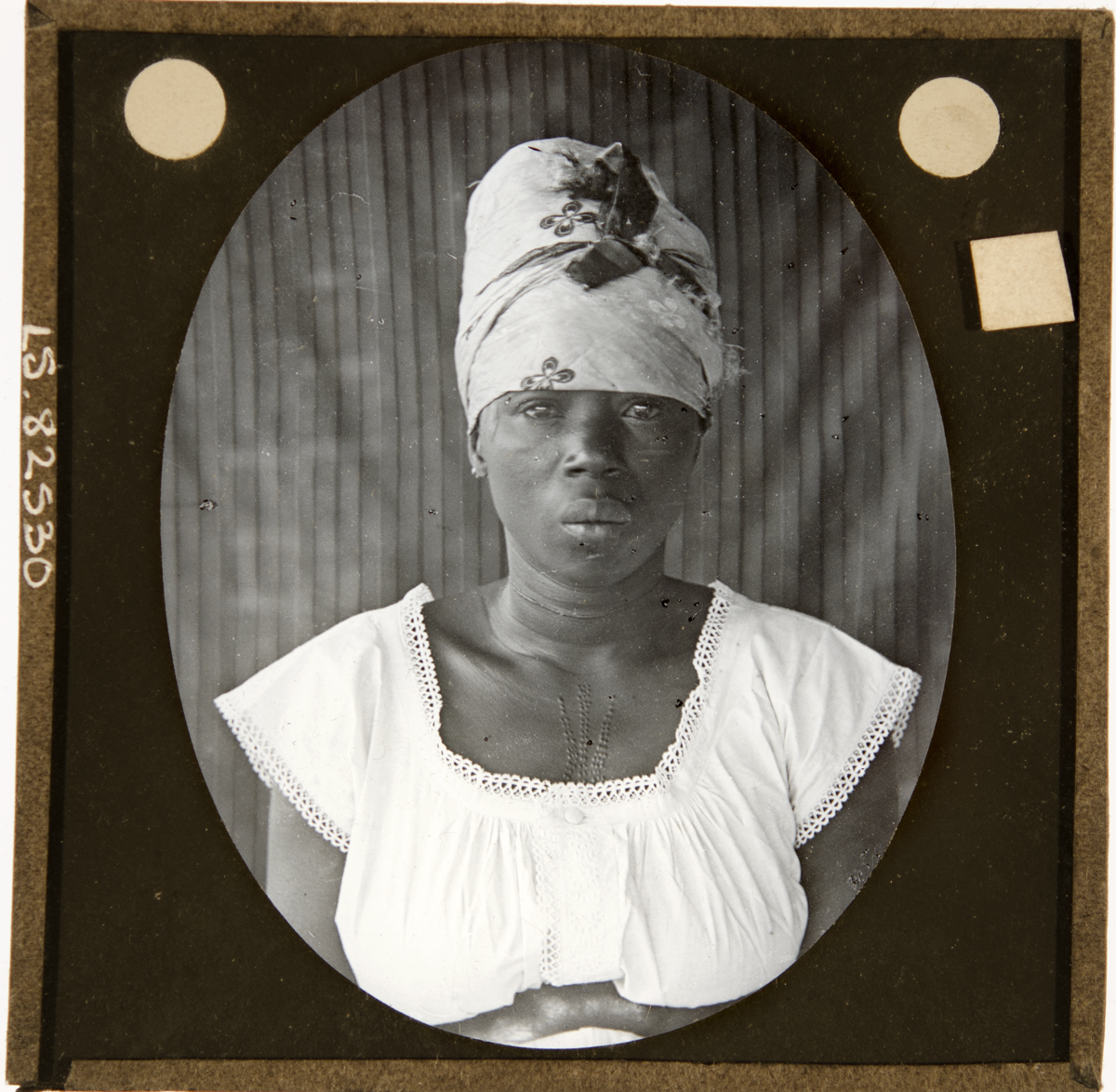
Portrait of an Igbo Woman
A photograph depicting a bust-length portrait of an Igbo woman in a frontal pose. She wears a light-colored, voluminous headwrap with dark repetitive decorative motifs and a light-colored short-sleeved blouse with a scooped neckline, decorative lace trim, and a single button. Visible dark, linear markings are present on her upper chest and sternum area. The image is presented as an oval vignette within a rectangular border. The photograph was taken by Dr. William Henry Crosse during his tenure as Principal …
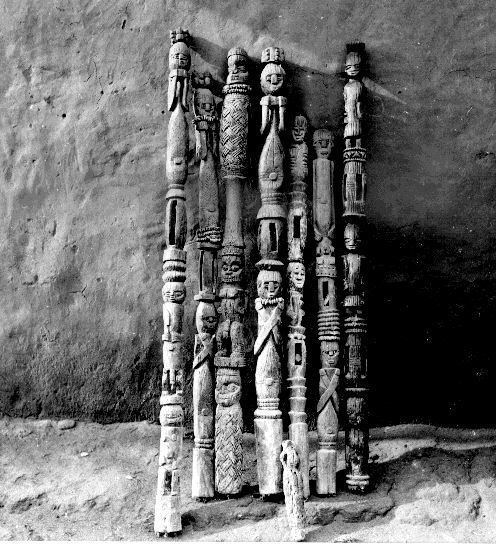
Uxurhe Staffs
A monochrome photograph depicting a collection of approximately eight carved wooden vertical shafts, identified as Uxurhe staffs. The shafts are slender and cylindrical, featuring relief carvings of anthropomorphic figures, including large-scale carved heads at the terminals and smaller human forms interspersed along the length. Decorative elements include horizontal bands, circumferential rings, and textural patterns such as chevrons and cross-hatching. The objects are shown leaning against a coarse, textured wall, with a strong light source from the left creating high-contrast shadows …
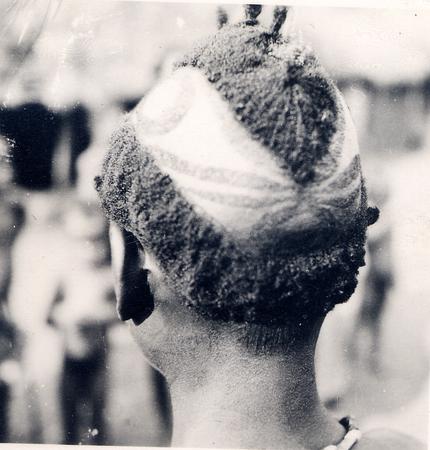
Rearview of Igbo Boy with Elaborate Hairstyle
A monochrome photograph depicting the back of the head of a young Igbo boy. The subject features a highly structured, conical hairstyle with tightly coiled hair extending upward, adorned with a light-colored, flexible material wrapped horizontally around the mid-section. The hair contains shaved and painted areas, consistent with traditional aesthetics. The background is shallow and blurred, showing indistinct silhouettes of other human figures in an outdoor communal setting. The image is a gelatin silver print characterized by analog film grain.
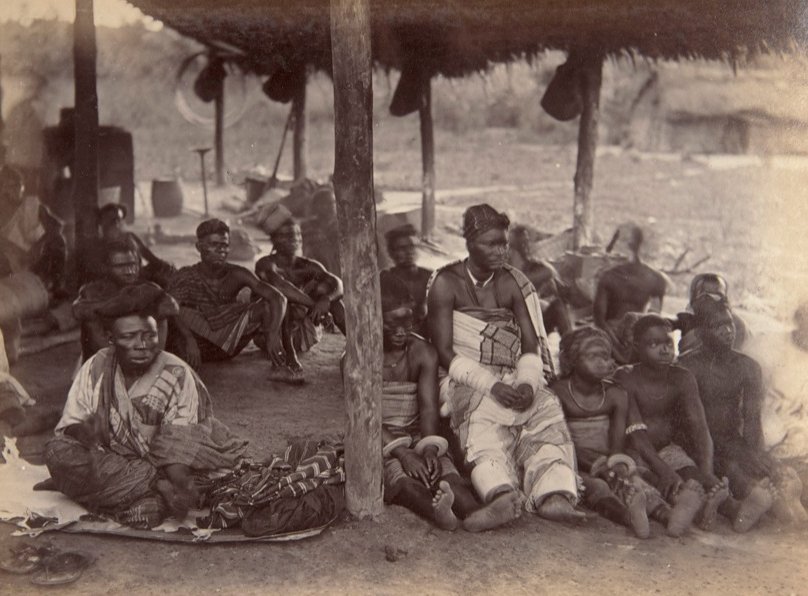
Trader from Timbuctou and Rich Trading Woman
This photograph, taken by G.F. Packer in 1889 and housed in the Pitt Rivers Museum, features a trader from Timbuktu on the right and a rich trading woman on the left, possibly a member of the Onitsha women's Otu Odu (ivory group) society or an Omu, the female counterpart to the king. The woman wears large ivory anklets, indicative of high socio-economic status in this traders' group. The image illustrates long-standing trade connections across West Africa and Igbo commerce along …
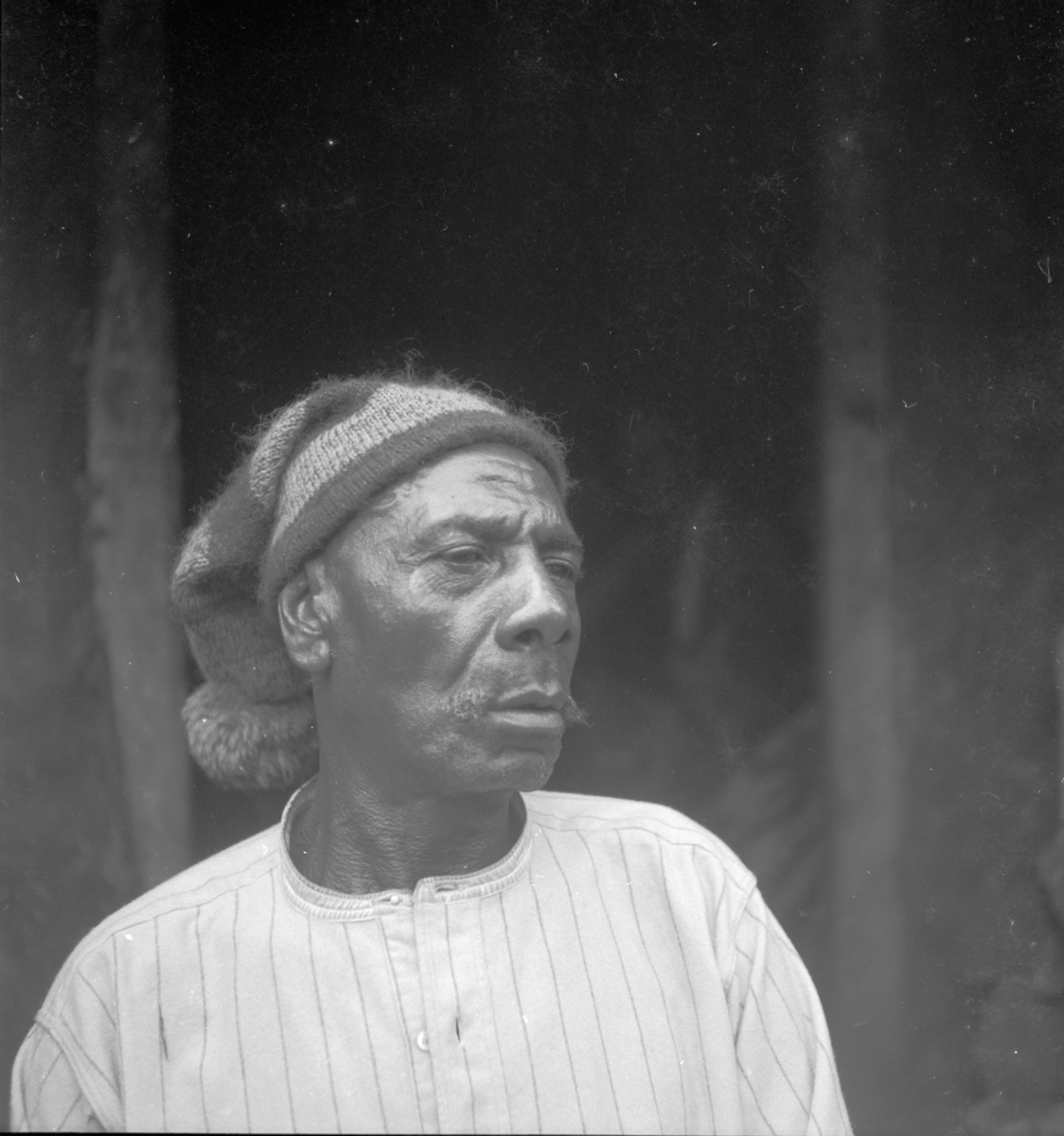
Igbo Elder in Knit Hat Portrait
This black-and-white photograph from the 1930s by G.I. Jones shows a close-up portrait of an elderly Igbo man. He wears a white tunic shirt and a distinctive striped knit hat with a pom-pom. The man's weathered face displays pronounced wrinkles, suggesting advanced age, with a neutral expression. The dark background with vertical elements appears to be natural vegetation or architectural features. This image is part of a series of portraits (N.13292.GIJ to N.13316.GIJ) for which no prints have been found. …
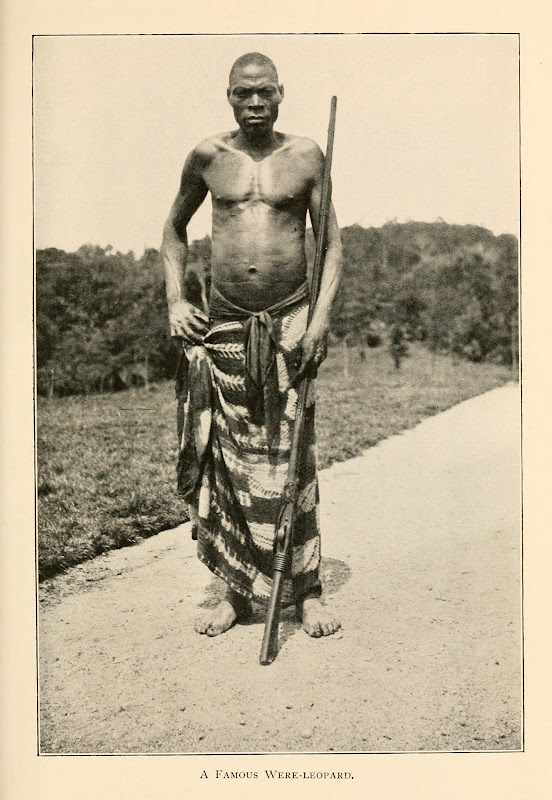
A Famous Were-Leopard
A monochrome photograph depicting an adult male standing on a dirt path in a forested environment. The subject is unclothed from the waist up and wears a wrap-around textile garment with high-contrast geometric patterns featuring diagonal bands and chevrons. He holds a long-barreled firearm in his left hand. The image is associated with Percy Amaury Talbot's 1923 publication, Life in Southern Nigeria, which discusses the belief in metamorphosis, known as Uworraw-Ukponn or Ehihi, and the spiritual bond between individuals and …
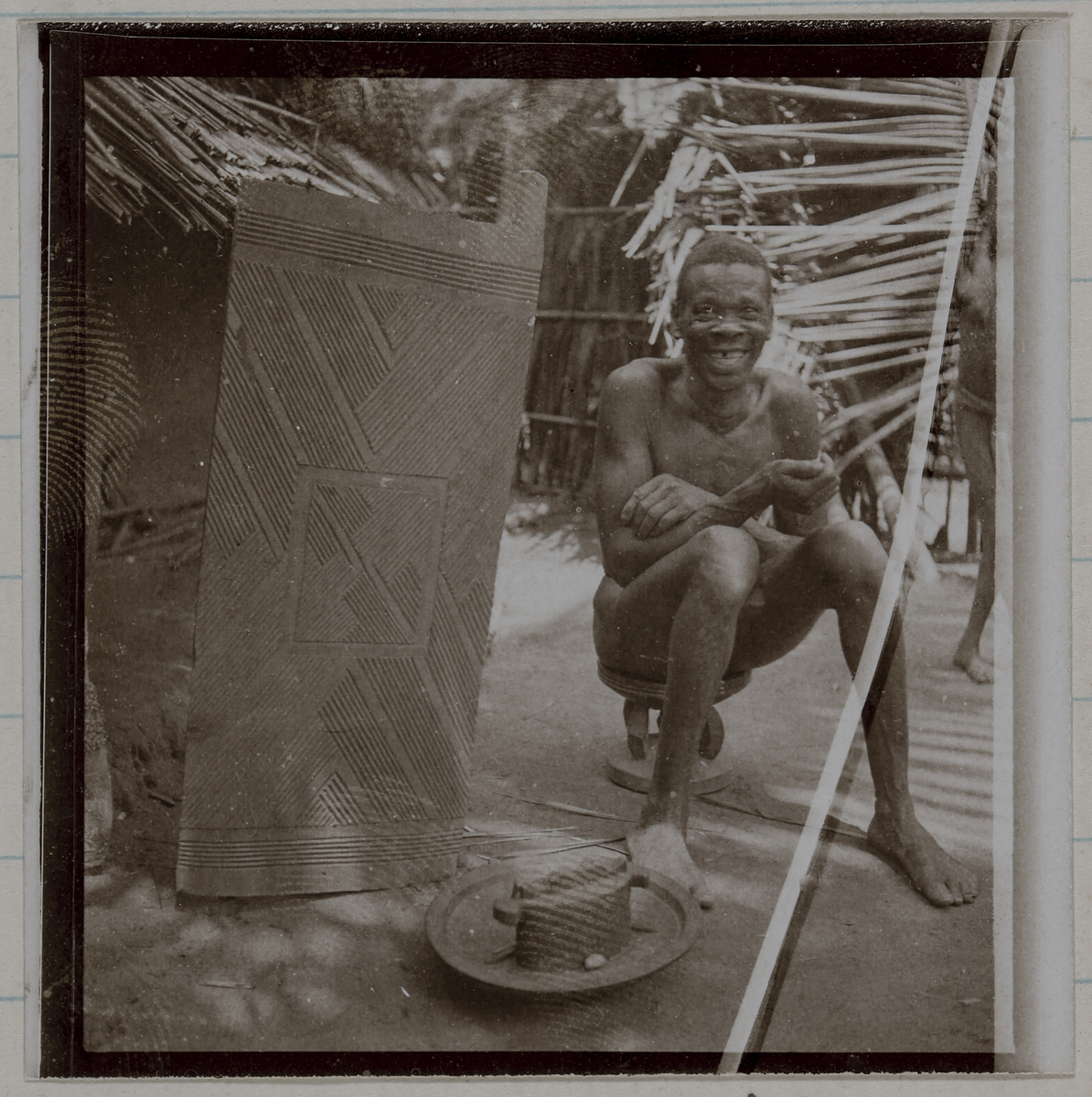
Portrait of a Man with Carved Wooden Door
A black-and-white photograph depicting an adult male seated on a low, tripod-style carved wooden stool. To his left is a large, vertical rectangular wooden panel featuring extensive geometric relief carving, including parallel linear grooves, a central square field with intersecting diagonal lines, and chevron patterns. The subject is shirtless and smiling, positioned in front of a structure made of organic materials with a thatched roof and walls of fibrous plant matter. In the foreground, a shallow circular tray and a …
Ohaffia Masquerader in Okwanku Performance, Akanu Village
Close-up view of an Ohaffia Igbo masquerader during the Okwanku performance in Akanu village. The wooden face mask displays a high forehead, slit eyes, elongated nose and mouth, all coated with white pigment. Long raffia strands form a fringe around the mask and hang over the performer’s chest. Spectators appear in soft focus behind. According to Jones, Okwanku masqueraders enacted a comic drama in which the character Dibia poisoned and revived the Rain Driver. The mask type, known as Otili, …

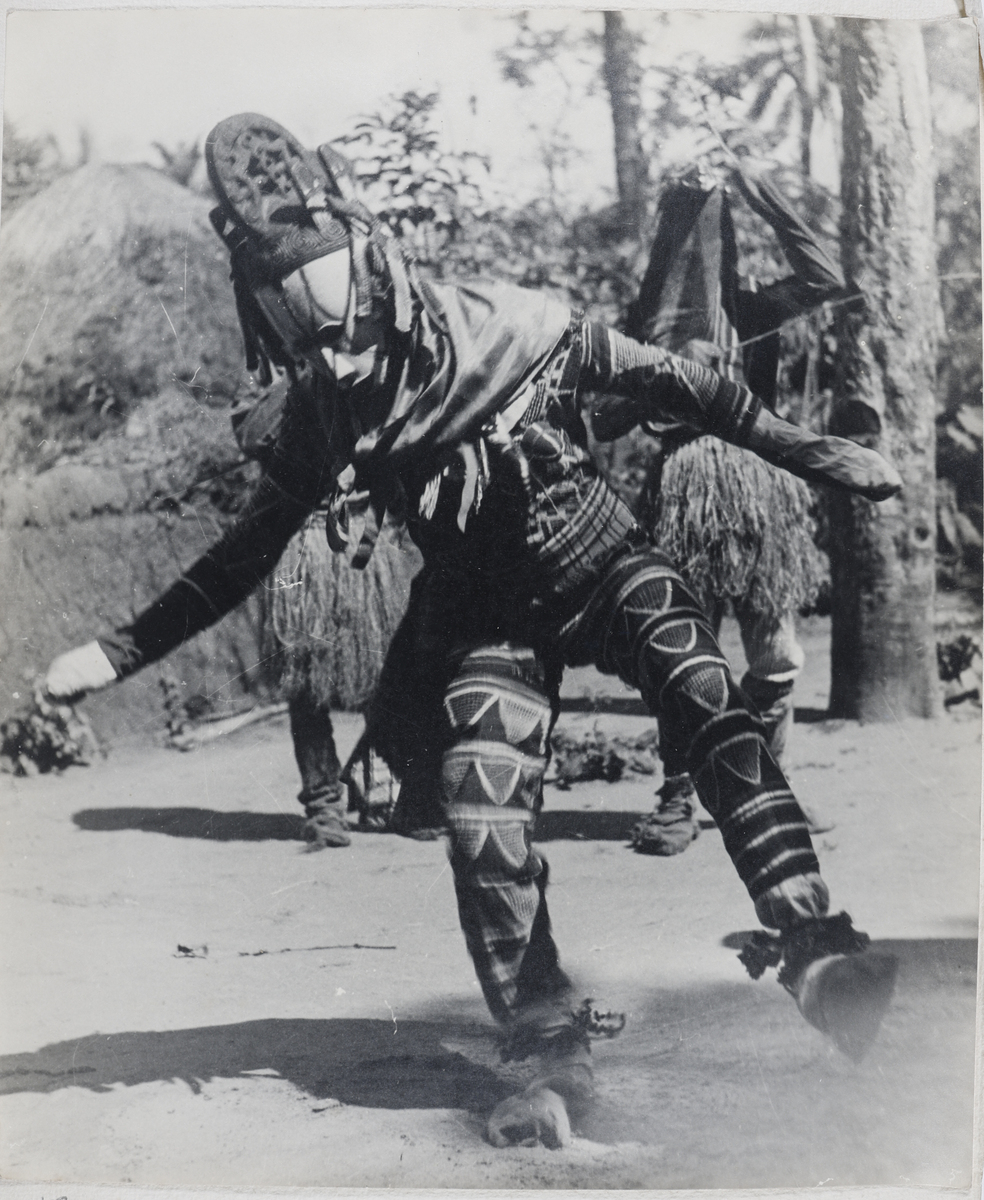
Ogbugulu Mau Masquerader Performing in Amuda Village
This black-and-white photograph captures the Ogbugulu Mau masquerade performance in Amuda village near Awka, southeastern Nigeria, between 1932 and 1938. The masquerader Nwaogho Ehi (Heifer) wears a white helmet mask with distinctive v-shaped markings above and below the eyes, a brightly colored harlequin-like appliqué costume, cloth cloak tied around the neck, and ankle-rattles made from seeds. The photograph documents Igbo masquerade traditions among the Isuochi people, showing the elaborate costume design and performance context within a rural setting with mud …
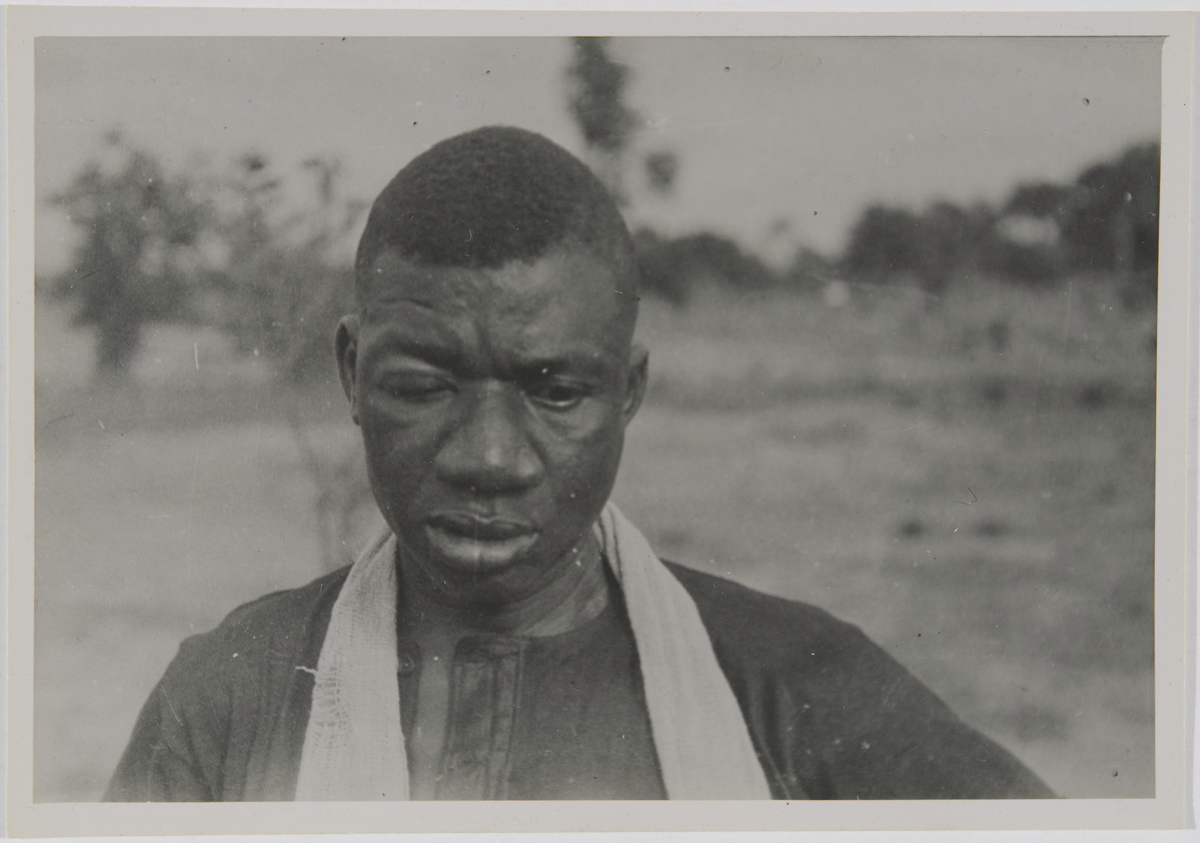
Portrait of a Man with Facial Scarring
A grayscale photograph depicting a head and shoulders portrait of a man facing the camera. He wears a collarless shirt with a dark-toned, textured garment and a light-colored cloth draped around his neck. The man's right eye appears to be scarred or bruised, with the eyelid puffed up and closed. The background consists of a shallow depth of field with out-of-focus natural elements, including trees and low-lying vegetation in an outdoor setting.
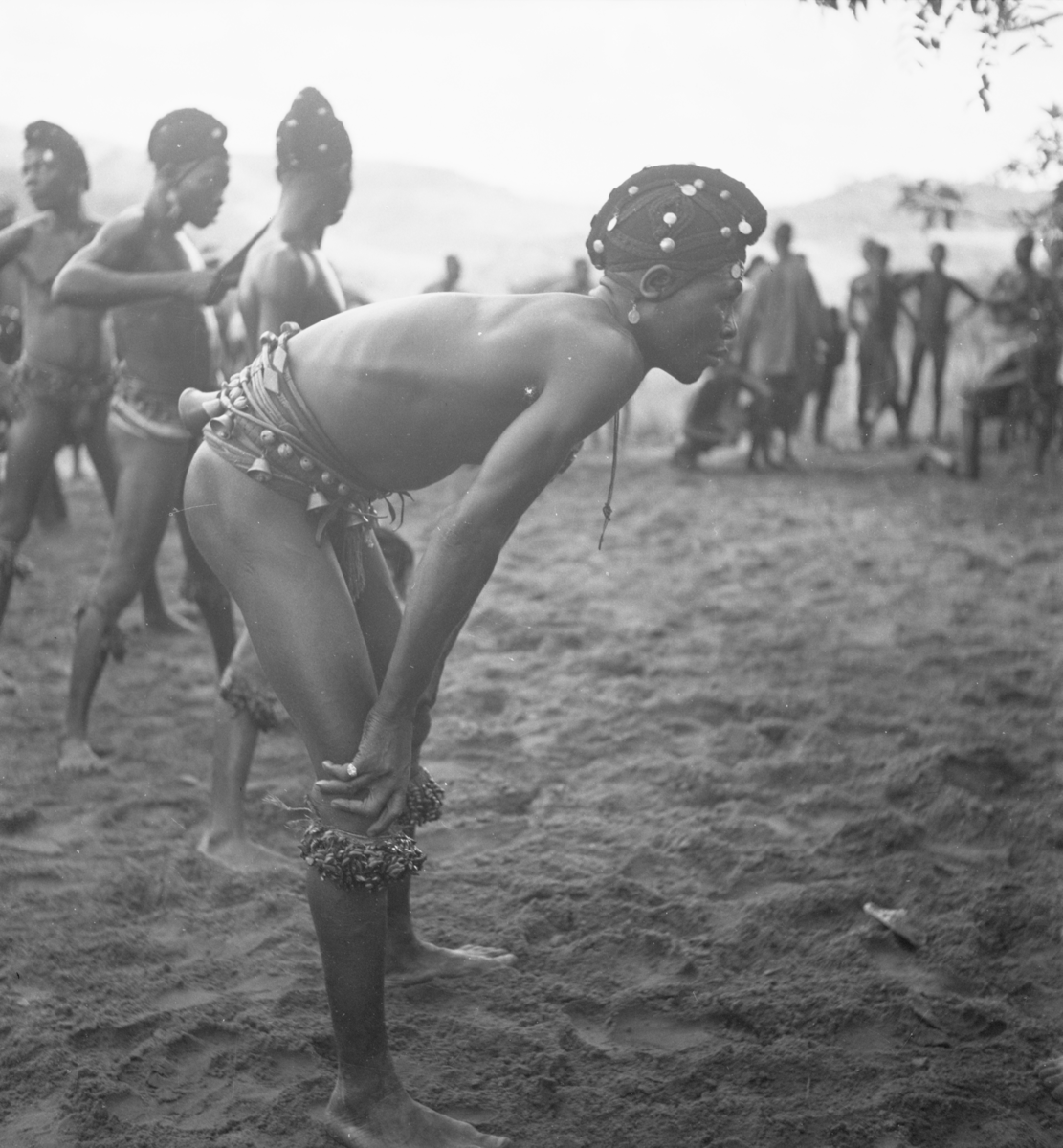
Boys' Initiation Dance in the Nri Akwa Area
A photograph depicting a boys' initiation dance in the Nri Akwa area. The male initiates are adorned with tight loin cloths decorated with bells around the waist, knee bands made of seeds or metal, and black caps styled as coiffure and studded with round metal decorations. Some individuals wear necklaces. In the background, spectators observe the ceremony. The image captures the physical posture of the initiates, including one subject in the foreground leaning forward at the waist with hands near …
Calabash Mask, Boys Initiation
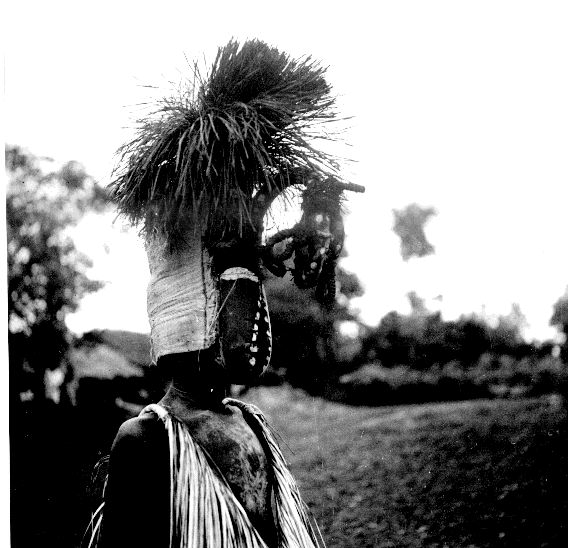
A photograph depicting a participant in a boys' initiation ritual in Nkporo. The individual is shown in profile, wearing a complex regalia consisting of a voluminous headpiece with elongated fibers extending vertically and radially. Beneath these fibers is a light-toned wrap covering the crown, and a dark, mask-like component attached to the side of the head featuring a vertical row of light-colored circular elements. The subject is adorned in a garment made of thin, vertical, light-toned fibrous strips, likely raffia …
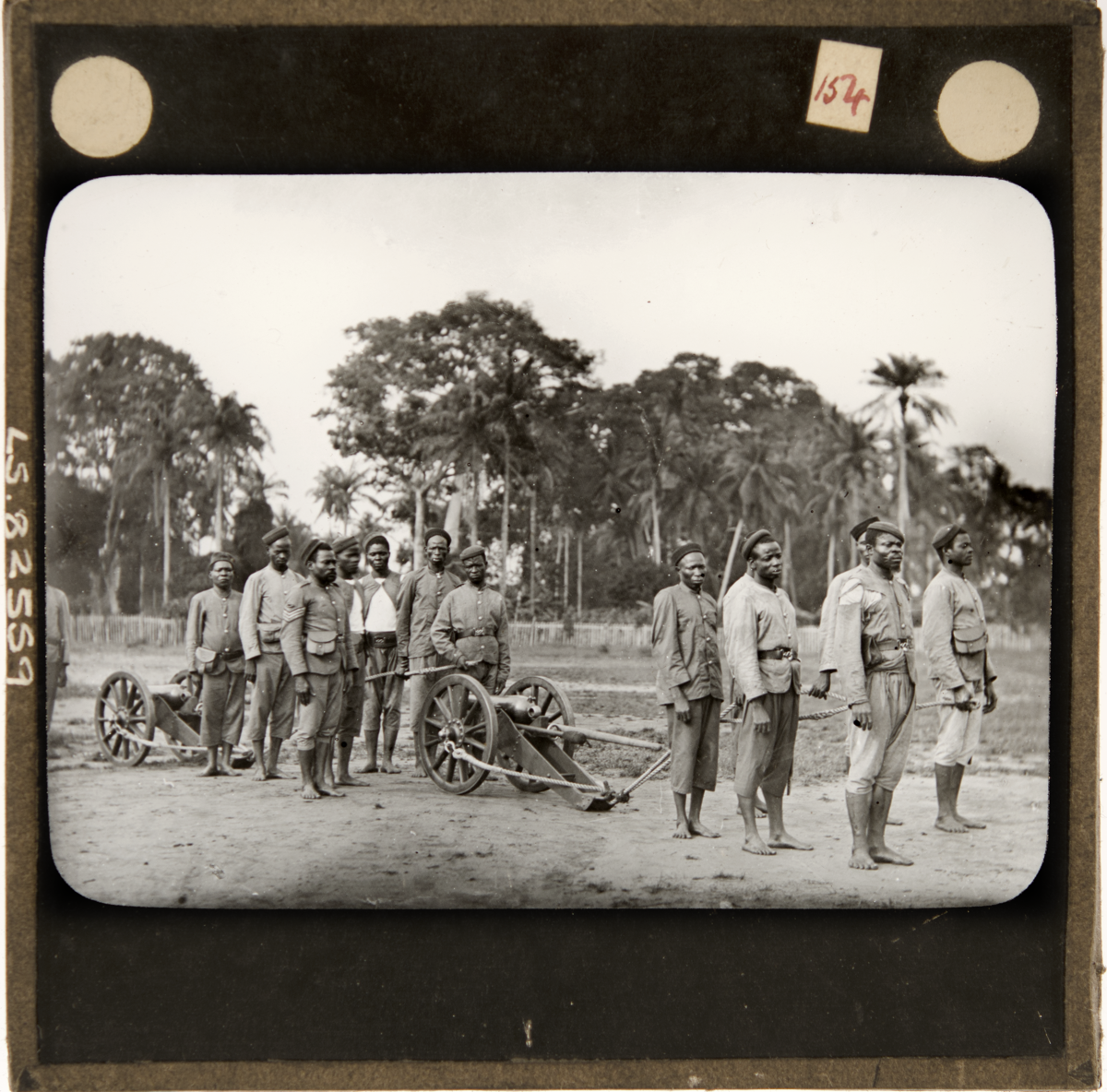
Soldiers of the Royal Niger Company
A photograph depicting approximately twelve men of African descent in light-colored military uniforms and dark pillbox caps. The subjects are positioned in a loose horizontal formation on a flat dirt expanse. Two light field artillery pieces, featuring dark metal barrels and wooden spoked wheels, are situated within the group. The background consists of a linear fence and tropical flora, including palm trees.
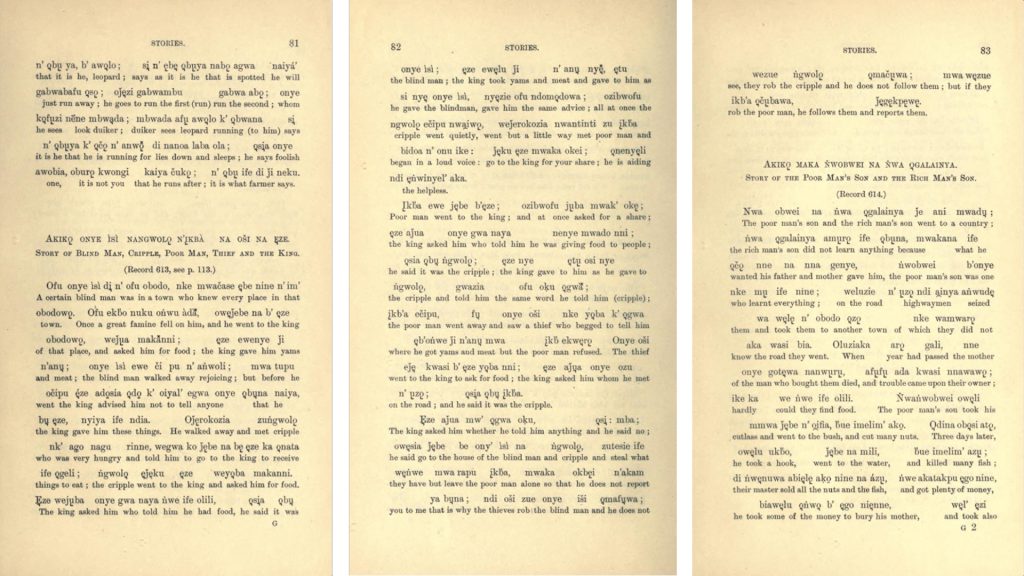
Excerpt from Anthropological Report on the Ibo-speaking Peoples of Nigeria
A photograph depicting three sequential pages (81, 82, and 83) from Northcote Thomas's 1914 publication, Anthropological Report on the Ibo-speaking Peoples of Nigeria, Part IV: Proverbs, Stories, Tones in Ibo. The pages feature a dual-script format with a primary language using a modified Latin alphabet with extensive diacritics, accompanied by English translations. Page 81 includes the story of the blind man, cripple, poor man, thief and the king (Record 613), and page 83 begins the story of the poor man's …
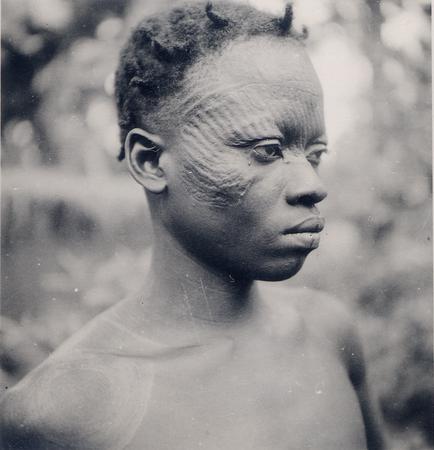
Portrait of an Igbo Man with Ichi Markings
A monochromatic photographic portrait of an Igbo man presented in a three-quarter profile view. The subject exhibits raised, hypertrophic ridges of Ichi scarification on the cheek, temple, and lateral forehead. His hair is plaited with small, vertical, cylindrical tufts on the crown of the head. The image is a gelatin silver print, set against a blurred natural background of vegetation. The portrait captures the dermal modifications and cranial styling typical of Igbo nobility during the late 19th to early 20th …
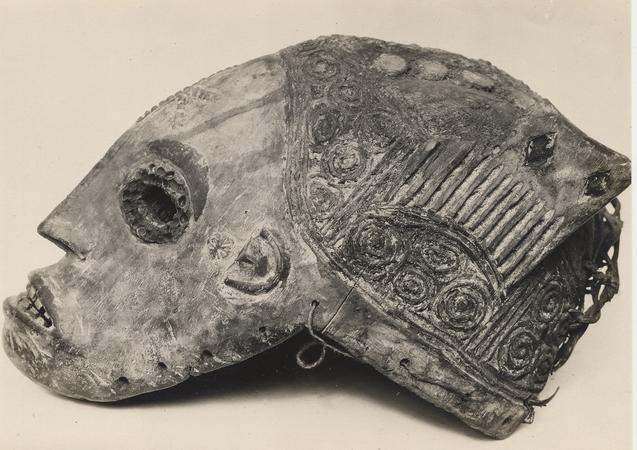
Agbhogho Mmanwu Maiden Mask
A photograph depicting a profile view of an Agbhogho Mmanwu maiden mask. The object is a stylized human head carved from wood and painted, featuring a prominent nose, thick lips, and a slightly open mouth revealing segmented teeth. The cranium is adorned with high-relief carvings, including parallel vertical ridges, spiral motifs, and dotted patterns. Perforations at the base and posterior edge indicate the mask was intended for attachment. The image is a monochromatic gelatin silver print set against a neutral …
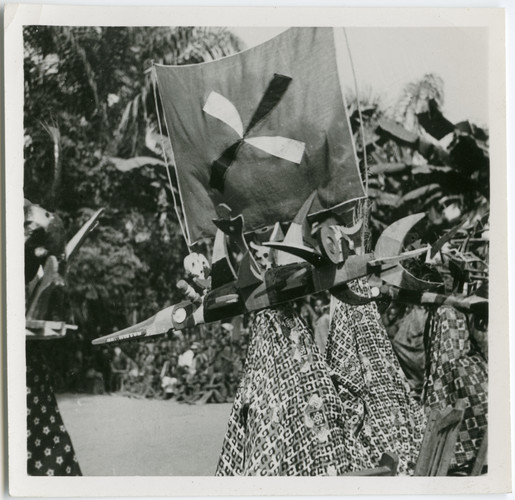
Dancer Wearing Fish Mask
A photograph depicting a dancer wearing a ceremonial mask representing a fish. The apparatus is an elongated, tapered horizontal structure with a crest-like form, featuring small, stylized facial motifs and light-colored decorative accents. A rectangular textile banner with a central four-pointed motif is mounted atop the structure. The dancer and other participants wear wrap-around garments with dense, repetitive geometric patterns of interlocking squares and diamonds. The scene is set outdoors in a tropical environment with dense vegetation and a crowd …
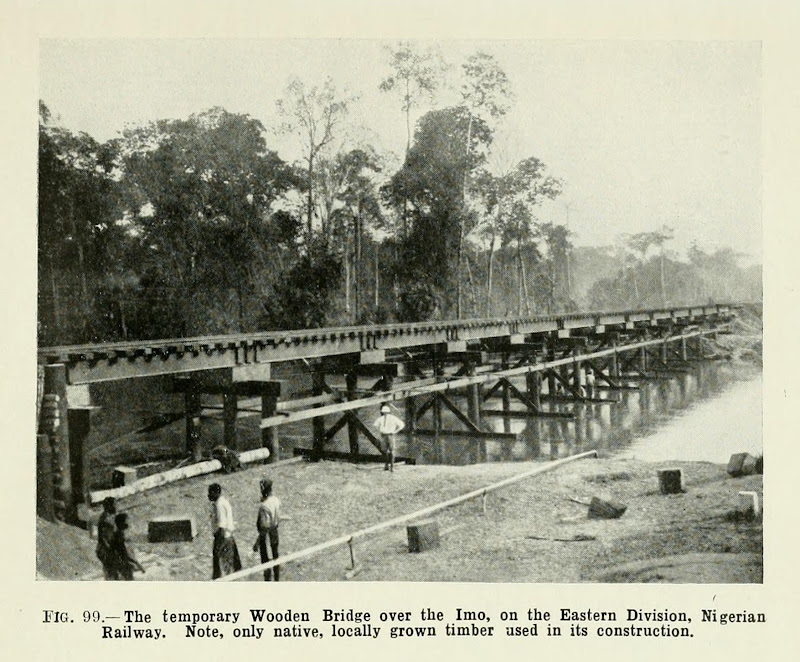
Temporary Wooden Bridge over the Imo River
A photograph depicting a temporary trestle-style bridge constructed from native, locally grown timber spanning the Imo River. This structure was part of the Eastern Division railway line, built starting in 1913 to facilitate access to the Udi coalfields near Enugwu Ngwo, terminating at the Diobu cliffs of Port Harcourt. The image shows vertical pilings and diagonal cross-bracing supporting the bridge deck. A dense tropical forest canopy is visible in the background. The construction of this railway involved forced labor coordinated …
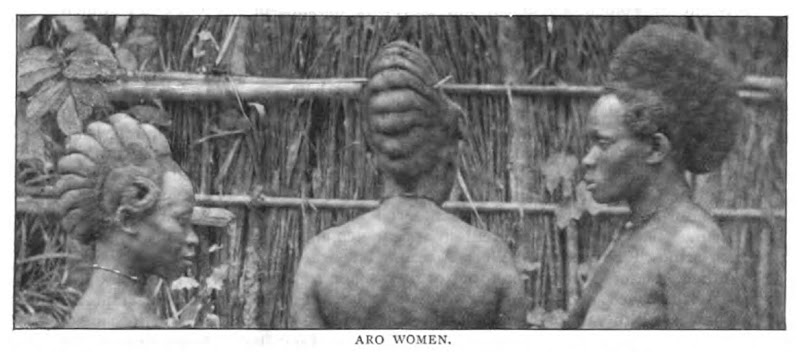
Aro Women
A photograph depicting three Aro women with distinct cranial hair styling. The subjects are positioned in a row in front of a vertical structure of thin, dried organic stalks and horizontal poles. One subject is shown in profile facing right with layered, horizontal hair ridges and a light-colored necklace. A second subject is shown from a posterior view with a tall, vertical, segmented columnar hair structure. The third subject is in profile facing left with a large, voluminous, and rounded …
Corrugated Metal Building and Individual along the Niger River
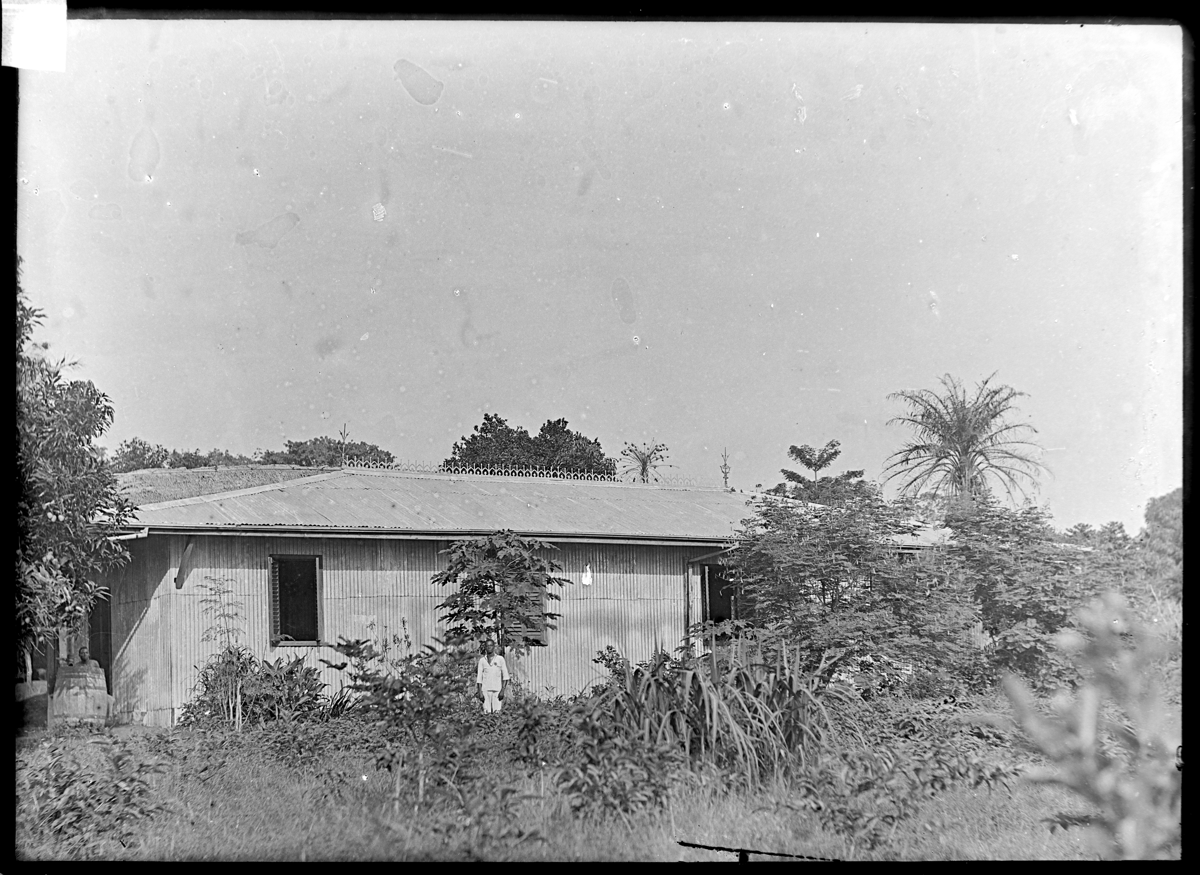
A photograph depicting a single-story, elongated rectangular building constructed from corrugated metal sheeting on both the walls and the roof. The structure features ornamental metal cresting along the roof ridge and one visible rectangular window. A single human figure wearing light-colored clothing stands in the mid-ground before the building. The surrounding environment consists of dense vegetation, including shrubs, tall grasses, and a palm specimen. This image is part of the Crosse Collection and relates to the operations of the Royal …
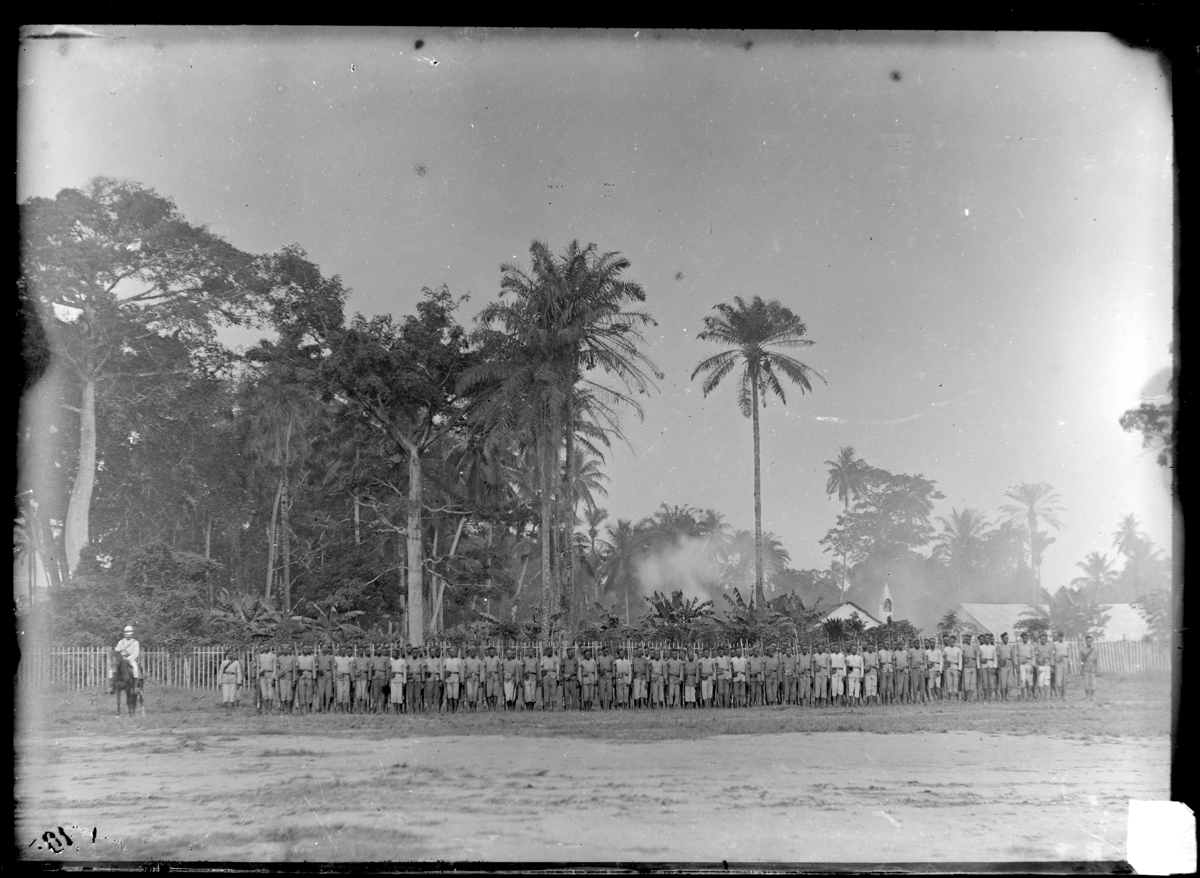
Royal Niger Company Soldiery
A photograph depicting a large group of approximately 45 to 55 individuals arranged in a formal, shoulder-to-shoulder linear formation. The personnel are wearing matching light-colored short-sleeved shirts and shorts, with most holding long-barreled firearms. To the far left, a single individual is positioned on horseback wearing a light-colored uniform and a pith helmet. The scene is set on a flat, open parade ground backed by a picket fence and dense tropical vegetation, including tall palm trees. In the distance, structures …
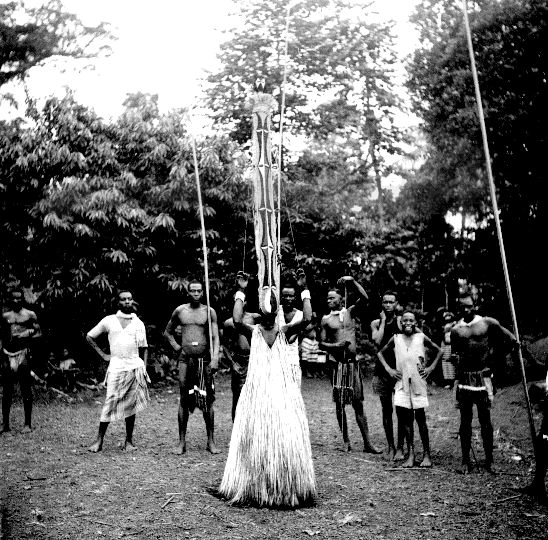
Initiation Mask for Boys Initiation in Nkporo
A photograph depicting a boys' initiation ritual in Nkporo. The central figure is enveloped in a conical, light-colored garment composed of long, vertical, textured fibers, from which extends a tall, slender vertical object featuring dark and light geometric patterns, including repeating triangular or diamond-shaped motifs. Approximately nine to ten adult males are arranged in a semi-circle around the central figure; some are shirtless with patterned waistcloths, while others wear simple shirts and shorts. Several individuals hold long, thin vertical poles. …
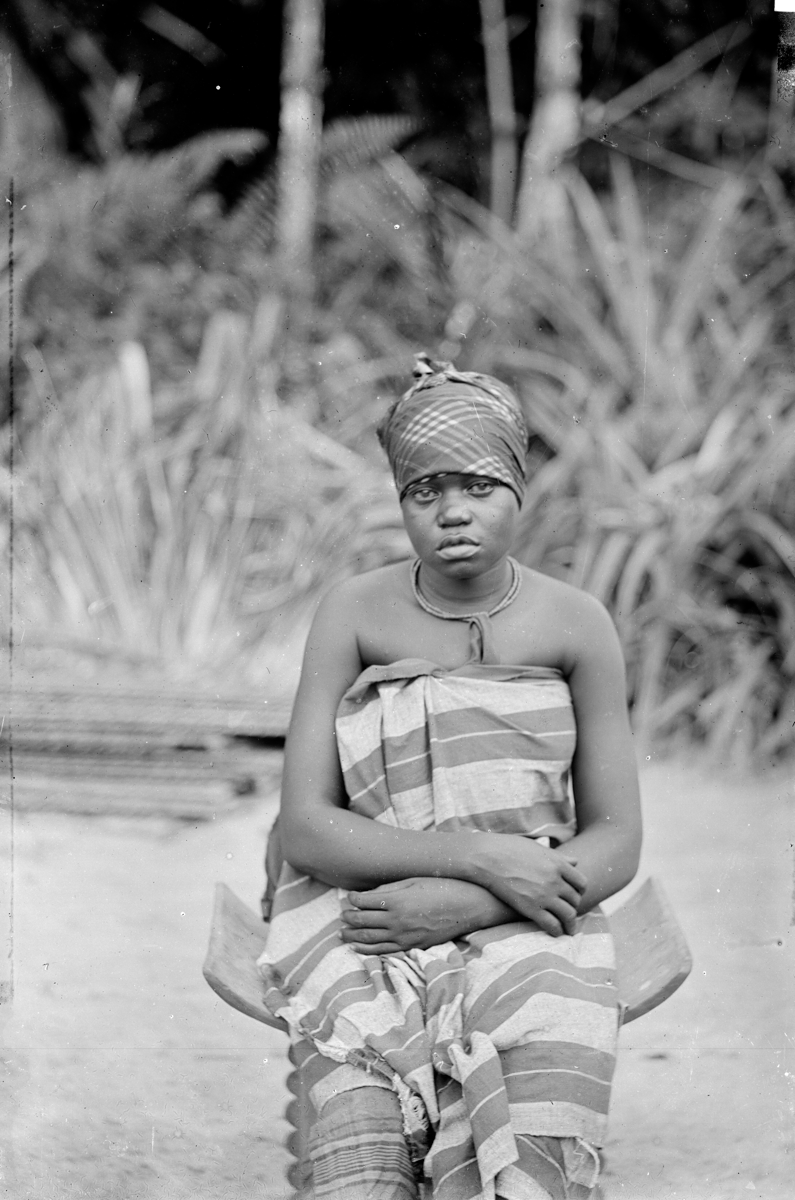
Portrait of a Woman in Striped Cloth
A photograph depicting a woman seated on a low, curved wooden stool, posing for the camera. She wears a fabric wrap or turban with a geometric pattern and a large piece of textile with wide, dark, horizontal stripes wrapped around her chest and lower body. A singular, light-colored circular ring or torque is positioned around the base of her neck. The subject is situated outdoors against a background of dense, blurred vegetation and is seated on a light-colored, granular surface. …
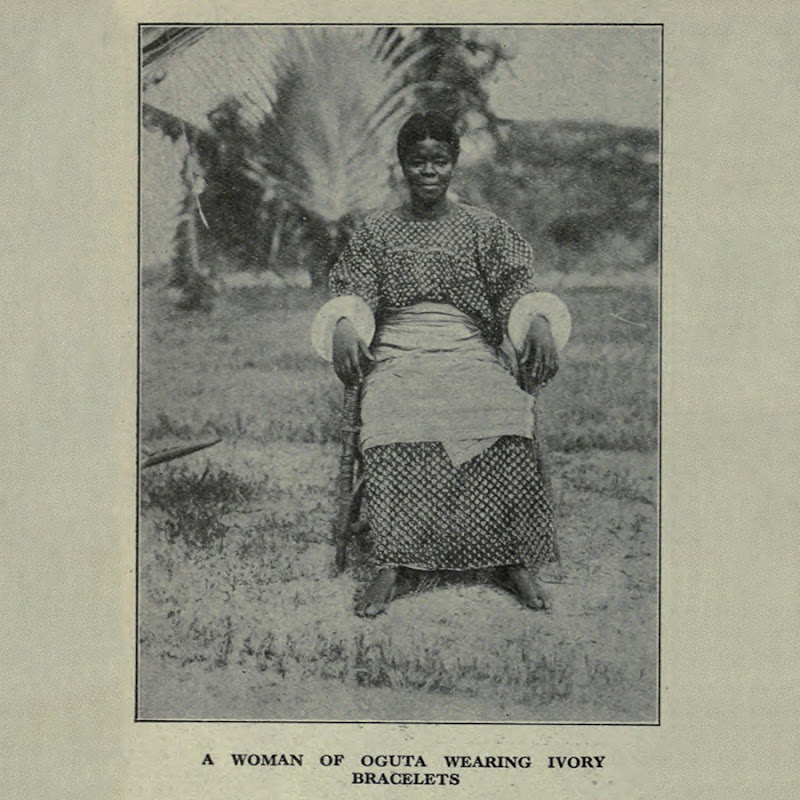
A Lady of Ụgwụtā wearing Ivory
A photograph depicting a woman from Ụgwụtā (Oguta) in the Òru area, dating from the early 20th century. The subject is seated on a wooden chair in an outdoor setting with palm-like vegetation. She is dressed in a patterned blouse and matching full-length skirt with small light-colored dots, complemented by a light-colored waist wrap. Two thick ivory rings are worn on her wrists. The source indicates that wealthy traders in the riverine Òru region, who utilized waterways for commerce, wore …
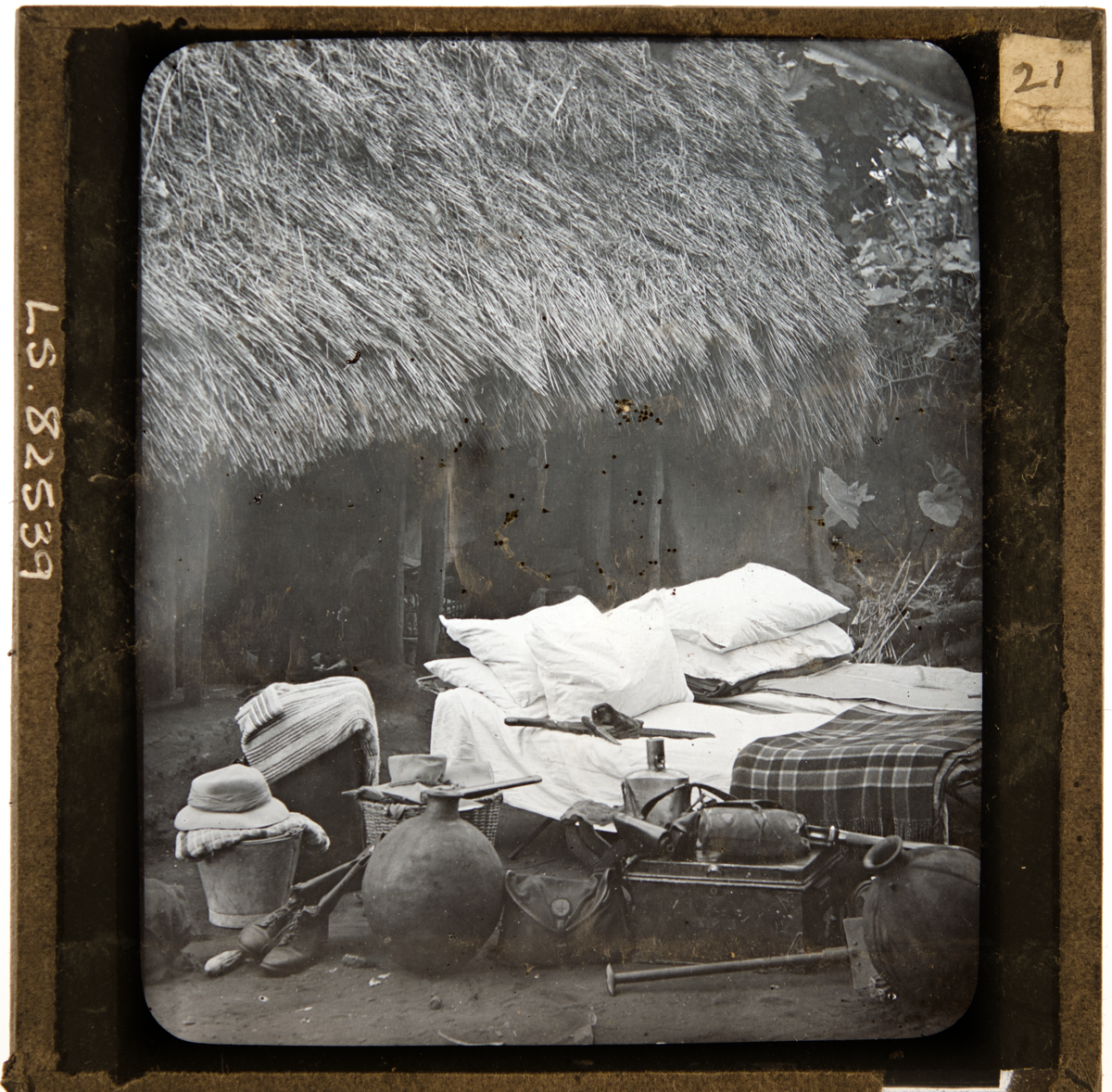
Domestic assemblage and sleeping area
A photograph depicting a collection of functional items and a sleeping area in an outdoor or semi-sheltered environment. The foreground contains various vessels, including a large spherical container and a rounded pot, along with a brimmed hat, dark footwear, and a rectangular chest. The midground features an elevated sleeping surface with light-colored sheets and pillows. A large thatched roof made of fibrous materials dominates the background.
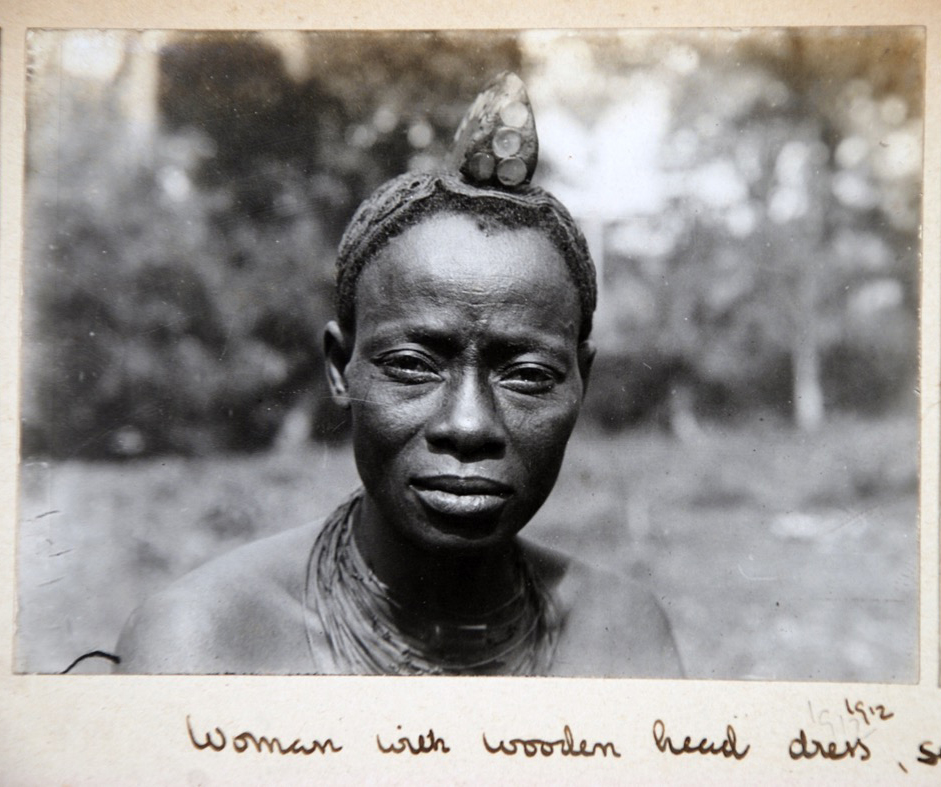
Igbo Elder from Awka on Oche Mpata
These black-and-white photographs, taken by Northcote Thomas between 1910 and 1911 as part of his anthropological survey, feature an Igbo elder from Öka (Awka). The first shows a close view of her face and head, adorned with a wooden head dress set with pearl buttons, known as “isi ojongo,” embodying Igbo identity and artistic expression. The second depicts the elder seated on an “oche mpata,” a stool reserved for titled individuals with the Ọzọ title, wearing a patterned sarong and …
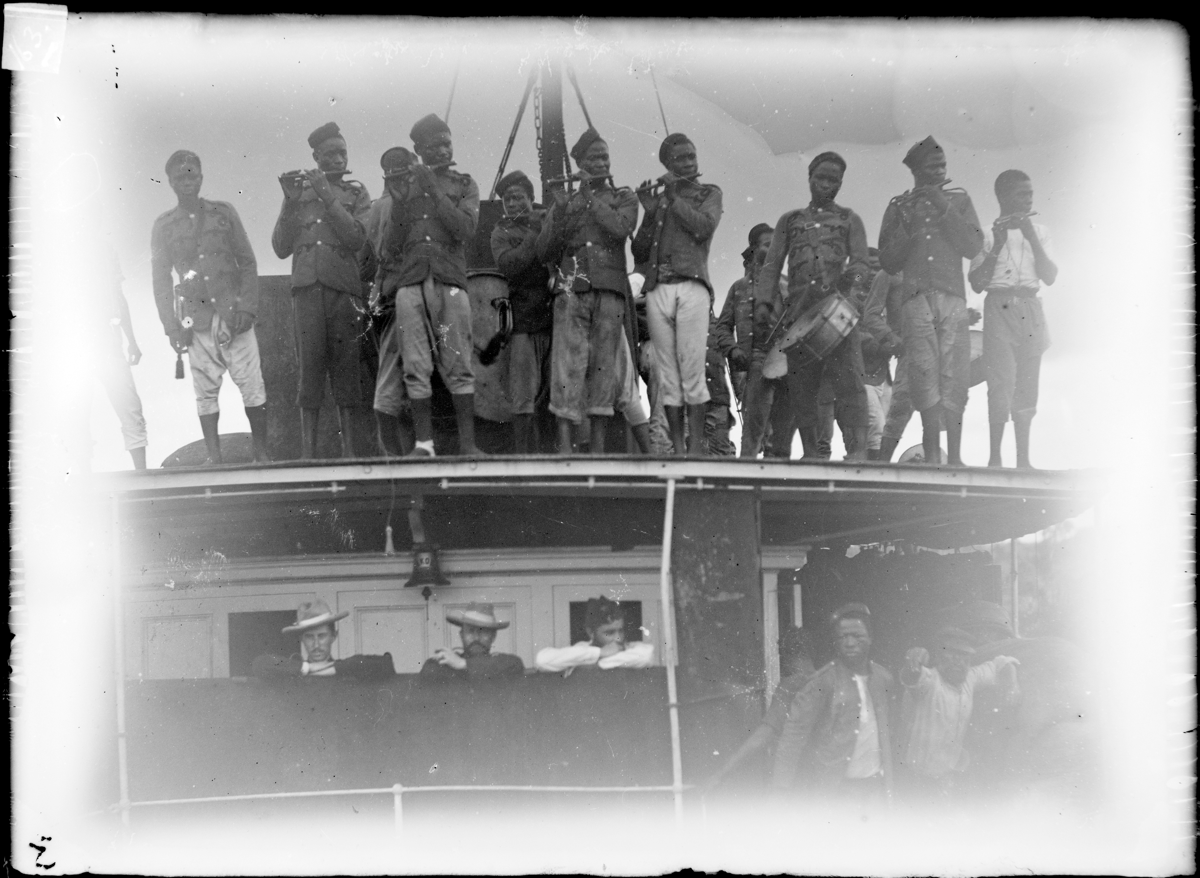
Royal Niger Company Constabulary Band
A monochromatic photograph showing a musical ensemble from the Royal Niger Company Constabulary on a maritime vessel. The group consists of approximately eleven Black men in military-style tunics and garrison side caps, playing woodwind and brass instruments and a snare drum. On the lower deck, a mixed group of individuals, including two light-skinned males in wide-brimmed hats and other men, are observing. The vessel features a protective canopy and a suspended bell. This image belongs to a series documented by …
Portrait of a Male Elder with Staff
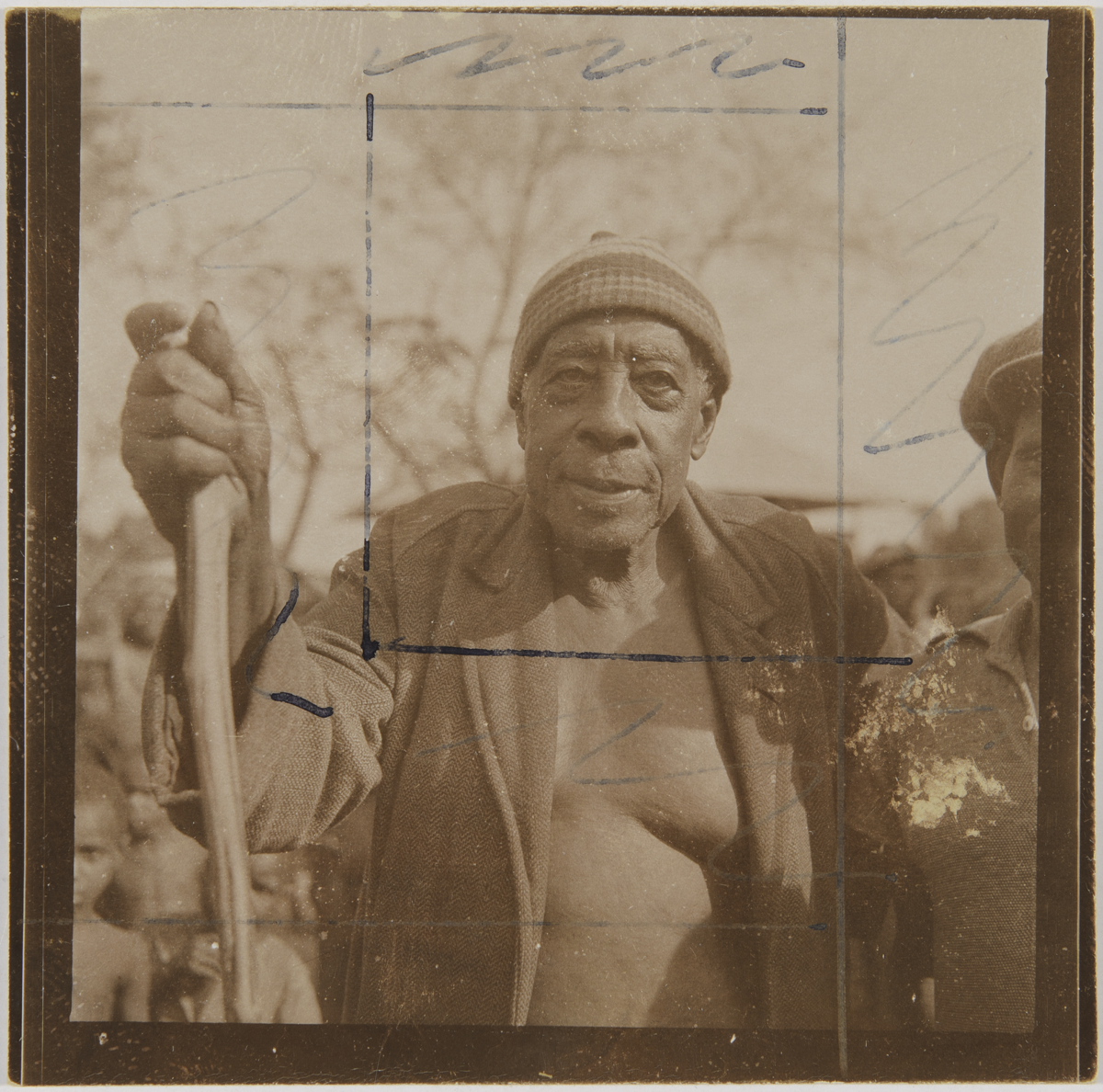
A photograph depicting a half-length portrait of an elderly Igbo man. The subject is wearing a textured, ribbed knit beanie and an unfastened, heavy-weight jacket with a discernible weave. He holds a light-colored, smooth-textured wooden staff vertically in his right hand. The image is a monochromatic sepia-toned print showing signs of chemical spotting and surface scratches, with a blue ink overlay across the frame. A partial view of another person is visible on the right edge, and blurred figures appear …
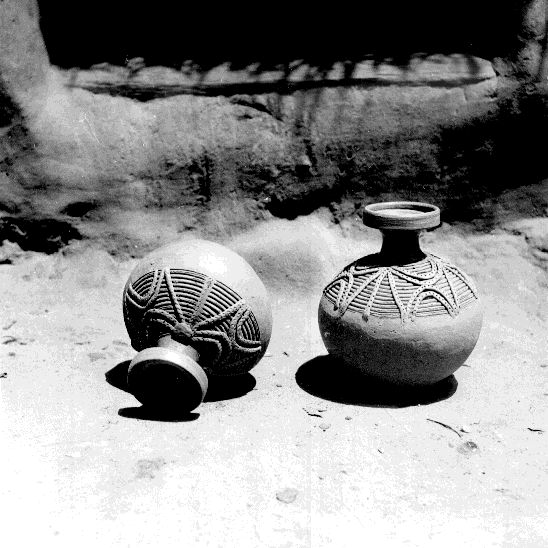
Decorated Pots of North Ika
A monochromatic photograph depicting two earthenware vessels from North Ika. The vessels feature globular bodies with short cylindrical necks and wide, flattened rims. One vessel stands upright while the other lies recumbent on a granular substrate. Both pots are adorned with high-relief, segmented geometric ornamentation on the upper shoulders, consisting of radiating curvilinear segments defined by punctate borders and fine parallel striations. The high-contrast lighting suggests an archaeological or field-documentation setting.
An Igbo couple from Asaba
This studio portrait from around 1900 depicts an Asaba man in riding gear or English recreational dress posing with his wife, illustrating the blend of traditional and colonial influences in Asaba. Asaba was a site of resistance to European invasion by the Igbo in the early 19th century, where British explorers Richard and John Lander were taken captive in 1830 during their expedition to trace the course of the Niger River. Later, Asaba became a trading post and administrative headquarters …

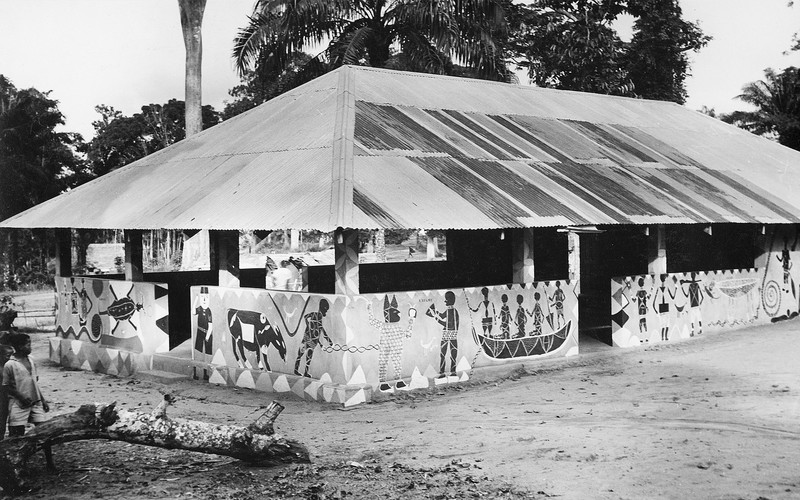
Painted Courthouse at Nri
A black-and-white photograph from 1938 depicting a single-story open-sided courthouse structure in Nri, Onitsha Province. The building features a corrugated metal hipped roof supported by vertical pillars and low-set perimeter panels serving as canvases for high-contrast, stylized murals. These murals include figurative motifs such as a large tortoise, a bovine, a figure in official attire, a figure holding a chain attached to another figure, and a series of figures in linear progression, some associated with a vessel. The background shows …
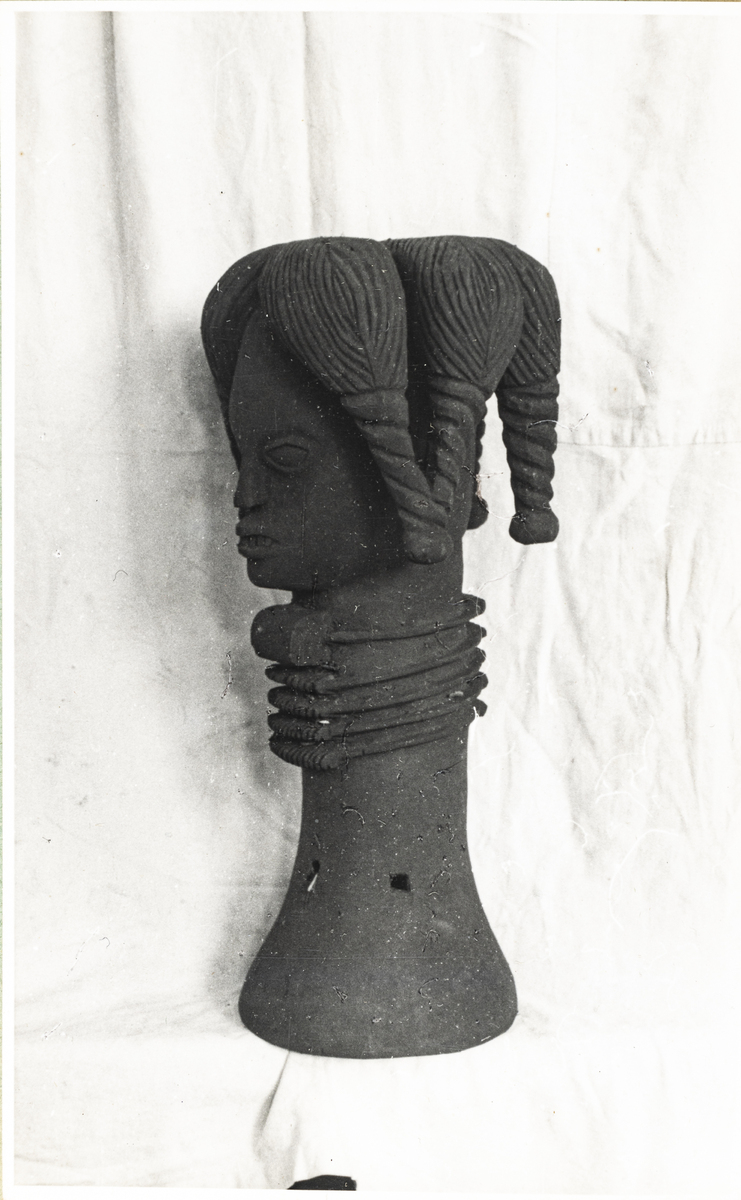
Female Ekpe Helmet Mask
A photograph depicting a carved wooden female Ekpe helmet mask in profile against a white background. The sculpture features finely detailed facial features, rhythmic linear striations representing braided hair bunches atop the cranium, and multiple horizontal neck rings with amulets. The mask is associated with the Oratta people of the Igbo cultural group. The image is part of the Jones Collection and was captured between 1930 and 1939.
Ogbugulu Mau (Ghost) Masquerade: Iro Ekpetu (Merciless)
A close up view of Iro Ekpetu (Merciless) wearing a black wooden face mask during an Ogbugulu Mau (Ghost) masquerade. The forehead is incised with decoration, the eyes consist of two small holes accentuated with white paint, and the mouth and teeth are also accentuated with white paint. Raffia hair is attached to the back of the mask, and a protrusion is visible on the head. The masquerader wears a cloth top and holds a stick switch. In the background, …
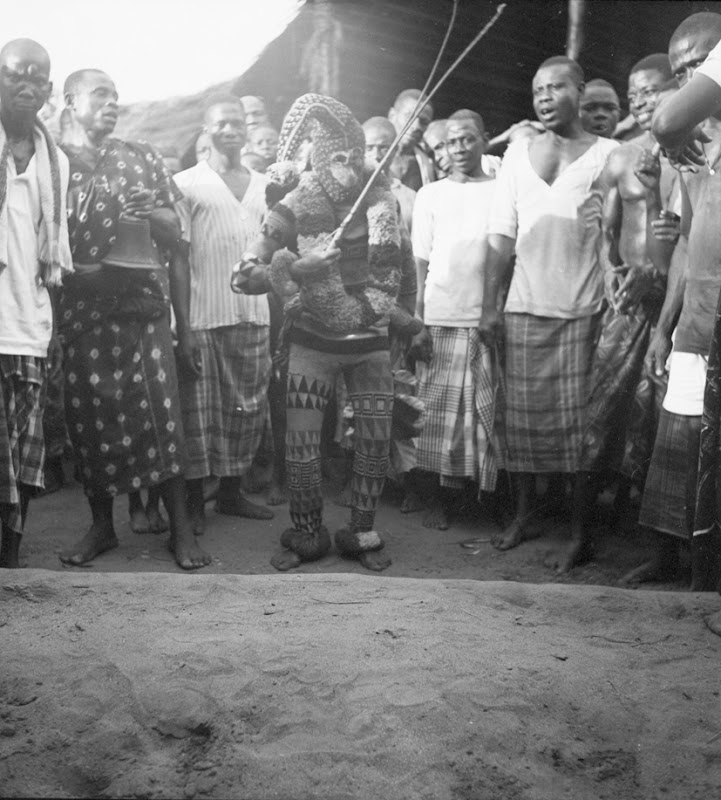
An Ekpe Masquerader in Uzuakoli
A black-and-white photograph from the 1930s by G.I. Jones depicting an Ekpe masquerader in Uzuakoli, present-day Abia State. The figure is centered in a medium-wide shot, wearing a large, volumetric mask with textured patterns and dark ocular regions. The costume consists of a thick, fibrous garment on the torso and form-fitting leggings featuring repeating geometric patterns, including triangles and zig-zags. The masquerader holds a long, thin, flexible rod diagonally across the body. The figure is surrounded by a semi-circle of …
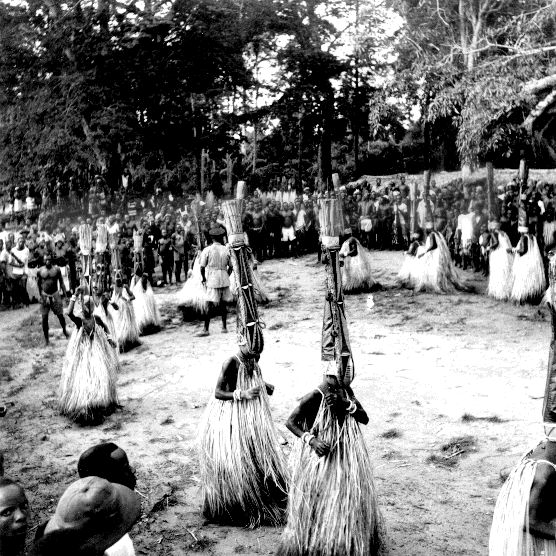
Dancing Initiation Masks, Boys Initiation
A photograph depicting a group of individuals participating in a boys' initiation ritual in Nkporo. The central figures wear voluminous, floor-length skirts made of raffia or dried grass and tall, cylindrical headdresses that partially obscure their faces. They are captured in rhythmic motion, dancing in a cleared earthen area. A dense crowd of spectators, including shirtless men and individuals in light-colored tunics, forms a semi-circle around the performance space. The scene is set in a forested area with a dense …
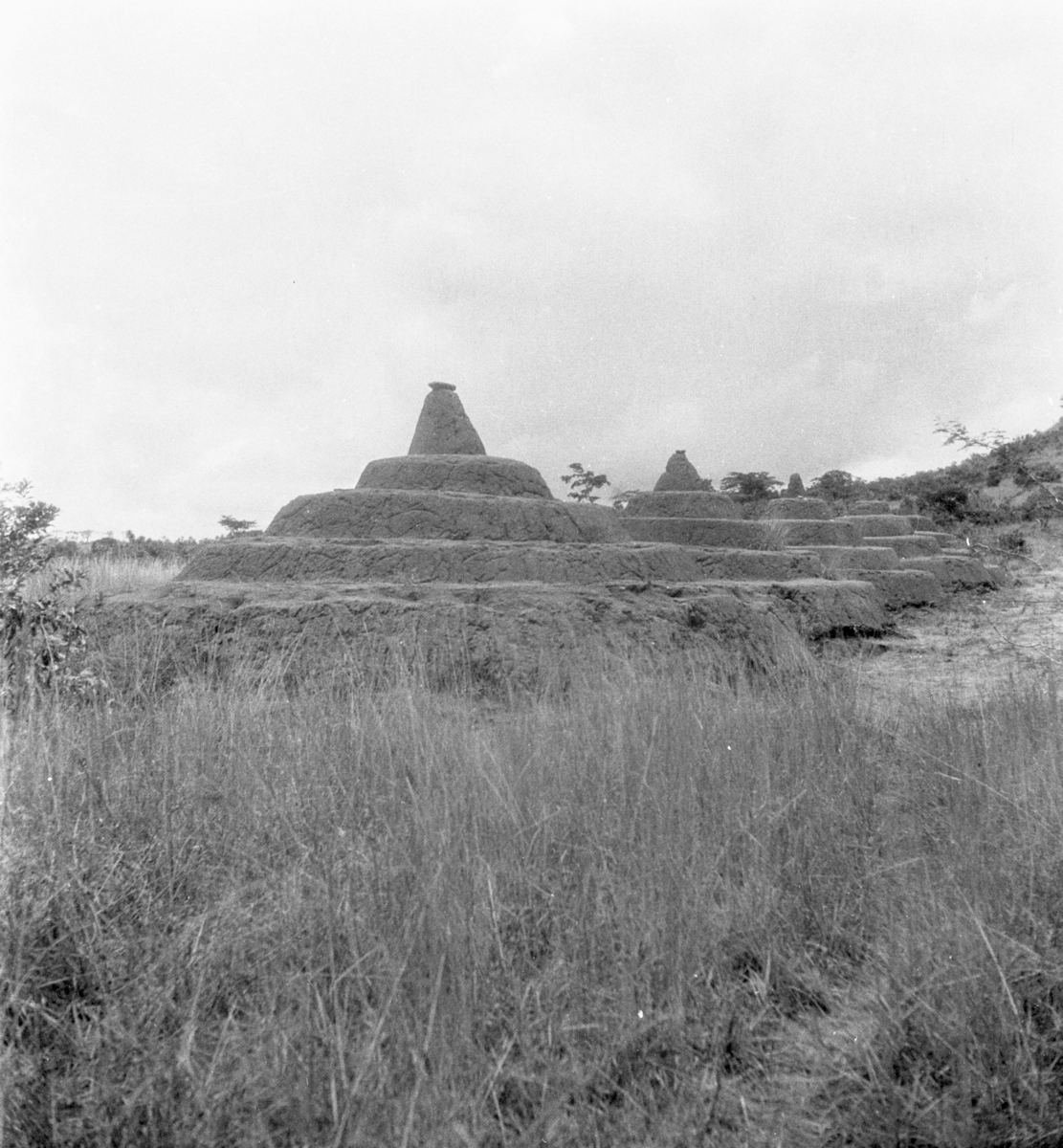
Pyramids at the Nsude Village Shrine, Abaja Igbo, Northern Igbo
This black-and-white photograph from the 1930s by G.I. Jones shows a series of stepped earthen pyramids at the Nsude village shrine in Abaja Igbo, Northern Igbo. The pyramids, constructed of mud, feature rounded graduated levels decreasing in size and culminating in a pointed top. Tall grasses and vegetation surround the structures, which are strategically placed on elevated ground. The image documents the architectural and religious significance of these shrine pyramids, which were associated with the Uto deity and represent important …
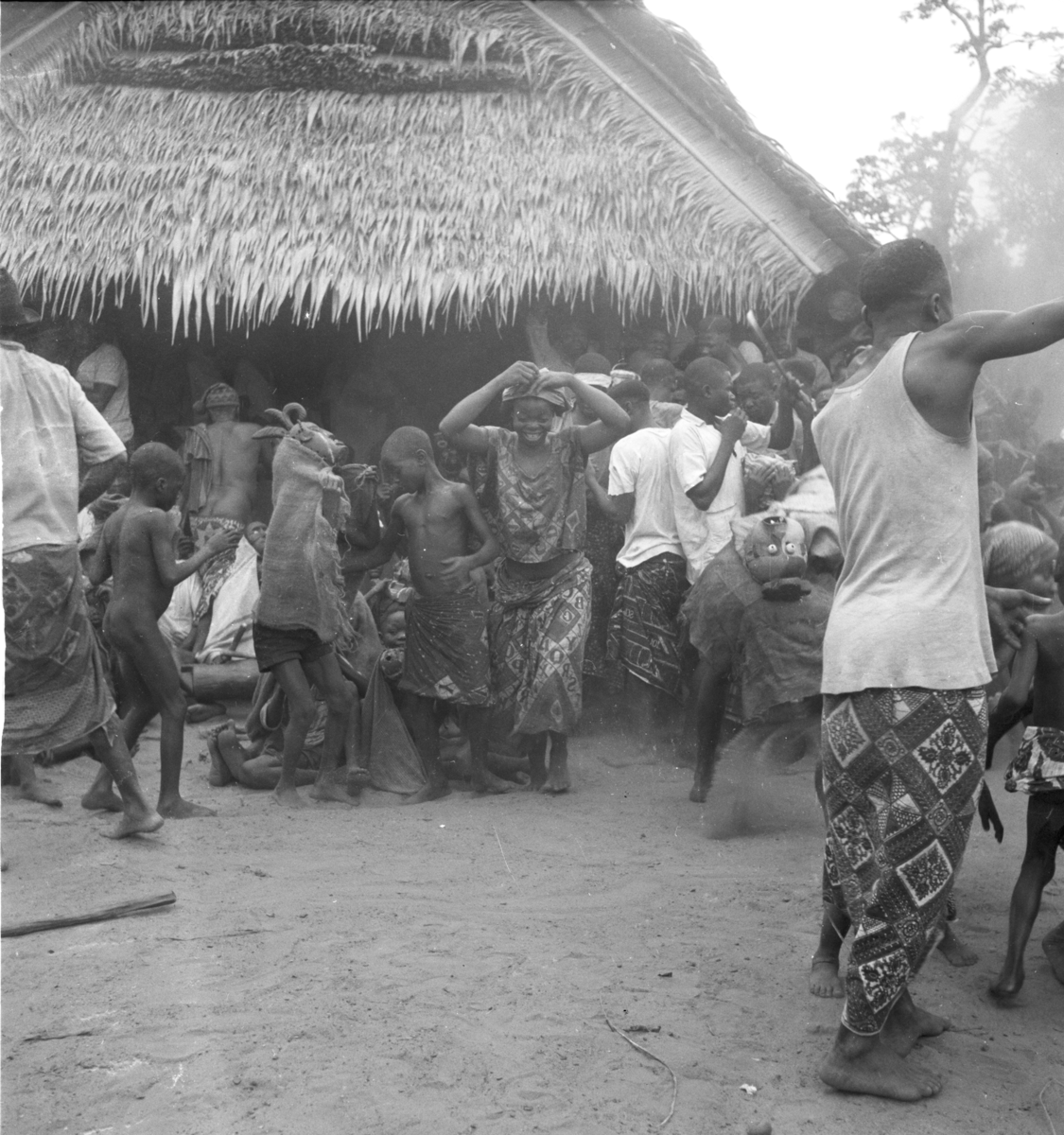
Ngbangba Ikoro Masquerade at Abiriba
This black-and-white photograph by G.I. Jones shows the Ngbangba Ikoro masquerade at Abiriba, circa 1930s. The scene depicts performers and spectators outside a traditional thatched building. One figure wears a dark wooden mask painted white with horns, attached to woven sackcloth. A young boy touches this character. Another rounded mask with white bulbous eyes appears upside down. The audience includes women, men, and children wearing printed cloths. Jones documented that Abiriba carvers created masks for this masquerade, with copyright shared …
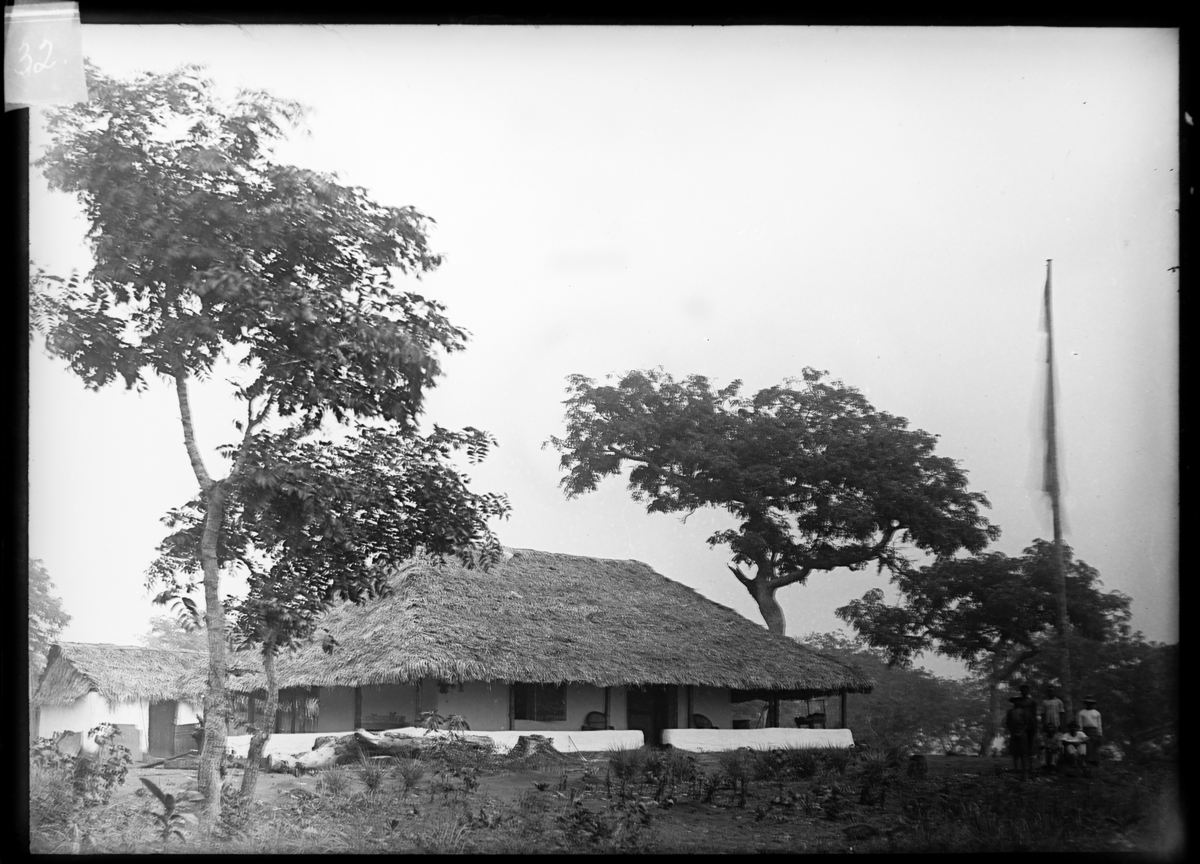
Thatched Dwelling and Group of Individuals
A photograph depicting a single-story dwelling with a steeply pitched thatched roof and light-colored walls. The structure features a veranda area with a low perimeter wall and several dark rectangular openings. To the right, a group of approximately five individuals wearing light-colored tunics and hats stands near a tall, slender vertical pole. The environmental context includes a tall, slender tree in the left foreground and a broad canopy tree behind the building. This monochrome image is a glass negative halfplate …
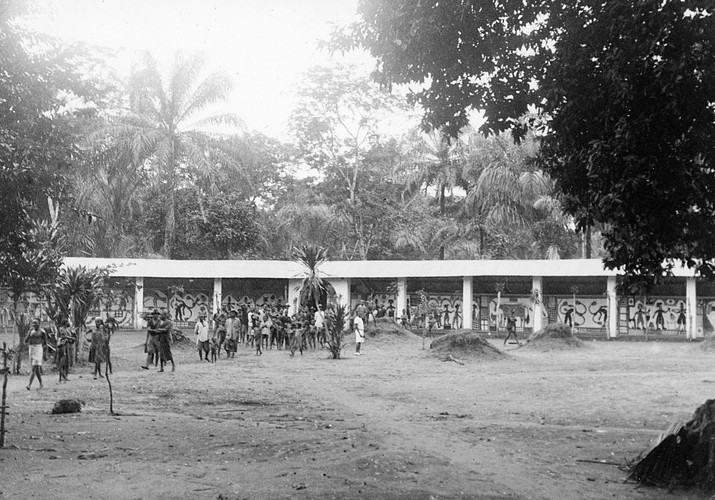
Mural Building at Okwu
A monochromatic photograph depicting a long, single-story building with a flat roof and a colonnade of vertical support columns. The wall behind the columns features large-scale graphic murals showing repetitive, stylized silhouettes of human figures in dynamic and rhythmic poses. A group of approximately 25 to 35 individuals, including adults and children in varied attire such as light-colored wraps and Western-style shirts and trousers, is gathered in the cleared earthen foreground. The scene is set against a backdrop of dense …
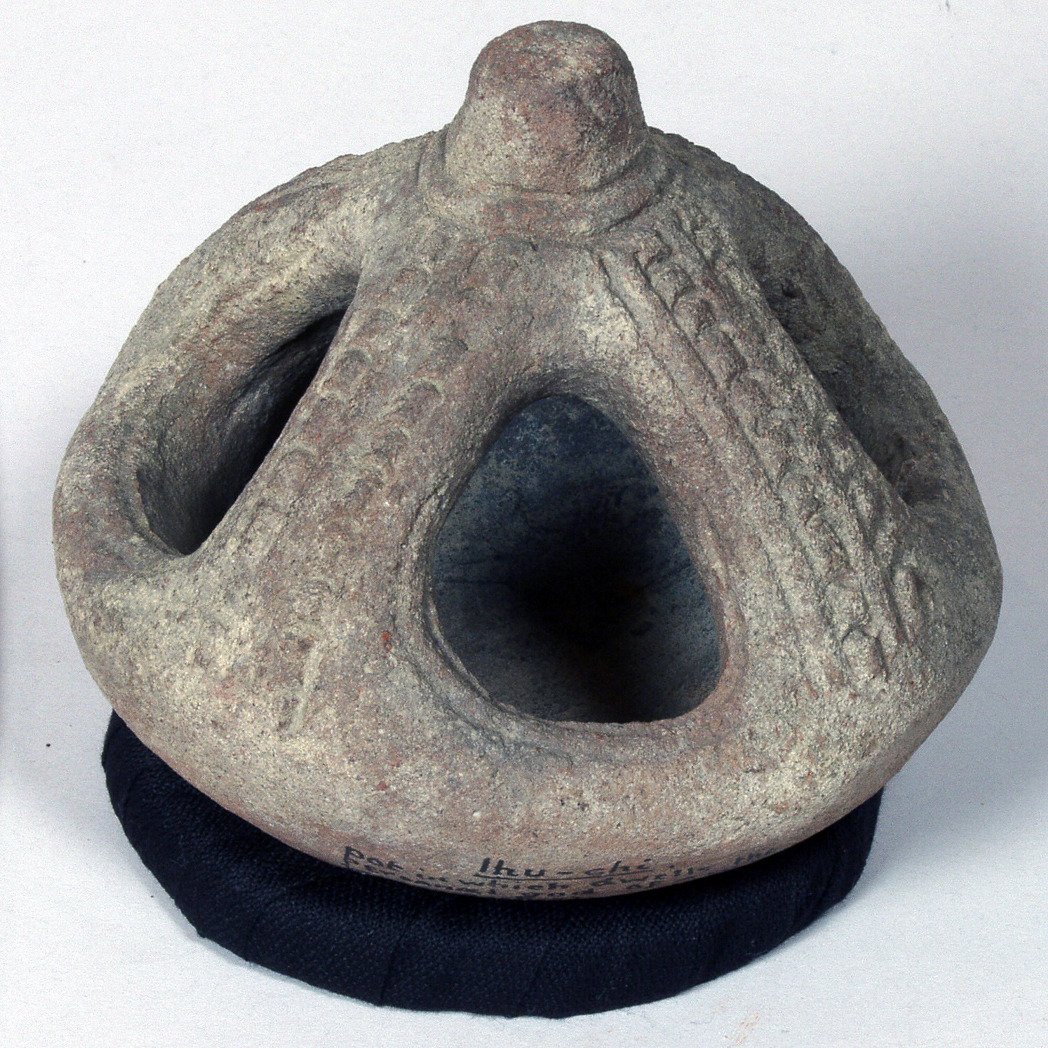
Pot believed to hold the personal spirit (chi)
This decorated pot, known as Ihu Chi, from Ekpeye in 1916, is believed to hold an individual's personal spirit or chi, a central concept in Igbo cosmology often translated as guardian angel or spirit-double. In Igbo belief, chi is a fractal of the supreme creator, Chineke or Chukwu, influencing personal destiny and authenticity.
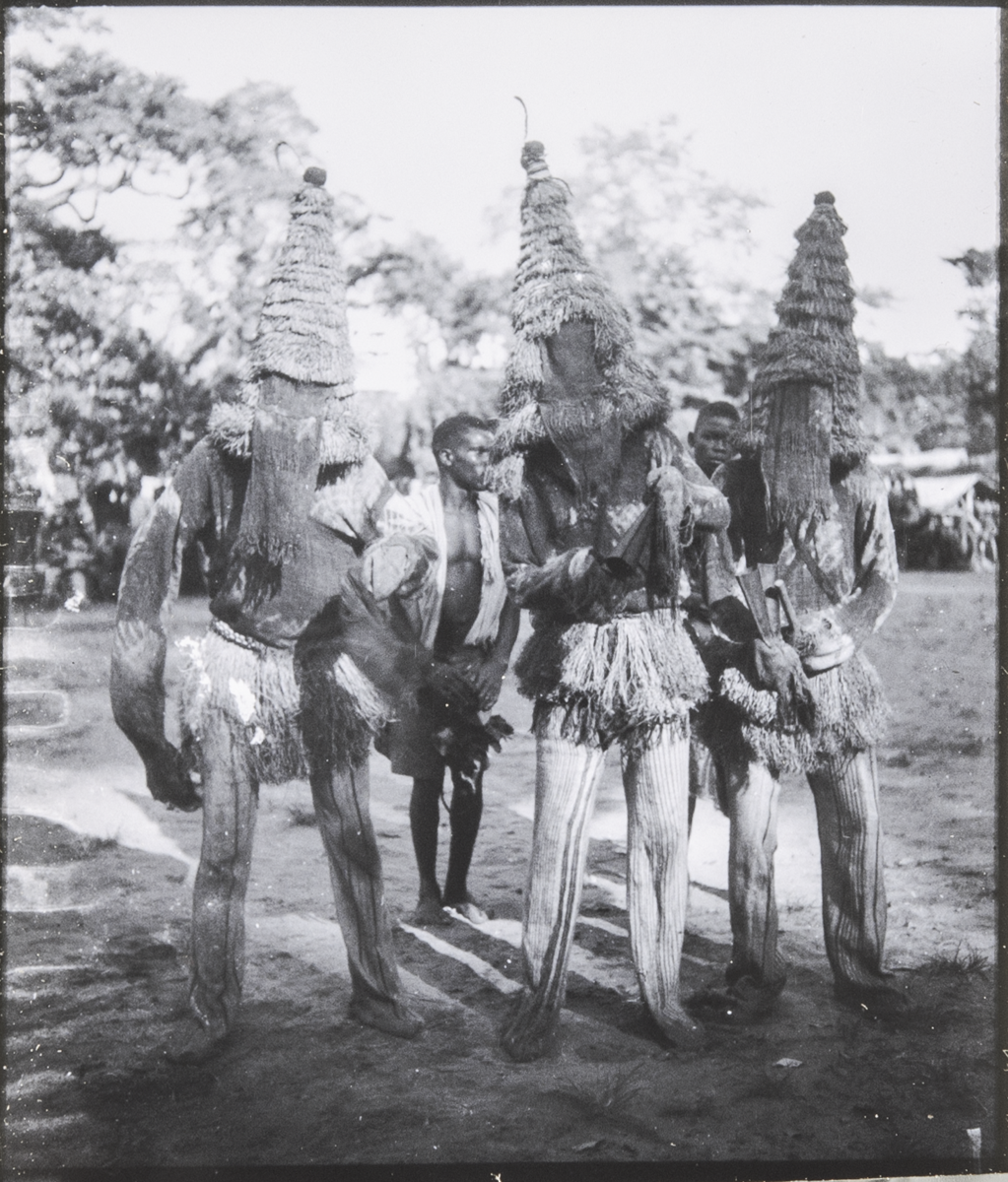
Onu Kamma Masqueraders at Nimo
Black-and-white photograph showing three Onu Kamma (Mouth stronger than sword) masqueraders at Nimo, Nri Awka, Onitsha province. Each figure wears a large conical faceless mask constructed from layered fibre with a cloth panel at the front. Their attire includes tie-dyed or batik upper garments, striped woven cloth trousers, and fibre skirts secured at the waist; cowrie shells are visible on the rightmost performer. Two masqueraders hold metal gongs, one striking his with a stick. A sizable crowd of bystanders observes …
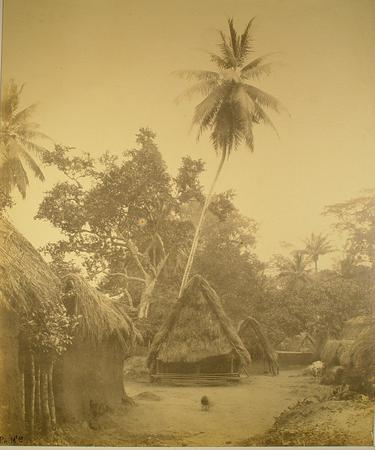
Interior View of a Chief's Compound
An albumen print photograph from approximately 1870-1900 showing the interior of a Chief's compound. The scene depicts five or six mud buildings with thatched roofs made from palm fronds. The architectural layout includes several steeply pitched, gabled structures. A single, tall palm tree with a slender trunk stands centrally in a cleared, flat area of earth. A small, indistinct humanoid figure is visible in the center of the clearing. The composition emphasizes the verticality of the central tree against the …
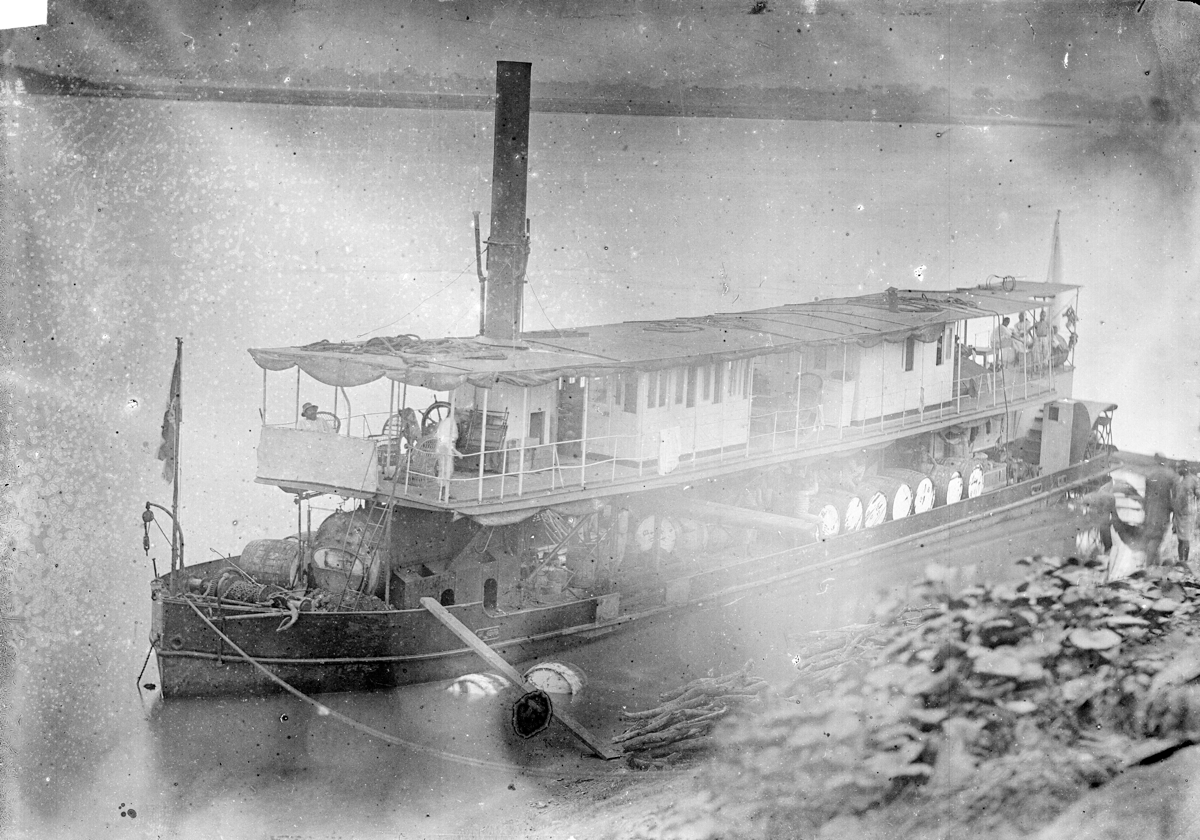
Royal Niger Company Vessel on the Niger River
A photograph depicting a multi-level watercraft anchored along an embankment on the Niger River. The vessel features a dark hull with barrels and utility equipment on the lower deck, a secondary upper deck with a rectangular cabin, and a light-colored canopy. A single tall, dark smokestack is positioned mid-vessel, and a flag is visible at the stern. Several human figures appear on the upper deck. The foreground consists of a shoreline with dense aquatic vegetation and debris. The image is …
Discover Our Platform
A comprehensive digital platform dedicated to preserving and celebrating Igbo culture, history, and heritage for future generations.
Cultural Archives
Explore our extensive collection of photographs, documents, artifacts, and historical records that tell the story of Igbo people.
Browse ArchivesCommunity Lore
Read and share perspectives on Igbo culture, traditions, and contemporary issues. Connect with writers preserving our heritage.
Read LoreBook Reviews
Discover and review books about Igbo culture, history, language, and literature. Build your knowledge through curated recommendations.
Browse BooksIgbo Archives AI
Chat with our AI assistant to learn about Igbo culture, get translations, analyze images, and receive personalized cultural lore.
Try AI AssistantCommunity
Join a vibrant community of culture enthusiasts, historians, and learners. Share knowledge and preserve our heritage together.
Join NowSupport Us
Help us preserve Igbo heritage for future generations. Your contribution keeps this platform running and growing.
DonateWhy Igbo Archives?
Preserve Heritage
Digitally preserve Igbo cultural artifacts for future generations
Global Access
Connect Igbo people worldwide with their roots and heritage
Educational
Comprehensive resources for learning and research
Community-Driven
Built by the community, for the community